| Piú viste - The Sun: just a star, like many others... |

The Sun-C2_EIT_Nov8_00G.jpgOur "restless" Sun... (2)76 visitenessun commento
|
|

The Sun-UvcseitG_c.jpgOur "restless" Sun... (12)76 visitenessun commento
|
|

Solar-Cycle.jpgA "Full Solar Cycle", from SOHO (extreme UV Light)76 visiteCaption NASA:"Every 11 years, our Sun goes through a Solar Cycle.
A complete Solar Cycle has now been imaged by the Sun-orbiting SOHO Spacecraft, celebrating the 12th anniversary of its launch yesterday (December, 12th, 2007).
A Solar Cycle is caused by the changing Magnetic Field of the Sun, and varies from Solar Maximum, when Sunspot, Coronal Mass Ejection, and Flare phenomena are most frequent, to Solar Minimum, when such activity is relatively infrequent.
Solar Minimums occurred in 1996 and 2007, while the last Solar Maximum occurred in 2001.
Pictured above is a SOHO image of the Sun in extreme ultraviolet light for each year of the last Solar Cycle, with images picked to illustrate the relative activity of the Sun".MareKromium
|
|

The_Sun-SS-HST.jpgThe Sun, Atlantis and Hubble75 visiteCaption NASA, da "NASA - Picture of the Day" del giorno 16 Maggio 2009:"On Wednesday, May 13th 2009, two, tiny, fast moving spots crossed an otherwise featureless Solar Disk. Not Sunspots though, the dark blemishes were silhouettes of the shuttle orbiter Atlantis and the Hubble Space Telescope side by side.
To record this sharp picture of the orbiting pair against the face of the Sun, astronomer Thierry Legault carefully set up his camera and telescope near the center of a 5 Km wide path of visibility about 100 Km South of Kennedy Space Center in Florida. He opened the shutter for 1/8000th second at 12:17 EDT, catching Atlantis and Hubble at a range of 600 Km while they were moving at a relative speed of about 7 Km-per-second.
The total duration of the transit (Sun crossing) was 0,8". Atlantis (top) is approaching Hubble prior to capturing the space telescope. Thursday (May 14, 2009), Astronauts began a series of spacewalks to perform the maintenance as part of the final mission to Hubble".MareKromium
|
|

Solar Flare.jpgLoops over the Sun74 visiteCaption originale:"How can gas float above the Sun? Twisted magnetic fields arching from the Solar Surface can trap ionized gas, suspending it in huge looping structures. These majestic plasma arches are seen as prominences above the Solar Limb. In September 1999, this dramatic and detailed image was recorded by the EIT experiment on board the space-based SOHO observatory in the light emitted by ionized Helium. It shows hot plasma escaping into space as a fiery prominence breaks free from magnetic confinement a hundred thousand kilometers above the Sun. These awesome events bear watching as they can affect communications and power systems over 100 MKM away on Planet Earth".
|
|

The Sun-Eit002G_b.jpgOur "restless" Sun... (7)74 visitenessun commento
|
|

The Sun-Eit171cfG.jpgOur "restless" Sun... (8)74 visitenessun commento
|
|
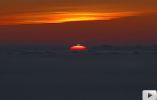
Green-Sun.jpgGreen flash from Italy74 visiteCaption originale, da "NASA - Picture of the Day" del 29 Gennaio 2007:"How could the Sun turn green? Difficult to observe, the momentary green flash above the rising or setting Sun has been documented as a phenomenon caused by the atmospheric bending or refraction of sunlight.
Like a weak prism, the Earth's atmosphere breaks white sunlight into colors, bending red colors slightly and green and blue colors through increasingly larger angles.
When the sky is (VERY) clear, a green flash just above the Sun's edge can sometimes be seen for a second or so, when the sun is close to a distant horizon. Still, from a site atop Mt. Autore (altitude 1.850 mt) in Italy, astrophotographer Danilo Pivato captured this dramatic green flash movie. The time between frames varies from over one minute in the beginning to about one second as the flash becomes visible".
|
|

Sunspot-10982.jpgSunspot 1098274 visiteDa "NASA - Picture of the Day", del giorno 6 Febbraio 2008:"A new Solar Cycle has begun on our Sun. Over the past year, the Sun's Magnetic Field has reset and now a new 11 year period is beginning.
Pictured above in a specific color of light emitted by Hydrogen is Sunspot 10982, one of the first sunspots of the new Solar Cycle. The two dark lines visible just above and to either side of the bright sunspot are cool filaments held aloft by the Sun's Magnetic Field. Hot and cold regions are shown as regions of relative light and dark, respectively.
A Solar Cycle is caused by the changing Magnetic Field, and varies from Solar Maximum (when sunspots, coronal mass ejections and flare phenomena are most frequent), to Solar Minimum (meaning when such activity is relatively infrequent).
Solar Minima occurred in 1996 and 2007, while the last Solar Maximum occurred in 2001 (...)".MareKromium
|
|

Sun filaments.jpgSun filaments73 visiteCaption NASA originale, da NASA Picture of the Day del 6 Dicembre 2004:"Two unusually long filaments crossed part of the Sun last week. The filaments are actually relatively cool and dark prominences of solar plasma held up by the Sun's magnetic field but seen against the face of the Sun. Filaments typically last a few weeks before falling back. Pictured above, the two filaments are visible on the Sun's right side. It would take twenty Earths, set end-to-end, to match the length of one of the filaments. Also visible are bright hot regions called plages and a carpet of hundreds of granules that provide the Sun's texture. The above image was taken early last week through a small telescope in a very specific color of light emitted primarily by hydrogen".
|
|

The_Sun_in_3D.jpg3-D Sun73 visiteCaption NASA:"What does the Sun look like in all three spatial dimensions? To find out, NASA launched two STEREO satellites to perceive three dimensions on the Sun much like two eyes allow humans to perceive three dimensions on the Earth.
Such a perspective is designed to allow new insight into the surface of the rapidly changing Sun, allowing humans to better understand and predict things like Coronal Mass Ejections and solar flares that affect the Earth as well as satellites and astronauts orbiting the Earth. Pictured above are two simultaneous images of the Sun taken by STEREO A and STEREO B, now digitally combined to give one of the first 3-D pictures of the Sun ever taken. To fully appreciate the image, one should view it with 3-D red-blue glasses. The teeming and bubbling solar surface can be seen sporting a prominent solar prominence near the top of the image".MareKromium
|
|

The_Sun-PIA09328.jpgThe North Pole of the Sun73 visiteNASA's Solar TErrestrial RElations Observatory (STEREO) satellites have provided the first three-dimensional images of the Sun. For the first time, scientists will be able to see structures in the Sun's atmosphere in 3D.
The new view will greatly aid scientists' ability to understand solar physics and thereby improve space weather forecasting.
The EUVI imager is sensitive to wavelengths of light in the extreme ultraviolet portion of the spectrum.
EUVI bands at wavelengths of 304, 171 and 195 Angstroms have been mapped to the red blue and green visible portion of the spectrum; and processed to emphasize the temperature difference of the solar material.
In this picture, a large spicule can be seen. MareKromium
|
|
| 144 immagini su 12 pagina(e) |
 |
|
|
|
|
|
|
9 | |
|
|








