| Piú viste - The Sun: just a star, like many others... |

The_Sun-PIA09330.jpgThe South Pole of the Sun81 visiteSTEREO, a two-year mission, launched October 2006, will provide a unique and revolutionary view of the Sun-Earth System. The two nearly identical observatories -- one ahead of Earth in its orbit, the other trailing behind -- will trace the flow of energy and matter from the Sun to Earth. They will reveal the 3D structure of coronal mass ejections; violent eruptions of matter from the sun that can disrupt satellites and power grids, and help us understand why they happen. STEREO will become a key addition to the fleet of space weather detection satellites by providing more accurate alerts for the arrival time of Earth-directed solar ejections with its unique side-viewing perspective. MareKromium
|
|

The Sun-EITquadsA.jpgMulticolor and Multispectrum...80 visitenessun commento
|
|

The_Sun.JPGCold Sun? (All Filters; credits: SOHO & Dr M. Faccin)80 visitenessun commentoMareKromium
|
|

Sunspots - SST.jpgSunspots79 visiteCaption NASA originale:"This stunning image shows remarkable and mysterious details near the dark central region of a planet-sized sunspot in one of the sharpest views ever of the surface of the Sun. Just released, the picture was made using the Swedish Solar Telescope now in its first year of operation on the Canary Island of La Palma. Along with features described as hairs and canals are dark cores visible within the bright filaments that extend into the sunspot, representing previously unknown and unexplored solar phenomena".
|
|
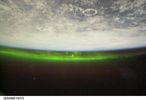
Coronal Aurora - ISS.jpgCoronal Aurora from Space79 visiteOriginal caption:"From the ground, spectacular auroras seem to dance high above. But the International Space Station (ISS) orbits at nearly the same height as many auroras, sometimes passing over them, and sometimes right through them. Still, the auroral electron and proton streams pose no direct danger to the ISS. In 2003, ISS Science Officer Don Pettit captured the green aurora, pictured above in a digitally sharpened image. From orbit, Pettit reported that changing auroras appeared to crawl around like giant green amoebas. Over 300 Km below, the Manicouagan Impact Crater can be seen in northern Canada, planet Earth".
|
|

Sunspot~0.jpgAn Active Sunspot Viewed Sideways79 visiteCaption NASA:"Why are there dark spots on the Sun? Although noted for thousands of years, sunspots have been known for decades to be regions of the Sun that are slightly depressed and cooled by the Sun's complex and changing Magnetic Field.
High resolution pictures like the above image from Japan's new Sun-watching Hinode satellite, however, are helping to increase modern understanding. In the center of the above image is a sunspot, but not seen in the usual orientation - this sunspot is seen sideways.
Of particular interest is erupting glowing gas that shows how the Sun's Magnetic Field comes right out of the spot center, but curves markedly around the spot edges. Better understanding of how the Sun ejects particles into space may result in more accurate predictions of solar storms that affect satellites, astronauts and even power grids on Earth".
|
|

Sunspot-1002.jpgActive Region 100279 visiteCaption NASA:"Why has the Sun been so quiet recently? No one is sure. Our Sun has shown few active regions -- that house even fewer associated sunspots -- for over a year now, and such a period of relative calm is quite unusual.
What is well known is that our Sun is in a transitional period between solar cycles called a Solar Minimum, where solar activity has historically been reduced.
The stark lack of surface tumult is unusual even during a Solar Minimum, however, and activity this low has not been seen for many decades. A few days ago, however, a "Bona-Fide Active Region! -- complete with Sunspots --appeared and continues to rotate across the Sun's face. Visible above, this region, dubbed "Active Region 1002" (AR 1002), was imaged in ultraviolet light yesterday by the SOHO Spacecraft, which co-orbits the Sun near the Earth.
Besides the tranquility on the Sun's surface, recent data from the Ulysses Spacecraft, across the Solar System, indicate that the intensity of the Solar Wind blowing out from the Sun is at a 50 year low. Predictions hold, however, that our Sun will show more and more active regions containing more and more Sunspots and Flares until Solar Maximum occurs in about 4 years from now (such as in the year 2012)".MareKromium
|
|

Solar_Prominence-304erupt_crop.jpgSolar Eruption!79 visiteCaption NASA:"On September 29, 2008, this magnificent eruptive Solar Prominence lifted away from the Sun's Surface, unfurling into space over the course of several hours.
Suspended in twisted Magnetic Fields, the hot plasma structure is many times the size of planet Earth and was captured in this view by the Sun-watching STEREO (Ahead) Spacecraft.
The image was recorded in extreme ultraviolet light emitted by ionized Helium, an element originally identified in the Solar Spectrum. Seen against the brilliant Solar Surface in visible light, such prominences appear as dark filaments because they are relatively cool. But they are bright themselves when viewed against the blackness of space, arcing above the Sun's edge".MareKromium
|
|

Solar Prominence.jpgSolar "Blow"...78 visiteDa "NASA - Picture of the Day" del 7 Agosto 2006:"Our Sun is still very active. In the year 2000, our Sun went though Solar Maximum, the time in its 11-year cycle where the most sunspots and explosive activities occur. Sunspots, the Solar Cycle, and Solar Prominences are all caused by the Sun's changing magnetic field.
Pictured above is a solar prominence that erupted in 2002, July, throwing electrons and ions out into the Solar System.
The above image was taken in the ultraviolet light emitted by a specific type of Ionized Helium, a common element on the Sun. Particularly hot areas appear in white, while relatively cool areas appear in red. Our Sun should gradually quiet down until Solar Minimum occurs, and the Sun is most quiet. No one can precisely predict when Solar Minimum will occur, although some signs indicate that it has started already".
|
|

The Sun-C2dblast.jpgOur "restless" Sun... (3)78 visitenessun commento
|
|

The_Sun-PIA09332.jpgLeft Limb of North Pole of the Sun (March 20, 2007)78 visitenessun commentoMareKromium
|
|

Solar_Corona.jpgIt's a "Corona", but it is not a "Beer", it's a "Crown", but is not a "Cola"...78 visiteDa "NASA - Picture of the Day", del giorno 8 Agosto 2008:"During a Total Solar Eclipse, the Sun's extensive Outer Atmosphere, or Corona, is an inspirational sight. The subtle shades and shimmering features of the Corona that engage the eye span a brightness range of over 10000 to 1, making them notoriously difficult to capture in a single picture. But this composite of 28 digital images - ranging in exposure time from 1/1000th to 2" - comes close to revealing the Crown of the Sun in all its glory.
The telescopic views were recorded near Kochenevo, Russia during the August 1 total Solar Eclipse and also show Solar Prominences extending just beyond the edge of the eclipsed Sun. Remarkably, features on the dark near side of the New Moon can also be made out, illuminated by sunlight reflected from a Full Earth".MareKromium
|
|
| 144 immagini su 12 pagina(e) |
 |
|
|
|
|
7 | |
|
|
|
|








