| Piú viste - The Sun: just a star, like many others... |

The_Sun-PIA09320.jpgFull Disk Image of the Sun (March 26, 2007)85 visitenessun commentoMareKromium
|
|

The_Sun-PIA09322.jpgClose-up View of an Active Region of the Sun (March 23, 2007)85 visitenessun commentoMareKromium
|
|

Sun & Comet (dtl-mgnf).jpgA comet approaching the Sun (from SOHO) - detail mgnf84 visiteCaption NASA originale:"Based on their similar orbits, as first worked out by 19th century German astronomer Heinrich Kreutz, all "sungrazers" are believed to originate from a single large "parent comet" which broke up during a perihelion passage perhaps 2.000 years ago. Over time, pieces have continued to split off producing a family of smaller comets which seem to travel in the same orbit".
|
|

ZZ-PIA00450.jpgThe Sun from 4 Billion Miles - Voyager 284 visiteCaption NASA originale:"This image of the Sun was taken by the Voyager 1 on Feb. 14, 1990, when it was approximately 32° above the plane of the ecliptic and at a slant-range distance of approximately 4BM. It is the first - and may be the only - time that we will ever see our Solar System from such a vantage point. This image is a portion of a wide-angle image containing the Sun and the region of space where the Earth and Venus were at the time. The wide-angle was taken with the camera's darkest filter (a methane absorption band) and the shortest possible exposure (5/1000 sec.) to avoid saturating the camera's vidicon tube with scattered sunlight. The Sun is not large in the sky as seen from Voyager's perspective at the edge of the Solar System but is still 8M times brighter than the brightest star in Earth's sky: Sirius.
The result of the brightness is a bright burned out image with multiple reflections from the optics in the camera. The "rays" around the Sun are just a diffraction effect".
|
|

The_Sun-PIA09330.jpgThe South Pole of the Sun84 visiteSTEREO, a two-year mission, launched October 2006, will provide a unique and revolutionary view of the Sun-Earth System. The two nearly identical observatories -- one ahead of Earth in its orbit, the other trailing behind -- will trace the flow of energy and matter from the Sun to Earth. They will reveal the 3D structure of coronal mass ejections; violent eruptions of matter from the sun that can disrupt satellites and power grids, and help us understand why they happen. STEREO will become a key addition to the fleet of space weather detection satellites by providing more accurate alerts for the arrival time of Earth-directed solar ejections with its unique side-viewing perspective. MareKromium
|
|

The_Sun-01.jpgThe Sun in 3D84 visitenessun commentoMareKromium
|
|

Solar_Corona-TSE2010_JLD4.jpgThe "Crown" of the Sun84 visiteDalla Rubrica "NASA - Picture of the Day" del giorno 21 Luglio 2010:"During a total Solar Eclipse, the Sun's extensive Outer Atmosphere, or Corona, is an inspirational sight. Subtle shades and shimmering features that engage the eye span a brightness range of over 10,000 to 1, making them notoriously difficult to capture in a single photograph.
But this composite of 7 consecutive digital images over a range of exposure times comes close to revealing the Crown of the Sun in all its glory. The telescopic views were recorded from the Isla de Pascua (Easter Island) during July, 11th, 2010 Total Solar Eclipse and also show solar prominences extending just beyond the edge of the eclipsed Sun.
Remarkably, features on the dim, Near Side of the New Moon can also be made out, illuminated by Sunlight reflected from a Full Earth".MareKromium
|
|
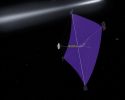
ZA-Solar Sail.jpgThe "Solar Sail"83 visiteNelle more del lancio del vettore Cosmos 1 (realizzato dalla Planetary Society in collaborazione con lo Space Research Institute -IKI- di Mosca), il quale dovrebbe portare nello spazio la prima sonda capace di usare il Vento Solare quale strumento di propulsione, noi ci domandiamo se questa trovata sia davvero un colpo di genio, oppure una delle "bufale" che, ogni tanto, la NASA o qualche altra Agenzia Spaziale si inventa per giustificare la spendita di fondi e gettare fumo negli occhi del pubblico...
|
|

The Sun from Soho.jpgA "Solar Prominence" from Soho83 visiteCaption NASA originale:"A 'Solar Prominence' is a cloud of solar gas held above the Sun's surface by the Sun's magnetic field. The Earth would easily fit under the hovering curtain of hot gas (like the one pictured above). A quiescent prominence typically lasts about one month, and may erupt in a Coronal Mass Ejection (CME) expelling hot gas into the Solar System. Although somehow related to the Sun's changing magnetic field, the energy mechanism that creates and sustains a Solar Prominence is still a mistery".
|
|

Solar_Eclipse-Tse2008_200_mo1_big.jpgAugust 2008 Total Solar Eclipse83 visiteCaption NASA:"For a moment on August 1st, the daytime sky grew dark along the path of a Total Solar Eclipse. While watching the geocentric celestial event from Mongolia, photographer Miloslav Druckmuller recorded multiple images with two separate cameras as the Moon blocked the bright solar disk and darkened the sky.
This final composition consists of 55 frames ranging in exposure time from 1/125 to 8 seconds. It spans nearly 12°, with the relative position of the Moon and Sun corresponding to mid-eclipse. On the left is bright planet Mercury, but many stars are also visible, including the Praesepe Star Cluster (also known as M44 or the Beehive Cluster) in Cancer, above and to the right of the silhouetted Moon. Remarkably, the nearly perfect conditions and wide range in individual exposures allow the composite picture to register the lunar surface and follow the delicate solar corona out to a distance of nearly 20 times the radius of the Sun. In fact, the composite presents a range in brightness beyond what the eye could see during the eclipse".MareKromium
|
|

The_Sun.JPGCold Sun? (All Filters; credits: SOHO & Dr M. Faccin)83 visitenessun commentoMareKromium
|
|

At the edge of the Sun.jpgAt the edge of the Sun82 visiteCaption NASA originale: "Dramatic prominences can sometimes be seen looming just beyond the edge of the Sun. A Solar Prominence is a cloud of solar gas held just above the surface by the Sun's magnetic field. The Earth would easily fit below the prominence on the left. A quiescent prominence typically lasts about a month and may erupt in a Coronal Mass Ejection (CME) expelling hot gas into the Solar System. Although very hot, prominences typically appear dark when viewed against the Sun, since they are slightly cooler than the surface. The above image - in false color - was taken on June 1st, 2003, from Stuttgart, Germany, with a simple amateur telescope and camera".
|
|
| 144 immagini su 12 pagina(e) |
 |
|
|
|
6 | |
|
|
|
|
|








