| Piú viste - The Sun: just a star, like many others... |

The_Sun-489332main_euvfilament-20101016-0.jpgIntense Solar Activity on the Sun: Sunspot 1112 and Solar Flares93 visitenessun commentoMareKromium
|
|

Sunspot.jpgSunspots' Region 87592 visiteCaption NASA originale (da "NASA - Picture of the Day" del 2 Maggio 2006):"An unusually active Sunspot Region is now crossing the Sun.
The Region, numbered 875, is larger than the Earth and has produced several Solar Flares over the past week. It should take a few more days for Sunspot 875 to finish crossing the solar disk. The above image of the Sun was taken last Wednesday in a very specific color of red light to bring up detail. Sunspot 875, in the midst of erupting a large "Class C" Solar Flare, can be seen as the dark region to the upper right. In the above image, relatively cool regions appear dark while hot regions appear bright.
On the far left, solar prominences are visible hovering above the Sun's surface".
|
|

Black Sun.jpgBlack Sun91 visiteCaption NASA originale:"During a total solar eclipse, Earth's moon blocks the Sun - almost exactly. While the Sun is about 400 times wider than the Moon, it is also about 400 times farther away and each appears to be half a degree or so in diameter. On August 11, 1999 this remarkable coincidence in the apparent size of two vastly different celestial bodies produced tantalizing solar spectacles for denizens of Europe and Asia. For example, prominences along the Sun's limb peer around the Moon's dark edge in this dramatic picture of totality recorded as the lunar shadow swept across Hungary. Subtle structures in the Sun's inner corona are also visible streaming beyond the silhouetted Moon".
|
|

Sunjet.jpgA Jet from the Sun90 visiteCaption NASA:"What powers the Solar Wind? Our Sun is known to emit a powerful wind of particles with gusts that can even affect astronauts and satellites orbiting Earth. The cause of the Solar Wind has been debated for decades but is thought to be rooted in Alfvén Waves generated by the ever changing Magnetic Field of the Sun.
Newly released images from the Japanese Hinode satellite appear to bolster this hypothesis, imaging an average of 240 daily plasma jets that are excellent candidates to fuel the outwardly moving Alfvén Waves.
The jets and waves are themselves ultimately created by magnetic reconnection events, rapid events where lines of constant magnetic field suddenly move extremely rapidly, dragging electrons and protons along with them.
On the image left, one such jet is visible in X-ray light. Bright spots show relatively energetic regions elsewhere on the Sun".MareKromium
|
|

Sun-PIA03149_modest.jpgSolar Flares from Soho89 visiteCaption NASA originale:"Extreme Ultraviolet Imaging Telescope (EIT) image of a huge, handle-shaped prominence taken on Sept. 14,1999 taken in the 304 angstrom wavelength - Prominences are huge clouds of relatively cool dense plasma suspended in the Sun's hot, thin corona. At times, they can erupt, escaping the Sun's atmosphere. Emission in this spectral line shows the upper chromosphere at a temperature of about 60,000 degrees K. Every feature in the image traces magnetic field structure. The hottest areas appear almost white, while the darker red areas indicate cooler temperatures".
|
|

Sun-TRACE.jpgThe Sun from TRACE in ultra-violet light88 visiteCaption NASA originale:"Shown in ultraviolet light, the relatively cool dark regions have temperatures of thousands of degrees Celsius. Large sunspot group AR 9169 is visible as the bright area near the horizon. The bright glowing gas flowing around the sunspots has a temperature of over 1.000.000° C. The reason for the high temperatures is still unknown but thought to be related to the rapidly changing magnetic field loops that "channel" solar plasma.
Sunspot group AR 9169 moved across the Sun during September 2000 and decayed in a few weeks".
|
|

The limb of the Sun.jpgThe limb of the Sun88 visiteFotografia amatoriale della corona solare durante l'ultima grande eclissi totale del 1999.
|
|

The Sun-CropplumeG.jpgOur "restless" Sun... (6)88 visitenessun commento
|
|

The Sun in Hydrogen-Alpha light (2).jpgThe Sun in Hydrogen-Alpha light87 visiteCaption NASA originale:"The above image, taken in a single color of light called Hydrogen Alpha, records a great amount of detail of the simmering surface of our parent star. The gradual darkening towards the Sun's edge, called limb darkening, is caused by increased absorption of relatively cool solar gas. Further over the edge, a giant prominence is visible, while a different prominence can be seen in silhouette as the dark streak near the image center. Two active areas of the Sun are marked by bright plages. The above amateur photograph of the Sun was taken just through a small telescope and a standard digital camera".
|
|

Sunflare.jpgA Sunflare from the Skylab86 visiteUn'immagine d'epoca: l'anno è il 1973 e dallo Skylab (allora conosciuto come "Il Laboratorio Spaziale") ci arriva l'immagine di una "fiaccola" o, se preferite, di un "Solar Flare".
|
|
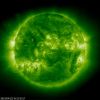
The Sun.jpgThe Sun86 visiteCaption NASA originale:"The ultraviolet light emitted by eleven times ionized iron at temperatures over 2 million degrees Farenheit was used to record the above picture of the Sun on September 22, 2001, the date of that year's autumnal equinox. The image was made by the EIT camera onboard the SOHO spacecraft, a space observatory which can continuously observe the Sun. Eleven times ionized iron is atomic iron with eleven of its electrons stripped away. Here the electrons are stripped by the frantic collisions with other atoms and electrons which occur at the extreme temperatures in the Solar Corona. Since electrons are negatively charged, the resulting ionized iron atom is highly positively charged. Astronomer's "shorthand" for eleven times ionized iron is written "Fe XII", the chemical symbol for iron followed by a Roman numeral 12 (Fe I is neutral iron)".
|
|

Solar_Prominence~0.jpgSolar Prominence85 visiteCaption NASA, da "NASA - Picture of the Day" del giorno 23 Marzo 2010:"Dramatic Prominences can sometimes be seen looming just beyond the edge of the Sun.
Such was the case last week as a Giant Prominence, visible above on the right, highlighted a Sun showing increased activity as it comes off an unusually quiet Solar Minimum. A changing carpet of hot gas is visible in the Chromosphere of the Sun in the above image taken in a very specific color of light emitted by Hydrogen.
A Solar Prominence is a cloud of Solar Gas held just above the Surface by the Sun's Magnetic Field. The Earth would easily fit below the Prominence on the right. Although very hot, Prominences typically appear dark when viewed against the Sun, since they are slightly cooler than the Surface.
A quiescent Prominence typically lasts about a month, and may erupt in a Coronal Mass Ejection (CME) expelling hot gas into the Solar System. The next day, the same prominence looked slightly different".MareKromium
|
|
| 144 immagini su 12 pagina(e) |
 |
|
4 | |
|
|
|
|
|
|
|








