| Piú viste - The Sun: just a star, like many others... |

The corona.jpgThe Sun's corona from TRACE (Transition Region and Coronal Explorer Satellite)112 visitenessun commento
|
|
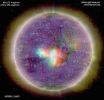
The_Sun-00.jpgThe Sun in 3D105 visitenessun commentoMareKromium
|
|
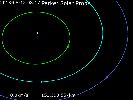
Parker_Solar_Probe_trajectory.gifThe Parker Solar Probe's Trajectory105 visiteInteressante.MareKromium
|
|

The Sun_s Corona.jpgThe "Corona"102 visiteIn sede di commento a questa immagine (amatoriale, ma non per questo meno bella) della corona solare - come visibile durante un'eclissi totale - una piccola curiosità: sapevate che alcune delle sfumature della corona sono visibili (anzi: percepibili) soltanto dall'occhio umano?
|
|

ZA-Sunspot.jpgSunspot and Solar "granules" (detail mgnf)99 visiteCaption NASA originale:"Sometimes, small regions of the Sun appear unusually dark. Visible above is a close-up picture of a sunspot, a depression on the Sun's face that is slightly cooler and less luminous than the rest of the Sun. Sunspots can be larger than the Earth and usually last for only a few days. As you can see, the Sun's face is a bubbling sea of separate cells of hot gas. These cells are known as "granules" and a solar "granule" is about 1000 Km across and "lives" for + or - 10 minutes, then explodes".
|
|

Sunrise from Space.jpgSunrise from space...98 visiteCaption NASA originale:"Sunrise seen from low Earth orbit by the shuttle astronauts can be very dramatic indeed. In this view, the Sun is just visible peaking over towering anvil-shaped storm clouds whose silhouetted tops mark the upper boundary of the troposphere, the lowest layer of planet Earth's atmosphere. Sunlight filtering through suspended dust causes this dense layer of air to appear red. In contrast, the blue stripe marks the stratosphere, the tenuous upper atmosphere, which preferentially scatters blue light".
|
|

A-The_Sun-SOHO-LASCO-2.gifA Day of the Sun (a GIF-Movie by Dr Gianluigi Barca - Lunexit Team)98 visitenessun commentoMareKromium
|
|

A-The_Sun-SOHO-LASCO-1.gifA Day of the Sun (a GIF-Movie by Dr Gianluigi Barca - Lunexit Team)97 visitenessun commentoMareKromium
|
|

The_Sun-XClass_Flare-SDO20110215_015332_2048_0193.jpgSolar "X-Class" Flare97 visiteCaption NASA:"On February 14, 2011, the Sun unleashed one of its most powerful explosions, an "X-Class Flare". The blast was the largest so far in the new Solar Cycle. Erupting from Active Region AR1158 in the Sun's Southern Hemisphere, the Flare is captured here in this extreme UltraViolet image from the Solar Dynamics Observatory (SDO). The intense burst of electromagnetic radiation momentarily overwhelmed pixels in SDO's detectors causing the bright vertical blemish.
This "X-Class Flare" was also accompanied by a Coronal Mass Ejection (CME), a massive cloud of charged particles traveling outward at nearly 900 Km per second".MareKromium
|
|

Sun_Spot.jpgA really beautiful and DEEP SunSpot96 visitenessun commentoMareKromium
|
|
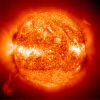
Sun-prom1743_eit_big.jpgAnother "Solar Prominence" from Soho94 visiteCaption NASA originale:"This large prominence is significant not only for its size, but also for its shape. The picture was taken early in the year 2000 by the Sun-orbiting SOHO satellite. Although large prominences and energetic Coronal Mass Ejections (CMEs) are relatively rare, they are occurred more frequently near Solar Maximum, such as the time of peak sunspot and solar activity in the 11 year solar cycle".
|
|

The_Sun-489332main_euvfilament-20101016-1.jpgIntense Solar Activity on the Sun: Sunspot 1112 and Solar Flares93 visiteOn Saturday, October 16, 2010, NASA’s Solar Dynamics Observatory captured this stunning image of one of the most intense, Solar Flares seen in the past few months. So far there have been no reports of energetic particles from this M-class Flare interfering with NASA Spacecraft or making their way to Earth.MareKromium
|
|
| 144 immagini su 12 pagina(e) |
 |
3 | |
|
|
|
|
|
|
|
|








