| Piú viste - The Sun: just a star, like many others... |

Sun_Flowers_NSO_1901.jpgFunny-looking Sun152 visiteIs that the Surface of the Sun? Yes it is, believe it or not...MareKromium
|
|
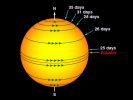
Solar_rotation.jpgThe "uneven" Solar Rotation149 visitenessun commentoMareKromium
|
|

A-The Sun from Soho~0.jpgA colorful Sun, a Solstice celebration148 visiteCaption NASA originale: "This composite image combines Extreme Ultravoilet Imaging Telescope (EIT)images from three wavelengths(171, 195 and 284 angstrom) into one that reveals solar features unique to each wavelength. Since the EIT images come to us from the spacecraft in black and white, they are color coded for easy identification. For this image, the nearly simultaneous images from May 1998 were each given a color code (red, yellow and blue) and merged into 1. SOHO is a project of international cooperation between ESA and NASA".
|
|

A-The Sun from Spitzer - spicules_sst_big.jpgSun "Spicules" from the Sptizer Space Telescope (SST)145 visiteCaption NASA originale: "Pictured above is perhaps the highest resolution image yet of the enigmatic "Solar Flux Tubes" known as "Spicules". Spicules dot the above frame of solar active region, but they are particularly evident as a carpet of dark tubes on the right. Time-sequenced images have recently shown that spicules "Life-span" is of about 5 minutes, starting out as tall tubes of rapidly rising gas but eventually fading as the gas peaks and falls back down to the Sun".
|
|

ZZ-ZZ-ZZ-3-The_Sun-FlareX13_20220330_171A_2048p30_Sq.gifThe always restless Sun... Sun-Flare X-13131 visitenessun commentoMareKromium
|
|

A-THE SUN-FLUXTUBE.jpgA very unusual "fluxtube" from the Sun123 visiteCaption originale NASA, da "NASA - Picture of the Day" dell'11 Gennaio 1999: "The Earth's orbit is not a perfect, sun-centered circle. At aphelion, the most distant point in Earth's orbit, the Sun is 150 MKMs away and at perihelion, the closest point, Earth approaches the Sun to within about 147 MKMs. While aphelion occurs in July, perihelion for planet Earth comes in January. In fact, inhabitants of the Northern Hemisphere, particularly those wearily weathering winter storms, may be surprised to learn that Earth reached its closest point to the Sun on early January, usually the coldest month of the year. This false-color picture recorded near perihelion is from the earth-orbiting Yohkoh Solar Observatory. It shows an increasingly active Sun in the light of X-rays. A negative color scheme is used, darker colors representing more intense X-ray light". Da notare che il commento NASA non menziona nè spiega - guarda caso... - il dettaglio più intrigante dell'immagine: il "tubo" di plasma e di gas...
|
|

Sun surface in 3D.jpgThe "bubbling" surface of the Sun in 3D119 visiteCaption NASA originale" How smooth is the Sun? The new Swedish 1-m Solar Telescope, deployed in the Canary Islands in 2002, allows imaging of objects less than 100-Km across on the Sun's surface. When pointed toward the Sun's edge, surface objects now begin to block each other, indicating true three-dimensional information. Close inspection of the image reveals much vertical information, including spectacular light-bridges rising nearly 500 Km above the floor of sunspots near the top of the image. Also visible in the above false-color image are hundreds of bubbling granules, each about 1000 Km across, and small bright regions known as "faculae".
|
|

Solar_Prominence-SOHO.jpgSolar Prominence118 visiteCaption NASA:"What's that coming over the edge of the Sun? What might appear at first glance to be some sort of Sun monster is actually a Solar Prominence. The above Prominence, captured by the Sun-orbiting SOHO satellite earlier this year during an early stage of its eruption, rapidly became one of the largest ever on record.
Even as pictured, the Prominence is huge -- the Earth would easily fit inside. A Solar Prominence is a thin cloud of Solar Gas held just above the Surface by the Sun's Magnetic Field.
A "Quiescent Prominence" typically lasts about a month, while an "Eruptive Prominence" like the one developing above may erupt within hours into a Coronal Mass Ejection (CME), expelling hot gas into the Solar System. Although very hot, Prominences typically appear dark when viewed against the Sun, since they are slightly cooler than the surface. As our Sun evolves toward Solar maximum over the next three years, more large eruptive prominences are expected".MareKromium
|
|

Solar_Corona~0.jpgDeep Coronal Holes117 visiteCaption NASA:"This ominous, dark shape sprawling across the face of the Sun is a Coronal Hole -- a low density region extending above the Surface where the Solar Magnetic Field opens freely into interplanetary space.
Studied extensively from space since the 1960s in UltraViolet and X-Ray Light, Coronal Holes are known to be the source of the high-speed Solar Wind (such as atoms and electrons which flow outward along the open Magnetic Field lines). During periods of low activity, Coronal Holes typically cover regions just above the Sun's Poles.
But this extensive Coronal Hole dominated the Sun's Northern Hemisphere earlier this week, captured here in Extreme UV Light by cameras onboard the Solar Dynamics Observatory. The solar wind streaming from this Coronal Hole triggered auroral displays on Earth".MareKromium
|
|

Active_Sun.jpgActive Sun (Credits: Mehmet Ergün)117 visiteCaption NASA Originale:"Our Sun is becoming a busy place. Only two years ago, the Sun was emerging from a solar minimum so quiet that months would go by without even a single sunspot. In contrast, already this year and well ahead of schedule, our Sun is unusually active, already nearing solar activity levels seen a decade ago during the last solar maximum. Our increasingly active Sun was captured two weeks ago sporting numerous interesting features. The image was recorded in a single color of light called Hydrogen Alpha, color-inverted, and false colored. Spicules carpet much of the Sun's face. The brightening towards the Sun's edges is caused by increased absorption of relatively cool solar gas and called limb darkening. Just outside the Sun's disk, several scintillating prominences protrude, while prominences on the Sun's face are known as filaments and show as light streaks. Magnetically tangled active regions are both dark and light and contain cool sunspots. As our Sun's magnetic field winds toward solar maximum over the next few years, whether the Sun's high activity will continue to increase is unknown".
“Non si presta mai attenzione a ciò che è stato fatto; si vede soltanto ciò che resta da fare"
Marie CurieMareKromium
|
|

The Sun in Hydrogen-Alpha light.jpgThe Sun in "Hydrogen-alpha" light114 visiteCaption NASA originale:"The above picture was taken in a specific color of light emitted by Hydrogen gas called Hydrogen-alpha. Granules cover the solar photosphere surface like shag carpet, interrupted by bright regions containing dark sunspots. Our Sun glows because it is hot, but it is NOT on fire. Fire is the rapid acquisition of oxygen, and there is VERY LITTLE O2 on the Sun! The energy source of the Sun is the nuclear fusion of Hydrogen into Helium (4H--->1He) deep within its core".
|
|

The_Sun-Spicules.jpgSpiculae in Solar Region 11092114 visiteCaption NASA:"Imagine a pipe as wide as a state and as long as the Earth. Now imagine that this pipe is filled with hot gas moving 50.000 Km per hour. Further imagine that this pipe is not made of metal but a transparent Magnetic Field. You are envisioning just one of thousands of young Spicules (Spiculae) on the active Sun.
Pictured above is one of the highest resolution image yet of these enigmatic Solar Flux Tubes. Spicules line the above frame of SAR 11092 that crossed the Sun last month, but are particularly evident converging on the Sunspot on the lower right.
Time-sequenced images have recently shown that Spicules last about five minutes, starting out as tall tubes of rapidly rising gas but eventually fading as the gas peaks and falls back down to the Sun. What determines the creation and dynamics of Spicules still remains a topic of the active Solar Research".MareKromium
|
|
| 144 immagini su 12 pagina(e) |
2 |  |
|
|
|
|
|
|
|
|
|








