| Piú viste - The Sun: just a star, like many others... |

The_Sun-PIA09321.jpgDisk Image of the Sun, March 26, 2007 (Anaglyph)66 visitenessun commentoMareKromium
|
|

Sungrazer-2010-SOHO.jpgSungrazer66 visiteCaption NASA:"Intense and overwhelming, the direct glare of the Sun is blocked by the smooth occulting disk in this image from the Sun-staring SOHO Spacecraft. Taken on January 3rd, 2010, an extreme UltraViolet image of the Sun to scale, is superimposed at the center of the disk. Beyond the disk's outer boundary, is a Sungrazer Comet, one of the brightest yet seen by SOHO.
The comet was discovered by an Australian Amateur Astronomer, Alan Watson, while examining earlier images from another Sun-watching Spacecraft, STEREO-A. Based on their orbits, Sungrazers are believed to belong to the Kreutz family of comets, created by successive break ups from a single large Parent Comet that passed very near the Sun in the twelfth century.
Subjected to strong Tidal Forces and intense Solar Heat, this Sungrazer did not survive its close encounter".MareKromium
|
|

The_Sun-Texture.jpgThe "Texture" of the Sun66 visiteUp close, the Solar Surface is a striking patch work of "granules" in this very High Resolution picture of the quiet Sun. Caused by convection, the granules are hot, rising columns of plasma edged by dark lanes of cooler, descending plasma. But the HR view reveals that the dark lanes are dotted with many small, contrasting bright points. Constantly present on the Solar Surface, the bright points do not seem to be related to Sunspots that come and go with the Magnetic Solar Cycle.
Nonetheless, the bright points are regions of concentrated Magnetic Fields and are bright because the magnetic pressure opens a window to hotter deeper layers below the Photosphere. For scale, the white bar at the lower left corresponds to approx. 5000 Km across the Sun's Surface.
The sharp, narrow-band image was recorded in September, 2007 using the Swedish Solar Telescope on the astronomical island of La Palma.MareKromium
|
|

The_Sun_from_SOHO_-_Coronal_Mass_Ejection.jpgCoronal Mass Ejection65 visiteCaption NASA originale:"What's happening to our Sun? Another Coronal Mass Ejection (CME)!
The Sun-orbiting SOHO spacecraft has imaged many erupting filaments lifting off the active solar surface and blasting enormous bubbles of magnetic plasma into space. Direct light from the sun is blocked in the inner part of the above image, taken in 2002, and replaced by a simultaneous image of the Sun in ultraviolet light.
The field of view extends over 2 MKM from the Solar Surface. While hints of these explosive events, called Coronal Mass Ejections or CMEs, were discovered by spacecraft in the early 70s, this dramatic image is part of a detailed record of this CME's development from the presently operating SOHO spacecraft.
Near the minimum of the Solar Activity Cycle CMEs occur about once a week, but near solar maximum rates of two or more per day are typical. Strong CMEs may profoundly influence space weather. Those directed toward our Planet can have serious effects".
|
|

The_Sun.jpgNever too close, never too far...65 visiteCaption NASA:"When is the Sun most distant from Earth? It happened again just this past weekend.
A common misconception is that the Sun is most distant during the Winter, when it's the coldest. In truth, however, the seasonal temperatures are more greatly influenced by the number of daylight hours and how high the Sun rises.
For example, during Northern Winter, the tilt of the Earth causes the Sun to be above the horizon for a shorter time and remain lower in the sky than in Northern Summer. The picture compares the relative size of the Sun during Earth's closest approach in January (Northern Winter) on the left, and in July (Northern Summer) on the right. The angular size of the Sun is noticeably smaller during July, when it is farther away. If the Earth's orbit was perfectly circular, the Sun would always appear to be the same size.
These two solar images were taken from Spain during 2006, but the same effect can be seen in any year from any Earth-bound location".MareKromium
|
|
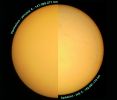
PerihelionAphelion_cervignon800.jpgPerihelion and Aphelion65 visiteDa "NASA - Picture of the Day" del giorno 3 Luglio 2009:"This year Aphelion, the point in Earth's elliptical orbit when it is farthest from the Sun, occurs tomorrow, July 4th.
Of course, that doesn't affect the seasons on our fair Planet, because those are determined by the tilt of Earth's Axis of Rotation and not Earth's distance from the Sun: so July is still Winter in the South and Summer in Northern Hemisphere. But it does mean that on July 4th the Sun will be at its smallest apparent size. This composite neatly compares two pictures of the Sun taken with the same telescope and camera on the dates of Perihelion (closest approach) and Aphelion in 2008.
The image labels include Earth's distance in kilometers from the Sun on the two dates.
Otherwise difficult to notice, the change in the Sun's apparent diameter between Perihelion and Aphelion is clear. The difference amounts to a little over 3%".MareKromium
|
|
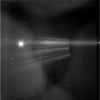
The Sun-W00011347.jpgThe Sun from Cassini64 visiteOriginal caption:"W00011347.jpg was taken on October 23, 2005 and received on Earth October 24, 2005. The camera was pointing toward SATURN-E-RING at approximately 6.847.402 kilometers away and the image was taken using the CL1 and IRP0 filters. This image has not been validated or calibrated".
Secondo noi questa è un'immagine del Sole e non un'istantanea relativa all'Anello E di Saturno. Un'immagine ottenuta casualmente: uno scatto nel buio, mentre una delle fotocamere di Cassini "cercava" l'Anello E.
|
|

Solar Corona.jpgThe 2006 Total Solar Eclipse: the Solar Corona64 visiteDa "NASA - Picture of the Day", del 7 Aprile 2006:"During a total Solar Eclipse, the Sun's extensive outer atmosphere (or Corona) is an awesome and inspirational sight. The subtle shades and shimmering features of the corona that engage the eye span a brightness range of over 10.000 to 1, making them notoriously difficult to capture in a single picture. But this composite of 33 digital images ranging in exposure time from 1/8000 to 1/5th of second comes very close to revealing the crown of the Sun in all its glory. The telescopic views were recorded from Side, Turkey, during the March 29, 2006, Solar Eclipse, a geocentric celestial event that was widely seen under nearly ideal conditions.
The composite also captures a pinkish prominence extending just beyond the upper edge of the eclipsed Sun".
|
|

The_Sun-PIA09324.jpgCloser View of the Equatorial Region of the Sun (March 24, 2007)64 visitenessun commentoMareKromium
|
|

Sun-Equinox 2002.jpgThe Sun during the 2002 Equinox63 visiteCaption NASA originale:"The active Sun near the March Equinox, the beginning of Autumn in the south and Spring in the northern hemisphere. Recorded in a band of extreme ultraviolet light emitted by highly ionized iron atoms, the Sun's upper atmosphere (or solar corona) shines with an array of active regions and plasma loops suspended in magnetic fields. The bright coronal structures and loops seen here have temperatures of about 1.500.000° K".
|
|
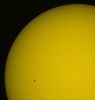
The Sun~0.jpgIn the Sun...63 visiteDa "NASA - Picture of the Day", del 21 Settembre 2006:" Though it's 93 MMs away, the Sun still hurts your eyes when you look at it.
But bright Sunlight (along with accurate planning and proper equipment!) resulted in this sharp silhouette of spaceship and space station.
The amazing telescopic view, recorded on September 17, 2006, captures Shuttle Orbiter Atlantis and the International Space Station in orbit over planet Earth.
At a range of 550 Km from the observing site near Mamers, Normandy, France, Atlantis (left) has just undocked and moved about 200 mt away from the Space Station.
Tomorrow (Sept. 22, 2006), yet another satellite of planet Earth can be seen in silhouette - the Moon will eclipse the Sun. This last eclipse of 2006 will be seen as an annular solar eclipse along a track that crosses Northern South America and the South Atlantic".
|
|

Earth&Sun-001-magfieldG_b.jpgMagnetic Fields... (2)63 visitenessun commento
|
|
| 144 immagini su 12 pagina(e) |
 |
|
|
|
|
|
|
|
|
12 |
|








