| Piú viste - The Sun: just a star, like many others... |
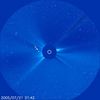
Sun-Saturn-IMG001612-br500.jpgSaturn's "superior conjunction"67 visiteIn this SOHO image taken July 21, 2005, the Sun is represented by the white circle in the center. Saturn is the bright object to the left of the Sun. Interestingly, the streak accompanying Saturn is not the rings but a distortion caused by Saturn's brightness. Saturn is approaching "superior conjunction," that is, it will be almost directly behind the Sun from Earth - thus the Cassini spacecraft, in orbit around Saturn, will not be able to send or receive transmissions normally. Regular science data collection has been temporarily suspended.
As Cassini passes closest by the limb of the Sun on July 24 PDT, all the communications will be impossible because of the Sun's radio noise. The spacecraft will regain full communication with Earth on July 27, once again returning Saturn science data. In the meantime, controllers are sending approximately 100 commands per day to test communication status. Cassini radio scientists are taking advantage of this opportunity to study the Sun's corona from its effects on the radio signals that reach Earth.
SOHO (Solar and Heliospheric Observatory Satellite) orbits the Sun parked in one of the five gravitational-neutral spots, called Lagrange Points. This specific spot, called L1, stays in the same place relative to the Sun and the Earth, offering a continuously uninterrupted view of the Sun.
|
|

Sunspot-reversed-1.jpgSunspot-905: a sign of an incoming new "Solar Cycle"? (2)67 visiteDa "NASA - Picture of the Day" del 30 Agosto 2006:"An indicator that the Sun's magnetic field is reversing is the appearance of sunspots with the reverse magnetic polarity.
A few weeks ago, one small candidate "reverse sunspot" was sited but faded quickly. Now, however, a larger sunspot with negative polarity is being tracked. This sunspot, numbered 905, appears as the unusual white spot in the above magnetic image of the Sun taken with the SOHO spacecraft a few days ago. In the past few days, Sunspot-905 has actually begun to break apart and might also become the source of coronal mass ejections and explosive solar flares.
Solar astronomers predict that the coming Solar Maximum will be unusually active".
|
|

The Sun-Suncombo1G.jpgOur "restless" Sun... (10)67 visitenessun commento
|
|

The Sun-TricutG-1.jpgOur "restless" Sun... (11)67 visitenesun commento
|
|
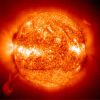
SunFlare-prom1743_eit_big.jpgA Twisted Solar Eruptive Prominence67 visiteCaption NASA:"Ten Earths could easily fit in the "claw" of this seemingly solar monster. The monster, though, visible on the lower left, is a huge Eruptive Prominence seen moving out from our Sun. The above dramatic image taken early in the year 2000 by the Sun-orbiting SOHO satellite. This large prominence, though, is significant not only for its size, but its shape. The twisted figure eight shape indicates that a complex magnetic field threads through the emerging solar particles. Differential rotation inside the Sun might help account for the surface explosion.
Although large prominences and energetic Coronal Mass Ejections (CMEs) are relatively rare, they are occurred more frequently near Solar Maximum, the time of peak sunspot and solar activity in the eleven-year Solar Cycle".MareKromium
|
|

Solar_Prominence-STEREO.jpgHuge Solar Prominence67 visiteCaption NASA:"What does a Solar Prominence look like in three dimensions? To help find out, NASA launched the STEREO satellites to keep a steady eye on the Sun from two different vantage points.
The STEREO satellites orbit the Sun nearly along Earth's orbit, but one (dubbed "Ahead" ---> Avanti) currently leads the Earth, while the other (dubbed "Behind" ---> "Dietro") currently trails. Three weeks ago, a powerful Prominence erupted and remained above the Sun for about 30 hours, allowing the STEREO satellites to get numerous views of it from different angles.
Pictured above is a High-Resolution image of the event from the STEREO "Ahead" satellite.
A video of the Prominence erupting as seen from both Spacecrafts can be found at http : // www . youtube . com / watch?v = _RjswBx6ysQ.
The unusually quiet nature of the Sun over the past two years has made large prominences like this relatively rare. The combined perspective of STEREO will help astronomers better understand the mechanisms for the creation and evolution of Prominences, Coronal Mass Ejections, and Solar Flares".
MareKromium
|
|

The_Sun_in_Extreme_UV.jpgThe Sun in Extreme UV67 visiteThis wild-looking portrait of the Sun was made on March 30th, 2010, by the recently launched Solar Dynamics Observatory (SDO).
Shown in false-color, the composite view covers Extreme UltraViolet wavelengths and traces hot plasma at temperatures approaching 1 million Kelvins. At full resolution, SDO image data is intended to explore solar activity in unprecedented detail. In fact, SDO will send 1.5 terabytes of data back each day, equivalent to a daily download of about half a million MP3 songs.MareKromium
|
|

Sun - Coronal holes.jpgCoronal "Holes"66 visiteCaption NASA originale:"The ominous, dark shapes haunting the left side of the Sun are coronal holes - low density regions extending above the surface where the solar magnetic field opens freely into interplanetary space. Studied extensively from space since the 1960s in ultraviolet and x-ray light, coronal holes are known to be the source of the high-speed solar wind, atoms and electrons which flow outward along the open magnetic field lines. During periods of low activity, coronal holes typically cover regions just above the Sun's poles. These coronal holes, however, have just moved into view near the Sun's equator, and particles escaping them have already caused notable aurora here on Earth. Coronal holes like this one may last for a few solar rotations before the magnetic fields shift and change configurations. Shown in false-color, this picture of the Sun on March 9, 2003, was made in extreme ultraviolet light by the EIT instrument on board the space-based SOHO observatory".
|
|

ZZ-The Sun.jpgAutumnal Equinox 199466 visiteDa "NASA - Picture of the Day" del 20 Marzo 2005:"Today, the Sun crosses the celestial equator heading North, marking the Vernal Equinox - such as the 1st day of Spring in the Northern Hemisphere and Autumn in the south. Equinox means equal night and with the Sun on the celestial equator, Earthlings will experience 12 hours of daylight and 12 hours of darkness. For those in the Northern Hemisphere, the days will continue to grow longer with the Sun marching higher in the sky as Summer approaches. A few weeks after the northern Autumnal Equinox of 1994, the Crew of the Shuttle Endeavor recorded this image of the Sun poised above the Earth's limb. Glare illuminates Endeavor's vertical tail (pointing toward the Earth) along with radar equipment in the payload bay. The space shuttle is expected to return to flight later this year with the launch of STS-114".
|
|

The Sun-P-021-01450.jpgJapanese Sun66 visitenessun commento
|
|

The Sun-C2helixG.jpgOur "restless" Sun... (4)66 visitenessun commento
|
|
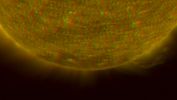
The_Sun-PIA09331.jpgThe South Pole of the Sun66 visiteThis image is a composite of left and right eye color image pairs taken by the SECCHI Extreme UltraViolet Imager (EUVI) mounted on the STEREO-B and STEREO-A Spacecraft.
STEREO-B is located behind the Earth, and follows the Earth in orbit around the Sun, This location enables us to view the Sun from the position of a virtual left eye in space.
STEREO-A is located ahead of the Earth, and leads the Earth in orbit around the Sun, This location enables us to view the Sun from the position of a virtual right eye in space.
The EUVI imager is sensitive to wavelengths of light in the extreme ultraviolet portion of the spectrum.
EUVI bands at wavelengths of 304, 171 and 195 Angstroms have been mapped to the red blue and green visible portion of the spectrum and processed to emphasize the three-dimensional structure of the solar material.MareKromium
|
|
| 144 immagini su 12 pagina(e) |
 |
|
|
|
|
|
|
|
|
11 |
|








