| Piú viste - Walking on Mars with Spirit and Opportunity |
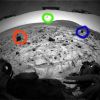
SOL772-2R194900669EFFAPD6P1309R0M1.jpgMartian "fly", "cube" and "strange balance" - Sol 772211 visiteQuesto frame, come tanti altri che, un poco alla volta, pubblicheremo, è stato individuato dal nostro Amico Lettore Gianluigi Barca (GE) il quale ha maturato una notevole sensibilità nell'individuazione di "features curiose" sulla superficie del Pianeta Rosso. La più grande stranezza potrebbe essere nella Cerchiatura Verde, che abbiamo battezzato "Martian Fly". Dire che cosa sia realmente la "mosca Marziana" è impossibile ed anche se la nostra prima sensazione è che si tratti di un photoartifact (uno di quelli connessi all'uso di uno specifico filtro/colore), non siamo (ancora) riusciti a trovare un altro frame Rear-HazCam che lo contenga. Molto curioso è il "cubo" di roccia cerchiato in Rosso. Questa caratterizzazione delle rocce di Marte non è rarissima (ne abbiamo incontrate altre di rocce in apparenza "cubiche"), ma è sicuramente affascinante.
Non bisogna tuttavia escludere a priori l'eventualità che si possa trattare di un fenomeno ottico connesso all'angolo di ripresa, all'altezza della camera...
|
|

OPP-SOL952-PIA08807-1.jpgCabo Frio - Sol 952 (Natural Colors; credits for the additional process. and color.: Dr Paolo C. Fienga - Lunexit Team)211 visitenessun commentoMareKromium
|
|
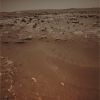
SOL766-2N194370732EFFAP00P0675R0M1.jpgWaiting for the Winter... (5) - Sol 766 (Natural Colors; credits for the additional process. and color.: Dr Paolo C. Fienga - Lunexit Team)211 visitenessun commentoMareKromium
|
|
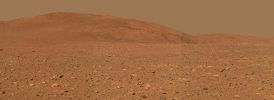
SOL149-The_Hills-PIA06045_modest.jpgThe Hills and the "Red Desert" - Sol 149 (Approx. True Colors; credits: NASA/JPL/Cornell)210 visiteCaption NASA:"This view from where NASA's Mars Exploration Rover Spirit stood on the Rover's 149th Martian Day, or Sol (such as June, 3, 2004), shows Terrain the MER has crossed since then. Spirit is currently headed East, traversing the flanks of the Hills en route to an overlook above a steep valley that is out of view from this perspective. Scientists hope to find more layered rocks that will tell a story of ancient water on Mars. Spirit has traveled 498 meters (more than one-quarter of a mile) and ascended 20 meters (66 feet) above the Plains since arriving at the "Columbia Hills" on sol 156 (June 11, 2004). It covered much of that distance driving on only five of its six wheels.
The images used to make this approximately true-color mosaic were taken with Spirit's panoramic camera from about 300 meters (984 feet) away from the base of the hills, using filters centered at wavelengths of 600, 530 and 480 nanometers".
|
|
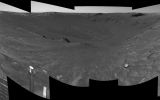
OPP-SOL285-1-B_site37_navcam_360_BurnsCliff_cyp_L-B296R1_br2.jpgBurns Cliff - 360° panorama (1) - Sol 285210 visitenessun commento
|
|
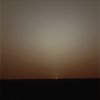
OPP-SOL101-1P137171835EFF2019P2680L2M1.jpgSunset on Mars: the whole sequence - Sol 101 (14 - Natural Colors; credits for the additional process. and color.: Dr Paolo C. Fienga - Lunexit Team) 210 visitenessun commentoMareKromium
|
|
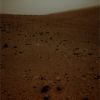
SOL523-2N172797718EFFABGZP0695R0M1.jpgLooking around on Sol 523 (3 - Natural Colors; credits for the additional process. and color.: Dr Paolo C. Fienga - Lunexit Team)209 visitenessun commentoMareKromium
|
|
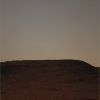
SOL443-2P165682374EFFA978P2390L7M1-PCF-LXTT.jpgHorizon - Sol 443 (Absolute Natural Colors; credits for the additional process. and color.: Dr Paolo C. Fienga - Lunexit Team)209 visitenessun commentoMareKromium
|
|

SOL643-3-On_Earth-IRIDIUM-2.jpgIridium Flash (credits: Dr Paolo C. Fienga)209 visiteImmagine riprocessata ed a contrasti accentuati. Colori naturali (non ritoccati).
Se Vi capitasse di vedere un qualcosa del genere nei Cieli Notturni, sappiate che NON é né una "Shooting Star" né un "UFO". E' solo il flash (raggi del Sole che si riflettono sui pannelli) di un Satellite Artificiale della Classe "IRIDIUM".
Nota: "Iridium" è un Sistema di Satelliti per Telecomunicazioni, il cui nome deriva da "Iridio" (n. 77 della Tavola Periodica degli Elementi). Per curiosità, 77 era esattamente il numero di satelliti che il Progetto originariamente prevedeva di posizionare in orbita terrestre.
A Settembre 2019, tuttavia, solo 72 sono effettivamente nello Spazio Circum-Terrestre (66 attivi e 6 quiescenti).MareKromium
|
|

OPP-SOL001-02-MERB_Sol1_Postcard-B002R1_br2.jpgThe "First Color View" of Eagle Crater (2) - Sol 1208 visiteCaption NASA originale:"The interior of a Crater surrounding the Mars Exploration Rover Opportunity at Meridiani Planum on Mars can be seen in this color image from the Rover's PanCam. This is the darkest landing site ever visited by a spacecraft on Mars. The rim of the Crater is approximately 10 mt (approx. 32 feet) from the Rover. The Crater is estimated to be 20 mt (approx. 65 feet) in diameter. Scientists are intrigued by the abundance of rock outcrops dispersed throughout the Crater, as well as the Crater's soil, which appears to be a mixture of coarse gray grains and fine reddish grains. Data taken from the camera's near-infrared, green and blue filters were combined to create this approximate true color picture, taken on the first day of Opportunity's journey. The view is to the west-southwest of the Rover".
|
|

SOL068_Bonneville_360_L256-A129R1_br2.jpgBonneville Crater and Surroundings - Sol 68 (Almost True Colors; credits: NASA/JPL-Caltech)206 visiteSe osservate questa bellissima ripresa in "full size" riuscirete a vedere, in lontananza e quasi a ridosso dell'orizzonte visibile, leggermente a Dx del Cratere Bonneville (Sn dell'Osservatore), un punto color argento.
E' la Silver Sphere di cui abbiamo proprosto svariate immagini (in b/n) nella Sezione dedicata alle Anomalie incontrate da Spirit.
|
|
SOL317-2N154507585EFF9300P1581L0M1.jpgThe Sky above Spirit - Sol 317 (Enhanced Natural Colors; credits for the additional process. and color.: Dr Paolo C. Fienga - Lunexit Team)206 visitenessun commentoMareKromium
|
|
| 5456 immagini su 455 pagina(e) |
 |
|
|
|
|
13 | |
|
|
|
|





