| |

| Piú viste - Mercury |

ZZ-Mercury-Full_Disk-PIA16853-PCF-LXTT-IPF.jpgMercury (Possible Absolute Natural Colors; credits for the additional process. and color.: Dr Paolo C. Fienga/Lunar Explorer Italia/Italian Planetary Foundation)99 visiteThis extremely detailed and, in fact, really impressive view of the Planet Mercury was produced by using images from the Color Base Map Imaging Campaign that was carried out during the NASA - MESSENGER Spacecraft's Primary Mission. Young Rays, extending radially from (relatively) fresh Impact Craters, appear of a light gray or whitish color; the dark-gray and almost black-colored Regions and Areas are those Geologic Units of Mercury's Crust which are known as the "Low-Reflectance Material" (such as a Material that, according to the opinion of many Planetary Scientists, is thought to be rich in a dark and opaque Mineral). The brown and orange Regions are Plains that were formed, most likely, by the passage of Highly Fluid Lavas. The giant Caloris Impact Basin is the large, and very well visible, circular yellow-orangish Surface Feature located just near the upper right of center of the image (such as at abour one 'o clock of Mercury's disk).
We, as IPF, believe that the different colors of Mercury, as visible in this picture (which is an Ortographic Projection of the Innermost Planet in the Solar System), also can tell us something important about the age of the various Mercurian Regions and Areas. For instance, the almost black (or completely black) Areas and Spots, should be the ones which were more exposed to (and therefore that should have suffered for the longest time) the relentless action of the Charged Particles forming the Solar Wind and the Cosmic Rays. This means, in terms of age of these Areas and Spots, that the Surface Materials forming them should be the oldest ones that can be found on the Planet.
On the other hand, the Regions and Areas whose colors become less and less dark (and therefore we are talking about colors going from brown and dark orange, to yellow and, finally, to light gray or white) should be the ones that were less exposed to the so-called Cosmic Weathering, and this means, still in terms of age, that the Surface Materials that form them, should be the youngest ones present, today, on Mercury.
Instrument: Wide Angle Camera (WAC) of the Mercury Dual Imaging System (MDIS)
Center Latitude: 0°
Center Longitude: 140,00° East
This image (which is an Original NASA - MESSENGER Spacecraft false color image-mosaic published on the NASA - Planetary Photojournal with the ID n. PIA 16853) has been additionally processed and then re-colorized in Absolute Natural Colors (such as the colors that a human eye would actually perceive if someone were onboard the NASA - MESSENGER Spacecraft and then looked outside, towards the Planet Mercury), by using an original technique created - and, in time, dramatically improved - by the Lunar Explorer Italia Team. Different colors, as well as different shades of the same color, mean, among other things, the existence of different Elements (Minerals) present on the Surface of Mercury, each having a different Albedo (---> Reflectivity) and Chemical Composition.MareKromium
|
|

B-Mercury-PIA02240.jpgThe components of the surface of Mercury98 visiteCaption NASA originale:"Updated calibration and subsequent mosaicing have led to substantial improvements in the Mariner 10 color image data. This color composite was formed to especially highlight differences in opaque minerals (such as Ilmenite), Iron content and soil maturity.
K - Crater Kuiper shows color consistent with fresh material excavated from a subsurface unit that may have an "unusual" composition;
D - relatively dark and blue unit consistent with enhanced Titanium content;
B - bright red unit that may represent primitive crustal material
F - color unit that follows plains boundaries, interpreted as lava flows".
|
|

ZZ-Mercury-Limb-Flare-Fake-PIA16909-PCF-LXTT-IPF-0.jpgThis is NOT a "Game"!98 visiteThis beautiful and, as you can see, deeply suggestive image has been recently taken by the NASA - MESSENGER Spacecraft, while it was imaging the Limb of the Planet Mercury. What you see here could reasonably be an "Outgassing" - like the controversial ones which, sometimes, have been seen occurring on our Moon (actually, the so-called "Outgassings" are events in which Volatile-rich Materials are vented from deep inside the Lunar Interior, up to the Lunar Surface - specifically, we can think about Elements like Radon, Nitrogen, Carbon Monoxide, and/or Carbon Dioxide - and which might be the visible result of Low Level (---> Residual) Lunar Volcanic and/or Tectonic Activities). These Outgassing Phenomena, as you should know, are commonly put in the Cathegory of the so-called "Transient Lunar Phenomena" (or TLP, for short).-
On the other hand, this "Flare" might also be the result of an extremely unlikely (but yet possible) Residual Active Volcanic Activity (so, in this scenario, we would be looking at an actual Volcanic Plume) which happened on the innermost Planet of the Solar System: a Planet that has always been considered by the Planetary Scientists - as well as by the General Scientific Community -, like a (Geologically speaking) "Completely Dead Celestial Body".
It is also possible (even though we, as IPF, believe that this very last hypothesis is the least likely of the three) that the "Flare-like Light" seen here, on the Mercurian Limb, could be the evidence of an Impact (i.e.: a Meteor Strike) that has just occurred. However, if this hypothesis were true, we could also assume, just by looking at the shapes of both the Main Plume and the Upper Cloud which can be seen right on top of the Plume itself, that the Celestial Object that hit the Surface of Mercury should/must have followed a nearly (---> almost perfectly) Vertical Impact Trajectory (and this is another rather unlikely - better yet: extremely rare - circumstance).
This picture (which is an Original NASA - MESSENGER Spacecraft b/w frame published on the NASA - Planetary Photojournal with the ID n. PIA 16909 - but now, as we wrote herebefore, removed) has been additionally processed and then colorized in Absolute Natural Colors (such as the colors that a human eye would actually perceive if someone were onboard the NASA - MESSENGER Spacecraft and then looked down, towards the Surface of Mercury), by using an original technique created - and, in time, dramatically improved - by the Lunar Explorer Italia Team. Different colors, as well as different shades of the same color, mean, among other things, the existence of different Elements (Minerals) present on the Surface of Mercury, each having a different Albedo (---> Reflectivity) and Chemical Composition.
Important Note for the Readers: the People working at NASA for The MESSENGER Team implied that this picture was (once again, after "Caduceus") some sort of "practical joke", created to celebrate the Worldwide famous "April Fools' Day". Well, we, as IPF, believe that if this picture, as it seems, is actually a "joke" (---> a fake, in this case), it really is a VERY, VERY poor and stupid one. Please, forgive us for being so direct, but even though some People may think that this idea of making a practical joke out of a MESSENGER b/w frame was "funny" and "educational" (and, in a pretty distorted way, it probably was so), we honestly believe that this silly "stunt" only proves, in a LOUD and CLEAR WAY, how easily, once you have the right REPUTATION, skills and means, the original RAW image-data received from Space can be corrupted/tampered with, either by adding or by removing Features.
As you can also easily understand, the implications arising out of this "stunt" are, actually, countless and, in a way (like we already underlined in the past), quite disturbing...
For your reference and information, please visit http://messenger.jhuapl.edu/gallery/sciencePhotos/image.php?gallery_id=2&image_id=1133MareKromium
|
|

ZZZ-Mercury-PIA19445.jpgReady to say "Farewell"....97 visiteCaption NASA:"This image, acquired on April, 29th, 2015, is one of MESSENGER's last. On April 30th, the Spacecraft will complete its highly successful orbital mission and impact the Surface of Mercury.
Impact was expected at 19:26:02 UTC (3:26:02 pm EDT) but will occur out of sight and communication with the Earth. The MESSENGER Team will try to establish communications with the Spacecraft when its orbit would allow it to be visible from Earth. The inability to establish communications between MESSENGER and the scheduled Earth-based tracking antenna will provide the first confirmation that the Spacecraft has impacted the Surface. After about 30 minutes following the predicted Mercury Impact Time, the Team plans to announce whether MESSENGER's orbital mission has come to an end".
Date acquired: April 29, 2015
Image Mission Elapsed Time (MET): 72595737
Image ID: 8414772
Instrument: Narrow Angle Camera (NAC) of the Mercury Dual Imaging System (MDIS)
Center Latitude: 69.46° North
Center Longitude: 229,49° East
Resolution: 1,7 meters/pixel
Scale: The largest crater in this image has a diameter of about 330 meters.MareKromium
|
|

ZZ-Mercury-Volcanic_Regions-Plains-PIA13676.jpgSmooth Plains and Impact Craters96 visiteThis scene, a mosaic of images acquired as MESSENGER approached Mercury for its third fly-by of the Planet, shows a large expanse of Smooth Volcanic Plains near the center of the image.
Most Smooth Plains are believed to have formed by Lavas that flooded Mercury's Surface. In this view, Craters are visible that have been nearly filled with Lava, leaving only traces of their Circular Rims.
Curving Scarps (or "Cliffs") and "Wrinkle Ridges" can also be seen running mostly from top to bottom of the frame. The density of Impact Craters on the Smooth Plains is less than on the heavily Cratered Terrain visible in the upper right and lower right corners of this image.
The presence of fewer Impact Craters per unit area means that the Volcanic Smooth Plains are younger than the Cratered Terrain.
During orbital observations beginning in 2011, MESSENGER will gather high-resolution and color imaging data to map the global extent of Mercury's Volcanic Smooth Plains, gaining clues to the composition of the Plains and unraveling the History of Volcanism on the Solar System's Innermost Planet. The named craters Picasso, Firdousi and Steichen are visible in this scene.
Date Acquired: September, 29th, 2009
Instrument: Narrow Angle Camera (NAC) of the Mercury Dual Imaging System (MDIS)
Scale: The bottom edge of this image is approximately 1450 Km (900,45 miles) acrossMareKromium
|
|

Mercury - Degas Crater from Mariner 10.jpgDegas Crater - Mariner 1095 visiteIl viaggio avrà inizio il giorno 2 Agosto 2004 con il lancio del Messenger dalla Cape Canaveral Air Force Station.
Il viaggio non sarà nè breve, nè semplice: il previsto ingresso della Sonda nell'orbita di Mercurio, infatti, avverrà soltanto nel Marzo del 2011.
|
|

ZX-Mercury-PIA13840.jpgCrescent Mercury (an Image-Mosaic by NASA/Johns Hopkins University Applied Physics Laboratory/Carnegie Institution of Washington)95 visiteThis HR mosaic of NAC images shows Mercury as it appeared to MESSENGER as the Spacecraft departed the Planet following its first mission's Fly-By. This mosaic resembles the historic first image transmitted back to Earth after that Fly-By and shows a portion of the Planet never previously seen by Spacecrafts.
Date Acquired: January, 14th, 2008
Instrument: Narrow Angle Camera (NAC) of the Mercury Dual Imaging System (MDIS)MareKromium
|
|

ZZ-Mercury-Full_Disk-PIA16852-PCF-LXTT-IPF.jpgMercury (Possible Absolute Natural Colors; credits for the additional process. and color.: Dr Paolo C. Fienga/Lunar Explorer Italia/Italian Planetary Foundation)95 visiteThis extremely detailed and, in fact, really impressive view of the Planet Mercury was produced by using images from the Color Base Map Imaging Campaign that was carried out during the NASA - MESSENGER Spacecraft's Primary Mission. Young Rays, extending radially from (relatively) fresh Impact Craters, appear of a light gray or whitish color; the dark-gray and almost black-colored Regions and Areas are those Geologic Units of Mercury's Crust which are known as the "Low-Reflectance Material" (such as a Material that, according to the opinion of many Planetary Scientists, is thought to be rich in a dark and opaque Mineral). The brown and orange Regions are Plains that were formed, most likely, by the passage of Highly Fluid Lavas. The Impact Crater visible in the upper right of the image, at about one 'clock, and whose etremely well defined Rays' System stretches across the entire Planet, is Hokusai Crater.
We, as IPF, believe that the different colors of Mercury, as visible in this picture (which is an Ortographic Projection of the Innermost Planet in the Solar System), also can tell us something important about the age of the various Mercurian Regions and Areas. For instance, the almost black (or completely black) Areas and Spots, should be the ones which were more exposed to (and therefore that should have suffered for the longest time) the relentless action of the Charged Particles forming the Solar Wind and the Cosmic Rays. This means, in terms of age of these Areas and Spots, that the Surface Materials forming them should be the oldest ones that can be found on the Planet.
On the other hand, the Regions and Areas whose colors become less and less dark (and therefore we are talking about colors going from brown and dark orange, to yellow and, finally, to light gray or white) should be the ones that were less exposed to the so-called Cosmic Weathering, and this means, still in terms of age, that the Surface Materials that form them, should be the youngest ones present, today, on Mercury.
Instrument: Wide Angle Camera (WAC) of the Mercury Dual Imaging System (MDIS)
Center Latitude: 0°
Center Longitude: 320,00° East
This image (which is an Original NASA - MESSENGER Spacecraft false color image-mosaic published on the NASA - Planetary Photojournal with the ID n. PIA 16852) has been additionally processed and then re-colorized in Absolute Natural Colors (such as the colors that a human eye would actually perceive if someone were onboard the NASA - MESSENGER Spacecraft and then looked outside, towards the Planet Mercury), by using an original technique created - and, in time, dramatically improved - by the Lunar Explorer Italia Team. Different colors, as well as different shades of the same color, mean, among other things, the existence of different Elements (Minerals) present on the Surface of Mercury, each having a different Albedo (---> Reflectivity) and Chemical Composition.MareKromium
|
|

Mercury - The Flat Plains.jpgThe Flat Plains - Mariner 1094 visiteDurante questi passaggi la Sonda (speriamo...) effettuerà la mappatura fotografica del Pianeta, coprendo anche quelle aree "non viste" da Mariner 10 (e che sono pari ad oltre il 55% dell'intera superficie!).
Gli Scienziati si aspettano grandi rivelazioni da questa Missione ed il motivo è semplice: Mercurio, a dispetto di 30 anni di "abbandono", è tutt'altro che poco interessante. Mercurio, per esempio, possiede un campo magnetico completo, proprio come la Terra.
E la cosa è assolutamente sorprendente.
|
|
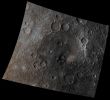
ZZ-Mercury-Craters-Raffaello_Crater-PIA16307-PCF-LXTT-IPF-1.jpgRaffaello Crater (Absolute Natural Colors; credits for the additional process. and color.: Dr Paolo C. Fienga/Lunar Explorer Italia/Italian Planetary Foundation)94 visiteThis beautiful Absolute Natural Color image-mosaic of the huge Impact Basin Raffaello (named after the Italian Renaissance painter and having a diameter of approx. 343 Km), taken in the past month of October 2012 by the NASA - MESSENGER Spacecraft, shows us a wide diversity of colors (which, as you know, represent a wide variety of Mineral Compositions) that exist and can be easily identified within the Volcanic Plains that, eons ago, flooded the Raffaello Basin's Floor. Furthermore, many white-colored Hollows appear to be in process of being formed along most of the Rim and the Northern portion of the Floor - and, in both cases, they are forming in the so-called Low Reflectance Material (or LRM for short) - of a smaller - roughly 40-Kilometer (such as approx. 25-miles) diameter -, Unnamed and Highly Complex Impact Crater that is located just South of the center of the giant Raffaello Basin.
Date acquired: October, 19th, 2012
Images Mission Elapsed Time (MET): 259122560, 259122580, 259122564
Images ID: 2793045, 2793050, 2793046
Instrument: Wide Angle Camera (WAC) of the Mercury Dual Imaging System (MDIS)
Center Latitude: 20,39° South
Center Longitude: 283,6° East
Resolution: 599 meters/pixel
Solar Incidence Angle: 53,4° (meaning that the Sun, at the time that the pictures were taken, was about 36,6° above the imaged Local Mercurian Horizon)
Emission Angle: 27,0°
Sun-Mercury-Messenger (or "Phase") Angle: 80,3°
This picture (which is an Original NASA - MESSENGER Spacecraft color frame published on the NASA - Planetary Photojournal with the ID n. PIA 16307) has been additionally processed and then re-colorized in Absolute Natural Colors (such as the colors that a human eye would actually perceive if someone were onboard the NASA - MESSENGER Spacecraft and then looked down, towards the Surface of Mercury), by using an original technique created - and, in time, dramatically improved - by the Lunar Explorer Italia Team. Different colors, as well as different shades of the same color, mean, among other things, the existence of different Elements (Minerals) present on the Surface of Mercury, each having a different Albedo (---> Reflectivity) and Chemical Composition.MareKromium
|
|

ZZ-Mercury-Craters-Berkel_Crater-PIA16890-PCF-LXTT-IPF.jpgBerkel Crater (Absolute Natural Colors; credts for the additional process. and color.: Dr Paolo C. Fienga/Lunar Explorer Italia/Italian Planetary Foundation)94 visiteBerkel Crater (a Mercurian Impact Crater that was so named after the Turkish painter and printmaker, Sabri Berkel) is a so-called "Complex Impact Crater" (approx. 24 Km - such as a little less than 15 miles - in diameter) that sits inside the larger Ellington Basin, which is located in the low Latitudes of the Southern Hemisphere of Mercury. Berkel's interior contains some kind of Material (so far unknown) that, as you can clearly see in today's image, is way darker than the surrounding Terrain; furthermore, a large number of the vey common Mercurian Surface Features, known as "Hollows", can also be seen all over the Floor of the Crater itself.
This image was acquired as a targeted set of stereo images. Targeted Stereo Observations are acquired at resolutions much higher than that of the 200-meter/pixel Stereo Base Map. These targets acquired with the NAC enable the detailed Topography of Mercury's Surface to be determined for a local area of specific interest.
Date acquired: February, 5th, 2013
Image Mission Elapsed Time (MET): 4159492
Image ID: 3589683
Instrument: Narrow Angle Camera (NAC) of the Mercury Dual Imaging System (MDIS)
Center Latitude: 13,85° South
Center Longitude: 26,56° East
Resolution: 71 meters/pixel
Solar Incidence Angle: 30,3° (meaning that the Sun, at the time that the picture was taken, was about 59,7° above the imaged Local Mercurian Horizon)
Emission Angle: 29,3°
Sun-Mercury-Messenger (or "Phase") Angle: 52,6°
This picture (which is an Original NASA - MESSENGER Spacecraft b/w frame published on the NASA - Planetary Photojournal with the ID n. PIA 16890) has been additionally processed and then colorized in Absolute Natural Colors (such as the colors that a human eye would actually perceive if someone were onboard the NASA - MESSENGER Spacecraft and then looked down, towards the Surface of Mercury), by using an original technique created - and, in time, dramatically improved - by the Lunar Explorer Italia Team. Different colors, as well as different shades of the same color, mean, among other things, the existence of different Elements (Minerals) present on the Surface of Mercury, each having a different Albedo (---> Reflectivity) and Chemical Composition.MareKromium
|
|

ZN-Messenger to Mercury.jpgMessenger going to Mercury93 visiteE, per concludere questo brevissimo "fly-by" fotografico di Mercurio, Vi offriamo una fotografia che contiene, in fondo, un pò di "speranza": è l'immagine della partenza della Sonda Messenger verso Mercurio.
Ci rivedremo fra qualche anno - se tutto andrà bene - con nuove fotografie ed informazioni provenienti da un mondo davvero poco conosciuto.
Se saremo bravi (e fortunati) troveremo senz'altro alcune risposte a molti quesiti, e certo non mancherà del materiale per porsi nuove domande e sbirciare nell'Ignoto, nei suoi Misteri, nei suoi Enigmi e nelle sue Anomalie.
Ed è per questi motivi (e per mille altri che non conosciamo ma che certamente esistono) che il Viaggio della Scienza è - e rimane - sempre e comunque, un Viaggio Infinito!
|
|
| 248 immagini su 21 pagina(e) |
|
|
|
|
|
7 | |
|
|
|
|
|
|





