| |

| Piú viste - Mercury |

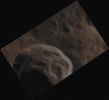
ZZ-Mercury-Craters-Copland_Crater-PIA13068.jpgCopland on Mercury (Natural Colors; credits for the additional process. and color.: Dr Paolo C. Fienga - Lunexit Team)134 visiteVisible in the center of this image is the Crater Copland, recently named in honor of the American composer and pianist Aaron Copland.
Aaron Copland and this Crater are both unquestionably worthy candidates for named features on Mercury, but how this specific crater came to be known as Copland has an interesting back-story.
Amateur astronomer Ronald Dantowitz and his colleagues Scott Teare and Marek Kozubal used the Mt. Wilson 60-inch telescope in 1998 to observe a very bright feature on this portion of Mercury's surface, and they assumed that the bright feature was an impact crater.
Mr. Dantowitz expressed his wish that the crater be named "Copland" once better images of the area were obtained from spacecraft. Surprisingly, MESSENGER images from Mercury flyby 3 revealed that the small bright feature, seen at the left edge of this image, is not an impact crater but more closely resembles a Volcanic Vent.
No convention for naming Volcanic Vents on Mercury has yet been adopted, because none were identified prior to MESSENGER's first Mercury flyby. However, even if a convention for naming volcanic features on Mercury is adopted in the future, the naming rules will likely differ from those for impact craters, and thus "Copland" would probably not be an acceptable name for the bright volcanic feature.
A MESSENGER team member corresponded with Mr. Dantowitz and suggested that the name Copland be proposed instead for a large crater nearby.
He agreed, and the International Astronomical Union (IAU) approved the name Copland on March 3, 2010. Copland crater is flooded with volcanic smooth plains material that could be related to the activity that formed the bright vent.
Date Acquired: September 29, 2009
Instrument: Narrow Angle Camera (WAC) of the Mercury Dual Imaging System (MDIS)
Scale: Copland crater has a diameter of about 208 Km (approx. 129 miles)
Projection: This image is a portion of the NAC approach mosaic from Mercury flyby 3. It is shown in a simple cylindrical map projection with a resolution of roughly 500 meters/pixel (approx. 0,31 miles/pixel).MareKromium
|
|
ZZ-Mercury-Craters-Unnamed_Crater-PIA16948-PCF-LXTT-IPF.jpgUnnamed Crater with "Slump" Deposits (Absolute Natural Colors; credits for the additional process. and color.: Dr Paolo C. Fienga/Lunar Explorer Italia/Italian Planetary Foundation)134 visiteThe Unnamed Impact Crater visible in this image taken by the NASA - MESSENGER Spacecraft shows prominent "Slump Deposits" that were created when the Crater Walls collapsed and, perhaps, some portion of the Ejecta, fell back down, inside the Crater itself. These events, according to NASA Scientists, probably occurred immediately (or just a VERY little time) after the Crater formation. If you look closely, you can also see that the Inner Rim appears to host small patches of Hollows. One clue to understand the Hollow formation is that they appear to form, preferentially (but NOT always!), on Sunward-facing Slopes (and since this Impact Crater is located at a high Northern Latitude, its Northern (Inner) Wall gets the most exposure to the Sun). This extra heating may enhance the sudden loss (---> escape) of the Volatiles that are present in and near the subsurface, thus creating those strange, bright Features that are now commonly known as "Hollows" (---> litterally: a "hollow" is a place that once was full of "something" - i.e.: Ice, Gases and/or other Volatiles like Nitrogen, Carbon Dioxide, Ammonia, Hydrogen, Methane and Sulfur Dioxide - and that now has become empty).
Date acquired: October 12th, 2012
Image Mission Elapsed Time (MET): 258544256
Image ID: 2752092
Instrument: Narrow Angle Camera (NAC) of the Mercury Dual Imaging System (MDIS)
Center Latitude: 59,38° North
Center Longitude: 307,20° East
Resolution: 16 meters/pixel
Solar Incidence Angle: 71,8° (meaning that the Sun, at the time that the picture was taken, was about 18,2° above the imaged Local Mercurian Horizon)
Emission Angle: 50,2°
Sun-Mercury-Messenger (or "Phase") Angle: 122,1°
This picture (which is an Original NASA - MESSENGER Spacecraft Map Projected b/w frame published on the NASA - Planetary Photojournal with the ID n. PIA 16948) has been additionally processed and then colorized in Absolute Natural Colors (such as the colors that a human eye would actually perceive if someone were onboard the NASA - MESSENGER Spacecraft and then looked down, towards the Surface of Mercury), by using an original technique created - and, in time, dramatically improved - by the Lunar Explorer Italia Team. Different colors, as well as different shades of the same color, mean, among other things, the existence of different Elements (Minerals) present on the Surface of Mercury, each having a different Albedo (---> Reflectivity) and Chemical Composition.MareKromium
|
|

ZZ-Mercury-Craters-Ives_Crater-PIA14360-PCF-LXTT.jpgIves Crater (Natural Colors; credits for the additional process. and color: Dr Paolo C. Fienga - Lunexit Team)133 visiteCaption NASA:"In this image, one is immediately drawn to the Rayed Crater in the upper right. Ives Crater, named in 1979 after American composer Charles Edward Ives, is smaller than many Unnamed Craters visible in this image, but it is younger and therefore brighter than its surrounding Terrain".
Date acquired: May, 20th, 2011
Image Mission Elapsed Time (MET): 214374721
Image ID: 276065
Instrument: Wide Angle Camera (WAC) of the Mercury Dual Imaging System (MDIS)
WAC filter: 7 (748 nanometers)
Center Latitude: 29,74° South
Center Longitude: 245,4° East
Resolution: 933 meters/pixel
Scale: the width of this image is approx. 677 Km
Incidence Angle: 49,0°
Emission Angle: 1,7°
Sun-Target-Spacecraft (such as "Phase") Angle: 50,7°MareKromium
|
|

ZZ-Mercury-Craters-Xiao_Zhao_Crater-PIA14495-PCF-LXTT.jpgXiao Zhao Crater (Absolute Natural Colors; credits for the additional process. and color.: Dr Paolo C. Fienga - Lunexit Team)133 visiteDate acquired: July, 11th, 2011
Image Mission Elapsed Time (MET): 218840609
Image ID: 489105
Instrument: Wide Angle Camera (WAC) of the Mercury Dual Imaging System (MDIS)
WAC filter: 9 (996 nanometers)
Center Latitude: 14,17° North
Center Longitude: 122,3° East
Resolution: 456 meters/pixel
Scale: the diameter of Xiao Zhao is 24,2 Km (approx. 15 miles)
Solar Incidence Angle: 22,1°
Emission Angle: 34,3°
Phase Angle: 56,4°MareKromium
|
|

ZZ-Mercury-Limb-PIA14551-pcf-lxtt.jpgMercurian Limb (Absolute Natural Colors; credits for the additional process. and color.: Dr Paolo C. Fienga - Lunexit Team)131 visiteThe Rays apparent in this spectacular Limb image of Mercury come from Debussy, the sharp Crater near the Terminator. This dominant Crater on Mercury was also a part of MESSENGER's historic image of Mercury- the first image ever to be taken from a spacecraft in orbit about this Planet. Readers may also notice a streak in the blackness of space in the top left corner of the image. This artifact was produced by a Cosmic Ray hitting the camera's CCD detector while the image was being collected.
This image was acquired as part of MDIS's Limb imaging campaign. Once per week, MDIS captures images of Mercury's Limb, with an emphasis on imaging the Southern Hemisphere's Limb. These Limb images provide information about Mercury's shape and complement measurements of topography made by the Mercury Laser Altimeter (MLA) of Mercury's Northern Hemisphere.
Date of acquisition: July, 26th, 2011
Image Mission Elapsed Time (MET): 220137668
Image ID: 550504
Instrument: Wide Angle Camera (WAC) of the Mercury Dual Imaging System (MDIS)
WAC filter: 7 (748 nanometers)
Center Latitude: 27,90° South
Center Longitude: 29,17° East
Resolution: 2783 meters/pixel
Scale: Mercury's radius is approximately 2440 km (about 1515,24 miles)
Solar Incidence Angle: 65,1°
Emission Angle: 48,2°
Sun-Mercury-Spacecraft (i.e.: "Phase") Angle: 95,3°MareKromium
|
|

ZZZ-Mercury-PIA19448.jpgFarewell Messenger!....131 visiteCaption NASA:"Originally planned to orbit Mercury for one year, the mission exceeded all expectations, lasting for over four years and acquiring extensive datasets with its seven scientific instruments and radio science investigation. This afternoon, the Spacecraft succumbed to the pull of Solar Gravity and impacted Mercury's Surface.
The image shown here is the last one acquired and transmitted back to Earth by the mission. The image is located within the Floor of the roughly 93-Km-diameter Impact Crater named "Jokai". The Spacecraft struck the Planet just north of Shakespeare Basin".
Date acquired: April 30, 2015
Image Mission Elapsed Time (MET): 72716050
Image ID: 8422953
Instrument: Narrow Angle Camera (NAC) of the Mercury Dual Imaging System (MDIS)
Center Latitude: 72,0° North
Center Longitude: 223,8° East
Resolution: 2,1 meters/pixel
Scale: This image is about 1 Km across
Solar Incidence Angle: 57,9° (meaning that the Sun was 32,1° high on the Local Horizon)
Emission Angle: 56,5°
Phase Angle: 40,7°MareKromium
|
|

ZZ-Mercury-Craters-Unnamed_Crater-CP_and_Hollows-PIA16952-PCF-LXTT-IPF-1.jpgHollowland, again! (Absolute Natural Colors; credits for the additional process. and color.: Dr Paolo C. Fienga/Lunar Explorer Italia/Italian Planetary Foundation)130 visiteThis image - taken by the NASA - MESSENGER Spacecraft - shows us the Hollow-covered Central Peak Structure (a Feature that is also often called Central Uplift) of a Mercurian Northern Hemisphere's Unnamed Impact Crater having a diameter of about 60 Km (such as approx. 37,26 miles). It is now clear that these mysterious Mercurian Surface Features known as "Hollows" are not only related - as it was thought at the beginning - to (relatively) flat surfaces (such as the Floors of a countless number of Impact Craters) or on areas located near or on top of the Rims of said Impact Craters: it has been now visually proven that the Hollows can also be found on highly irregular (---> NOT "flat") and complex rocky structures (---> Central Peaks and, maybe, Hills and Mountains). And, in the meanwhile, the search continues...
Date acquired: March, 24th, 2013
Image Mission Elapsed Time (MET): 6465097
Image ID: 3753557
Instrument: Narrow Angle Camera (NAC) of the Mercury Dual Imaging System (MDIS)
Center Latitude: 36,20° North
Center Longitude: 244,20° East
Resolution: 29 meters/pixel
Solar Incidence Angle: 61,7° (meaning that the Sun, at the time that the picture was taken, was about 28,3° above the imaged Local Mercurian Horizon)
Emission Angle: 21,1°
Sun-Mercury-Messenger (or "Phase") Angle: 65,8°
This picture (which has been cropped from an Original NASA - MESSENGER Spacecraft b/w frame published on the NASA - Planetary Photojournal with the ID n. PIA 16952) has been additionally processed and then colorized in Absolute Natural Colors (such as the colors that a human eye would actually perceive if someone were onboard the NASA - MESSENGER Spacecraft and then looked down, towards the Surface of Mercury), by using an original technique created - and, in time, dramatically improved - by the Lunar Explorer Italia Team. Different colors, as well as different shades of the same color, mean, among other things, the existence of different Elements (Minerals) present on the Surface of Mercury, each having a different Albedo (---> Reflectivity) and Chemical Composition.MareKromium
|
|

ZZ-Mercury-Terminator-PIA10937-1.jpgNorthern Latitudes and a possible Orbital Anomaly (EDM - Enhanced Natural Colors; credits for the add. process. and color.: Dr Paolo C. Fienga)) 130 visiteRaggio Cosmico, senza dubbi.MareKromium
|
|

ZZ-Mercury-Craters-Unnamed_Crater-PIA18372-PCF-LXTT-IPF.jpgUnnamed Crater with Hollows (Absolute Natural Colors; credits for the additional process. and color.: Dr Paolo C. Fienga/Lunar Explorer Italia/Italian Planetary Foundation)129 visiteAs the NASA - MESSENGER Spacecraft passes progressively closer to the Planet Mercury, we are able to see Always better resolved Surface Features in the images that the Spacecraft returns. Here, in this frame, at a pixel scale of 9 meters, we can see the Eastern Portion of an Unnamed Impact Crater approx. 13 Km (such as about 8,073 miles) in diameter. The Inner Wall of the Crater is replete (---> full of), as you can see, with smaller, superposed Impact Craters, some of which appear elongated (---> ellipsoidal), possibly because they impacted on the larger Crater's inclined Inner Wall.
Interestingly, there are also Bright Spots on the Sunlit Portion of this Unnamed Crater's Wall (Right Side - Dx - of the frame, at about 4 o'clock), and that is exctly the right place where we might reasonably expect to see, in a near future, some new "Hollows" (actually, we, as IPF, do believe that the Surface Features visible in the area indicated by NASA are ALREADY FORMED "Hollows" whose shapes and dimensions, probably, are still in course of modification).
Date acquired: March, 3rd, 2014
Image Mission Elapsed Time (MET): 36136338
Image ID: 5862963
Instrument: Narrow Angle Camera (NAC) of the Mercury Dual Imaging System (MDIS)
Center Latitude: 56,30° North
Center Longitude: 301,60° East
Solar Incidence Angle: 59,3° (meaning that the Sun, at the time that the picture was taken, was about 30,7° above the imaged Local Mercurian Horizon)
Emission Angle: 43,0°
Sun-Mercury-Messenger (or "Phase") Angle: 102,3°
This picture (which is an Original NASA - MESSENGER Spacecraft's b/w and NON Map-Projected image published on the NASA - Planetary Photojournal with the ID n. PIA 18372) has been additionally processed, contrast enhanced, Gamma corrected, magnified to aid the visibility of the details and then colorized in Absolute Natural Colors (such as the colors that a human eye would actually perceive if someone were onboard the NASA - MESSENGER Spacecraft and then looked outside, towards the Surface of Mercury), by using an original technique created - and, in time, dramatically improved - by the Lunar Explorer Italia Team. Different colors, as well as different shades of the same color, mean, among other things, the existence of different Elements (Minerals) present on the Surface of Mercury, each having a different Albedo (---> Reflectivity) and Chemical Composition.MareKromium
|
|

ZZ-Mercury-Craters-Unnamed_Craters-PIA15857-PCF-LXTT-IPF.jpgCraters on the Mercurian Terminator (Absolute Natural Colors; credits for the additional process. and color.: Dr Paolo C. Fienga/Lunar Explorer Italia/Italian Planetary Foundation)128 visiteThis is a beautiful and dramatic image of the Surface of Planet Mercury that was taken by the NASA - MESSENGER Spacecraft just when the Sun was a mere 10 degrees above the Local (imaged here) Horizon. The frame shows us four (4) Simple Unnamed Impact Craters which are all located on top of the Rim of a larger (approx. 3 Km-diameter) Simple Unnamed Crater (look from about 12 to a little after 1 o' clock of the disc drawn by the larger Crater) which, on its side, is positioned on the Outer Rim of an even larger (such as approx. 35 Km-diameter) Unnamed Complex Impact Crater which has been already caught and flooded by the shadows of the Mercurian Night.
As a matter of fact, the Rims of the four small Impact Craters show almost no signs of Erosion, or Collapse, and this circumstance marks them (always relatively speaking) as "young" Surface Features. However, while almost the entire Surface of Mercury is covered by Chains of small Craters (mostly formed by the action of repeated "waves" of Ejecta Boulders), these four small Craters DO NOT form nor constitute what is technically defined as a "Chain of Craters".
This image was acquired as a High-Resolution Targeted Observation. Targeted Observations are images of a small area on Mercury's Surface at resolutions much higher than the usual 200-meters per pixel Morphology Base Map. It is not possible to cover all of Mercury's Surface at such an High Resolution, but typically several areas of remarkable scientific interest are imaged in this mode each week.
Date acquired: May, 2nd, 2012
Image Mission Elapsed Time (MET): 217183900
Image ID: 1750578
Instrument: Narrrow Angle Camera (NAC) of the Mercury Dual Imaging System (MDIS)
WAC filter: 7 (748 nanometers)
Center Latitude: 79,27° North
Center Longitude: 232,13° East
Resolution: 15 meters/pixel
Solar Incidence Angle: 79,8° (meaning that the Sun, at the time that the picture was taken, was about 10,2° above the Local Mercurian Horizon)
Emission Angle: 11,9°
Sun-Mercury-Messenger (or "Phase") Angle: 67,9°
This frame (which is an Original NASA - MESSENGER Spacecraft image published on the NASA - Planetary Photojournal with the ID n. PIA 15857) has been additionally processed and then colorized in Absolute Natural Colors (such as the colors that a human eye would actually perceive if someone were onboard the NASA - MESSENGER Spacecraft and then looked down, towards the Surface of the Planet Mercury), by using an original technique created - and, in time, dramatically improved - by the Lunar Explorer Italia Team. Different colors, as well as different shades of the same color, mean, among other things, the existence of different Elements (Minerals) present on the Surface of Mercury, each having a different Albedo (---> Reflectivity) and Chemical Composition.MareKromium
|
|

ZZ-Mercury-Craters-Faulkner_Crater-PIA16908-PCF-LXTT-IPF-1.jpgFaulkner Crater (EDM - Absolute Natural Colors; credits for the additional process. and color.: Dr Paolo C. Fienga/Lunar Explorer Italia/Italian Planetary Foundation)128 visiteIn this picture, taken by the NASA - MESSENGER Spacecraft, we can see relatively young and smooth Lava Plains which have filled and partially (actually, almost completely) buried the Mercurian Faulkner Crater (approx. 168 Km - such as about 104,32 miles - in diameter), leaving only the Northern three-quarters of its highly degraded Rim visible. These smooth Lava Plains, which have relatively few superposed Impact Craters (and that is why they can be considered - always relatively speaking - "young") and appear of a light brown-pink color in this Absolute Natural Colors image, were - likely - emplaced when powerful Volcanic Flows breached Faulkner's Southern Rim, invaded the whole Floor of the Crater and then set, leaving only the highest-standing portions of Terrain (such as, as we wrote herebefore, some part of its Northern Rim) almost intact.
Date acquired: January, 19th, 2013
Images Mission Elapsed Time (MET): 878881, 878901, 878885
Images ID: 3356193, 3356198, 3356194
Instrument: Wide Angle Camera (WAC) of the Mercury Dual Imaging System (MDIS)
Center Latitude: 8,61° North
Center Longitude: 77,37° East
Resolution: 299 meters/pixel
Solar Incidence Angle: 36,5° (meaning that the Sun, at the time that the picture was taken, was about 53,5° above the imaged Local Mercurian Horizon)
Emission Angle: 43,6°
Sun-Mercury-Messenger (or "Phase") Angle: 78,1°
This picture (which has been cropped from an Original NASA - MESSENGER Spacecraft false color image-mosaic published on the NASA - Planetary Photojournal with the ID n. PIA 16908) has been additionally processed and then re-colorized in Absolute Natural Colors (such as the colors that a human eye would actually perceive if someone were onboard the NASA - MESSENGER Spacecraft and then looked down, towards the Surface of Mercury), by using an original technique created - and, in time, dramatically improved - by the Lunar Explorer Italia Team. Different colors, as well as different shades of the same color, mean, among other things, the existence of different Elements (Minerals) present on the Surface of Mercury, each having a different Albedo (---> Reflectivity) and Chemical Composition.MareKromium
|
|

ZZ-Mercury-Craters-Scarlatti_Crater-PIA18215-PCF-LXTT-IPF.jpgScarlatti Crater (Absolute Natural Colors; credits for the additional process. and color.: Dr Paolo C. Fienga/Lunar Explorer Italia/Italian Planetary Foundation)128 visiteIn this image-mosaic, obtained by putting together three frames taken by the NASA - MESSENGER Spacecraft on March, 30, 2014, we can see, located almost at the center of the frame, the large (such as approx. 132 Km - such as about 81,97 miles - in diameter) Peak-Ring Basin known as Scarlatti.
While Scarlatti has a typical Peak-Ring in many respects, if you take a good look towards its North/Eastern Section (upper right side - Dx - of the Feature), you will be able to notice its "transition" to a relatively wide (in this case, approx. 30 Km - such as about 18,63 miles - across) sort of Collapse Pit, surrounded by High-Reflectance (white and reddish in color) Surface Material. This Pit (perhaps a Volcanic Vent or a Caldera, eons ago), according to several NASA Planetary Scientists, could have been - and we say, as IPF, reasonably, considering all the visible Features characterizing it - the site of some (most likely extremely ancient as well as really powerful) Explosive Volcanic Activity.
Date acquired: March, 30th, 2014
Images Mission Elapsed Time (MET): 38528557, 38528553, 38528551
Images ID: 6032934, 6032932, 6032931
Instrument: Wide Angle Camera (WAC) of the Mercury Dual Imaging System (MDIS)
Center Latitude: 40,70° North
Center Longitude: 258,90° East
Solar Incidence Angle: 86,2° (meaning that the Sun, at the time that the picture was taken, was about 3,8° above the imaged Local Mercurian Horizon)
Emission Angle: 51,1°
Sun-Mercury-Messenger (or "Phase") Angle: 137,3°
This picture (which is an Original NASA - MESSENGER Spacecraft's false colors and NON-Map-Projected image-mosaic published on the NASA - Planetary Photojournal with the ID n. PIA 18215) has been additionally processed, contrast enhanced, Gamma corrected, magnified to aid the visibility of the details and then re-colorized in Absolute Natural Colors (such as the colors that a human eye would actually perceive if someone were onboard the NASA - MESSENGER Spacecraft and then looked outside, towards the Surface of Mercury), by using an original technique created - and, in time, dramatically improved - by the Lunar Explorer Italia Team. Different colors, as well as different shades of the same color, mean, among other things, the existence of different Elements (Minerals) present on the Surface of Mercury, each having a different Albedo (---> Reflectivity) and Chemical Composition.MareKromium
|
|
| 248 immagini su 21 pagina(e) |
|
|
4 | |
|
|
|
|
|
|
|
|
|





