| Piú viste - Mercury |

ZZ-Mercury-Scarp-PIA12054.jpgLong and High Scarp (Natural Colors; credits: Lunar Explorer Italia)61 visiteThe Scarp cutting through this Unnamed Crater was imaged as MESSENGER approached the Planet during the mission's second Mercury flyby. The full NAC image acquired by MDIS is shown in a previous release (see PIA11772) while the image shown here is a reprojected view. Compare the two images to see the differences.
By using very precise knowledge about the time that the image was taken and the location of the Spacecraft at that time, the original image can be mapped onto a globe of Mercury. Once mapped onto a Mercury globe, that globe can be viewed in many different ways, including reprojections that create flat maps of Mercury's Surface, as seen in the Global Map of Mercury (see PIA11403). The reprojected image shown here is from a simple cylindrical map projection. Map projections are needed to measure accurately the extent of features on the surface. For example, from this reprojection it was determined that this Scarp is about 1 Km (0,6 miles) high and over 160 Km (about 100 miles) in length. MESSENGER Science Team members recently published an image similar to this reprojection in Science magazine.
Date Acquired: October 6, 2008
Image Mission Elapsed Time (MET): 131766501
Instrument: Narrow Angle Camera (NAC) of the Mercury Dual Imaging System (MDIS)
Resolution: 420 meters/pixel (0,26 miles)
Scale: This crater is about 200 Km (about 124 miles) in diameter
Spacecraft Altitude: 16.300 Km (about 10.100 miles)MareKromium
|
|

B-Mercury-PIA02946.jpgCraters on the morning terminator...60 visiteCaption NASA originale:"As Mariner 10 passed by Mercury on its second encounter with the planet on September 21, 1974, this picture (FDS 166850) of a large circular (350 Km - or 220 mile diameter) basin was obtained near the morning terminator. The basin appears to have been flooded with the plain material and then subsequently cratered by numerous large events. Filling of the basin, presumably by lava flows analogous to those of the lunar maria, partially inundated small craters which had formed along the basin rim (lower left) and in some places overflowed the basin rim and spilled onto the surrounding terrain (top)".
|
|

B-Mercury-PIA02939.jpgDark-rimmed crater and extensive "Ejecta Blanket"60 visiteCaption NASA originale:"Mariner 10 took this picture (FDS 166840) from a distance of 63.400 Km (39.300 miles) about one hour after it passed under the South Pole of Mercury. The dark-rimmed crater at upper left is 67 Km (42 miles) in diameter. It is surrounded by an extensive ejecta blanket and exhibits a bright ray pattern, which extends into and beyond the larger crater (120 Km - or 75 miles) to its right and near the picture's center. The dark-rimmed crater is similar to crater Tycho on Earth's moon. The center of this picture is located 33° South Lat. and 158° West Long. North is to the top".
|
|

C-Mercury-HR-PIA02416.jpgA slice" of Mercury... (HR)60 visiteCaption NASA originale:"A limping Mariner 10 spacecraft was coaxed into a third and final encounter with Mercury in March of 1975. Due to several problems with the aging spacecraft, only ~450 useful images of the planet were acquired, though many are at significantly higher resolution than previous encounters. This is one of the highest resolution images of Mercury acquired by Mariner 10: Frame 528922, ~90 m/pixel.
The vertical (tall narrow) format of the third encounter images resulted from problems with the tape recorder and transmitter on the spacecraft. Only the middle quarter of each frame could be sent back".
|
|

ZZ-Mercury-Limb-PIA10359.jpgCaloris Basin (natural colors; credits: Lunexit)60 visiteThis natural-color image of Mercury shows the great Caloris Impact Basin (see also PIA10383), visible in this image as a large, circular feature in the center of the picture. The contrast between the colors of the Caloris Basin Floor and those of the surrounding plains indicate that the composition of Mercury's surface is variable. Many additional geological features with intriguing color signatures can be identified in this image. For example, the bright spots just inside the rim of Caloris Basin are thought to mark the location of Volcanic Features, such as the volcano shown in this previously released Narrow Angle Camera (NAC) image PIA10942.
MESSENGER Science Team members are studying these regional color variations in detail, to determine the different mineral compositions of Mercury's surface and to understand the geologic processes that have acted on it. (...)
Date Acquired: January 14, 2008
Image Mission Elapsed Times (MET): 108827278-108827328
Instrument: Wide Angle Camera (WAC) of the Mercury Dual Imaging System (MDIS)
Resolution: about 2,3 Km (approx. 1,4 miles/pixel)
Scale: Caloris Basin is about 1550 Km in diameter (approx. 960 miles)
Spacecraft Altitude: approx. 13.000 Km (about 8000 miles)MareKromium
|
|

ZZ-Mercury-Craters-Kertész_Crater-PIA10933.jpgKertész Crater (Saturated Natural Colors; credits for the additional process. and color.: Dr Paolo C. Fienga/Lunar Explorer Italia/Italian Planetary Foundation)60 visiteLocated in the Western Edge of Mercury's giant Caloris Basin, Kertész Crater (recently named for André Kertész, a Hungarian-born American photographer) has some unusual, bright material located on its floor. Sander crater, located in the North-Western Edge of Caloris Basin, also shows bright material on its floor.
The MESSENGER Science Team is investigating the nature and composition of these bright materials and making comparisons between these two craters both located at the edges of Caloris Basin.
Just North-East of Kertész, a small crater has very bright rays and ejecta in this image, indicating that the crater is young.
Date Acquired: January 14, 2008
Image Mission Elapsed Time (MET): 108826812
Instrument: Narrow Angle Camera (NAC) of the Mercury Dual Imaging System (MDIS)
Resolution: 260 meters/pixel (0,16 miles/pixel
Scale: Kertész Crater is about 34 Km (approx. 21 miles) in diameter
Spacecraft Altitude: about 10.200 Km (approx. 6.340 miles)MareKromium
|
|

ZZ-Mercury-Limb-PIA12046.jpgMercurian Limb and Navoi Crater (Natural Colors; credits: Lunar Explorer Italia)60 visiteAt the center of this NAC image is the crater Navoi, named in November 2008 for the Uzbek poet Alisher Navoi (1441/1501 - see also PIA11762).
Located in the far north of Mercury’s Northern Hemisphere, Navoi can be seen clearly as a bright orange feature near the top of a previously released enhanced-color Wide Angle Camera (WAC) image of the Caloris Basin (part of which is shown in this release) (see PIA10359). As seen in that color WAC image, Navoi contains uncommon reddish material that indicates a different rock composition from its surroundings. In the high-resolution NAC image shown here, Navoi also appears to have an irregularly shaped depression in its center. Such depressions have been seen elsewhere on Mercury, including within Praxiteles Crater (see PIA12040), and may indicate past volcanic activity.
Date Acquired: January 14, 2008
Image Mission Elapsed Time (MET): 108828804
Instrument: Narrow Angle Camera (NAC) of the Mercury Dual Imaging System (MDIS)
Resolution: 550 meters/pixel (0,34 miles)
Scale: Navoi is about 66 Km (approx. 41 miles) in diameter
Spacecraft Altitude: approx. 21.700 Km (about 13.500 miles)MareKromium
|
|
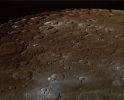
ZZ-Mercury-Limb-PIA11374-0.jpgA View to the South…from the Other Side of Mercury (Extremely Enhanced Natural Colors; credits for the additional process. and color.: Dr Paolo C. Fienga/Lunar Explorer Italia/Italian Planetary Foundation)59 visiteMESSENGER’s 2nd Mercury flyby passed over the opposite side of the Planet from that seen during the Mission’s 1st Mercury encounter. Thus, if one could follow this view obtained by the NAC during the 2nd flyby toward the South, beyond Mercury’s South Pole, it would lead to the Surface seen in an image from MESSENGER’s 1st Mercury flyby (see PIA10187).
Visible in the recently obtained image shown here are many features also seen by Mariner 10: Shevchenko crater named for the 19th century Ukrainian poet, Khansa for the Arabic poet of the 7th century, Rabelais for the Renaissance French writer, Holberg for the Norwegian-Danish writer of the 18th century, Spitteler for the Swiss epic poet who won the Nobel Prize for Literature in 1919, Rameau for the Baroque-era French composer, Puccini for the Italian composer of the late 1800s and early 1900s, and Horace for the ancient Roman poet. Discovery Rupes cuts through Rameau and is named for the ship of English explorer Captain James Cook.
Date Acquired: October 6, 2008
Image Mission Elapsed Time (MET): 131773823
Instrument: Narrow Angle Camera (NAC) of the Mercury Dual Imaging System (MDIS)
Resolution: 510 meters/pixel (0,32 miles/pixel) at the top of the image
Scale: Shevchenko crater is approx. 137 Km (about 85 miles) in diameter
Spacecraft Altitude: approx. 20.000 Km (about 12.400 miles)MareKromium
|
|
| 248 immagini su 21 pagina(e) |
 |
|
|
|
|
|
|
|
|
21 |
|





