| |

| Piú viste - Mercury |
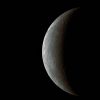
ZO-Mercury14_Messenger-209132main_color_mercury.jpgMercury in Natural Colors (credits: Lunexit)65 visitenessun commentoMareKromium
|
|

ZO-Mercury21_Messenger-big.jpgCrescent Mercury (in Accentuated Colors; credits: NASA)65 visiteCaption NASA:"The colors of Mercury are subtle but beautiful. At first glance, our Solar System's innermost Planet appears simply black and white, but images that include IR colors normally beyond human vision accentuate a world of detail. One such image, shown above, was acquired by the robotic MESSENGER Spacecraft that swung by Mercury in mid-January 2008.
Here, most generally, the hot world itself acquires a slightly more brown hue. Many craters that appear on top of other craters - and so surely have formed more recently - appear here as bright with bright rays that include a slightly blue tint, indicating that soil upended during the impact was light in color. A few craters, such as some in the huge Caloris Basin impact feature visible on the upper right, appear unexpectedly to be ringed with a dark material, the nature of which is being researched.
MESSENGER continues to glide through the inner Solar System and will pass Mercury again this October and next September, before entering orbit around the desolate world in 2011".MareKromium
|
|

ZQ-Mercury-PIA10984.jpgCraters "Deformed" and "Shortened" on Mercury65 visiteNumerous examples of craters that have been deformed and shortened by younger faults have been identified on images returned from MESSENGER’s first flyby of Mercury. In three cases shown here (arrows), portions of the floor and rim of a crater were buried when a large block of crust was thrust over the crater during the formation of a prominent fault scarp or cliff. By comparing the estimated size and shape of the original, undeformed crater with the crater’s current geometry, scientists can infer the amount of movement between the two crustal blocks on either side of the fault. This figure was recently published in Science magazine.
For each of the three examples of deformed and shortened craters shown here, movement on the faults buried at least a kilometer of the original crater. A: 17-Km (11-mile) diameter crater (arrows) shortened by Beagle Rupes. B: 5-Km (3-mile) diameter crater deformed near the rim of an older, larger crater, shown enlarged in the box on the lower left. C: 11-Km (7-mile) diameter crater (arrows) shortened by a North/West-South/East-trending fault scarp.MareKromium
|
|

ZQ-Mercury-PIA10942.jpgShield-Volcano on Mercury65 visiteAs reported in the July 4, 2008 issue of Science magazine, volcanoes have been discovered on Mercury’s Surface from images acquired during MESSENGER’s first Mercury flyby. This image shows the largest feature identified as a volcano in the upper center of the scene. The volcano has a central kidney-shaped depression, which is the vent, and a broad smooth dome surrounding the vent. The volcano is located just inside the rim of the Caloris Impact Basin. The rim of the Basin is marked with hills and mountains, as visible in this image. The role of volcanism in Mercury’s history had been previously debated, but MESSENGER’s discovery of the first identified volcanoes on Mercury’s surface shows that volcanism was active in the distant past on the innermost Planet.
Date Acquired: January 14, 2008
Image Mission Elapsed Time (MET:108826877
Instrument: Narrow Angle Camera (NAC) of the Mercury Dual Imaging System (MDIS)
Resolution: 270 meters/pixel (0,17 miles/pixel)
Scale: This image is about 270 Km across (approx. 170 miles)
Spacecraft Altitude: approx. 10.500 Km (about 6500 miles)MareKromium
|
|

ZZ-Mercury-Craters-Mena_Crater-PIA15202-PCF-LXTT-IPF-00.jpgMena Crater, in context (Possible Absolute Natural Colors; credits for the additional process. and color.: Dr Paolo C. Fienga/Lunar Explorer Italia/Italian Planetary Foundation)65 visiteThe (relatively) young Rays of Mena Crater (approx. 15 Km - such as about 9,315 miles - in diameter) contrast brightly against the surrounding Mercurian Surface, though these beautiful and colorful Rays will gradually fade, and disappear, with time (Eons, in fact).
Furthermore, the asymmetric pattern of the Rays themselves, with an obvious gap in their South-Western direction, may be due to the angle at which the Impact that formed the Crater occurred or, maybe, it can also be due to the circumstance that Mena Crater formed on a very uneven Surface, such as just right on top of the Outer Rim of a larger, pre-existing, Impact Crater, as it can well be seen in this contextual image-mosaic. We, as IPF, believe that the second scenario which was mentioned herebefore is quite more plausible than the first one (even though a combination of the two scenarios/factors cannot be excluded).
Date acquired: November, 12th, 2011
Images Mission Elapsed Time (MET): 229581348, 229581352, 229581356
Images ID: 1003074, 1003075, 1003076
Instrument: Wide Angle Camera (WAC) of the Mercury Dual Imaging System (MDIS)
Center Latitude: 0,97° South
Center Longitude: 234,00° East
Solar Incidence Angle: 29,7° (meaning that the Sun, at the time that the picture was taken, was about 60,3° above the imaged Local Mercurian Horizon)
Emission Angle: 16,3°
Sun-Mercury-Messenger (or "Phase") Angle: 46,0°
This frame (which is an Original NASA - MESSENGER Spacecraft's false colors and Map-Projected image-mosaic published on the NASA - Planetary Photojournal with the ID n. PIA 15202) has been additionally processed, contrast enhanced, magnified to aid the visibility of the details, Gamma corrected and then re-colorized in Absolute Natural Colors (such as the colors that a human eye would actually perceive if someone were onboard the NASA - MESSENGER Spacecraft and then looked down, towards the Western Edge of the Mercurian Impact Crater "Mena"), by using an original technique created - and, in time, dramatically improved - by the Lunar Explorer Italia Team. Different colors, as well as different shades of the same color, mean, among other things, the existence of different Elements (Minerals) present on the Surface of Mercury, each having a different Albedo (---> Reflectivity) and Chemical Composition.MareKromium
|
|

B-Mercury-PIA02418.jpgMercury: the "outgoing" hemisphere64 visiteCaption NASA originale:"This mosaic shows the planet Mercury as seen by Mariner 10 as it sped away from the planet on March 29, 1974. The mosaic was made from over 140 individual TV frames taken about two hours after encounter, at a range of 37.300 miles (60.000 Km ). North is at top. The limb is at right, as is the illuminating sunlight. The equator crosses the planet about two-thirds of the way from the top of the disc. The terminator - such as the line-separating day from night - is about 190° West longitude. The planet shows a gibbous disc-more than half-illuminated. This hemisphere is dominated by smooth plains, rather than heavily cratered terrain, and resembles portions of the Moon's maria in general shape. Half of a very large, multi-ringed basin named Caloris Basin appears near the center of the disc near the terminator. Its surrounding mountain ring is 800 miles (1.300 Km) in diameter".
|
|

ZZ-Mercury-Cliffs_and_Ridges-208889-MZO-MESSENGER_012008.jpgRidges and Cliffs64 visiteBoth it and the lighter-colored ridge that extends downward from it resemble wrinkle ridges that are common on the large Volcanic Plains, or "Maria," on the Moon.
The MESSENGER science team is studying what features like these reveal about the interior cooling history of Mercury.
Ghostly remnants of a few craters are seen on the right side of this image, possibly indicating that once-pristine, bowl-shaped craters (like those on the large crater’s floor) have been subsequently flooded by volcanism or some other plains-forming process.
A complex history of geological evolution is recorded in this frame from the Narrow Angle Camera (NAC), part of the Mercury Dual Imaging System (MDIS) instrument, taken during MESSENGER’s close flyby of Mercury on January 14, 2008.
Part of an old, large crater occupies most of the lower left portion of the frame. An arrangement of ridges and cliffs in the shape of a "Y" crosses the crater’s floor.
The shadows defining the ridges are cast on the floor of the crater by the Sun shining from the right, indicating a descending stair-step of plains. The main, right-hand branch of the "Y" crosses the crater floor, the crater rim, and continues off the top edge of the picture; it appears to be a classic “lobate scarp” (irregularly shaped cliff) common in all areas of Mercury imaged so far. These lobate scarps were formed during a period when Mercury’s crust was contracting as the planet cooled. In contrast, the branch of the Y to the left ends at the crater rim and is restricted to the floor of the crater.
This image was taken 18 minutes after close approach, when MESSENGER was about 5000 Km (about 3000 miles) away from Mercury.
The image is about 200 Km (approx. 125 miles) across, and features as small as about 400 mt (about 400 yards) can be resolved. MareKromium
|
|

ZP-Mercury-PIA10381.jpgTopographic "Close-up"64 visiteCaption NASA:"A close-up of the Mercury Laser Altimeter (MLA) profile of Mercury acquired during MESSENGER's first Mercury flyby on January 14, 2008.
Comparison with an Arecibo radar image mosaic (bottom) provided by Harmon and co-workers shows that the two largest depressions are adjacent impact craters.
The craters have rim-to-rim diameters of 107 Km (left) and 122 Km (right).
The root mean square roughness of the floor the larger crater is ~35 m.
The vertical exaggeration in the figure is equal to 35:1".MareKromium
|
|

ZP-Mercury-PIA10379.jpgMESSENGER Flies through Mercury's Magnetosphere64 visiteCaption NASA:"This picture shows a conceptual sketch of Mercury's Magnetosphere at the time of the MESSENGER flyby. The graphs at the bottom show observations made by the Fast Imaging Plasma Spectrometer (FIPS) portion of the Energetic Particle and Plasma Spectrometer (EPPS) instrument as the Spacecraft followed the indicated trajectory. The top plot depicts the low-energy plasma of solar wind origin, and the bottom plot shows heavy ion intensities associated with the Planet.
This flyby was the first survey of the ion plasma of Mercury's space environment. The positions at which the Spacecraft first crossed the "bow shock" of the magnetospheric interaction with the Solar Wind, passed closest approach to the Planet, and crossed the outbound bow-shock crossing are indicated.
These results show the expected increases in Solar Wind Plasma density downstream of the bow-shock boundary, as well as significant Solar Wind Plasma densities within Mercury's Magnetosphere close to the Planet. The latter measurements provide definitive evidence that Mercury's Magnetosphere — despite its small size — is not a vacuum but hosts significant densities of heated Solar Wind pPasma. The plasma affects the Magnetic Field, contributes to the "space weathering" of the Planet's Surface, and sputters material from the surface to populate the Exosphere. This first detection of heavy pick-up ions, Na+ and other species, near Mercury is consistent with their production by ionization of exospheric neutral species.
This complex system and all of its time variations will be studied during the next two MESSENGER flybys as well as throughout the orbital phase of the Mission".MareKromium
|
|

ZS-Mercury-PIA11077.jpgFaults in Caloris Basin64 visiteAs the youngest large impact basin known on Mercury, the Caloris Basin has landforms that are better preserved than in older basins, which have been more modified by impact cratering.
This figure, recently published in Science magazine, shows a map of many linear features within Caloris Basin that formed when the near-surface rocks were subjected to large horizontal forces. The Caloris Basin contains hundreds of extensional troughs, mapped as black lines, where the surface has been pulled apart and faulted.
Pantheon Fossae (located inside the white box of the top map and shown in detail in the bottom image) has over 200 such troughs in a radiating pattern, but near the outer edges of the basin interior troughs are seen in patterns broadly concentric to Caloris Basin. The Caloris Basin interior also has been deformed by many wrinkle ridges, mapped as red lines, formed when the surface was compressed or shortened horizontally. Relationships between the extensional troughs and contractional wrinkle ridges provide information about the evolution of the Caloris basin and Mercury's interior.
Date Acquired: January 14, 2008
Instrument: Narrow Angle Camera (NAC) of the Mercury Dual Imaging System (MDIS)
Scale: Caloris Basin is about 1550 Km (approx. 960 miles) in diameter. The crater Apollodorus near the center of Pantheon Fossae is about 41 Km (approx. 25 miles) in diameter. MareKromium
|
|
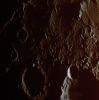
ZZ-Mercury-Terminator-PIA11372.jpgDawn on Mercury (HR - possible True Colors; credits: Lunexit)64 visiteThe first image taken following MESSENGER’s closest distance to Mercury (PIA11352) during the mission’s recent flyby was a Wide Angle Camera (WAC) image. The image shown here is the first NAC image acquired after closest approach, and since the resolution of the NAC is a factor of seven higher than that of the WAC, this image is the highest-resolution image obtained during MESSENGER’s second Mercury flyby.
The image was taken near local dawn, so the shadows are long and many features are shrouded in darkness. The right side of this image overlaps with the left side of the previously released close-up view of Machaut crater (see PIA11249), which was taken just 5" later than this image. This portion of Mercury’s Surface is heavily cratered, with small craters visible down to the limits of even this highest-resolution image.
Date Acquired: October 6, 2008
Image Mission Elapsed Time (MET): 131770803
Instrument: Narrow Angle Camera (NAC) of the Mercury Dual Imaging System (MDIS)
Resolution: 100 meters/pixel (0,06 miles/pixel)
Scale: This image is about 100 Km (approx. 63 miles) across
Spacecraft Altitude: approx. 3800 Km (about 2400 miles)MareKromium
|
|

ZZ-Mercury-Craters-Munch_Crater_et_al_-PIA12034_fig1.jpgMunch, Sander and Poe Crater64 visiteSander, Munch and Poe are a trio of impact craters within the Caloris Impact Basin (see PIA10359).
Munch and Poe were recently named (see PIA11762), while Sander received its name in the first set of feature names (see PIA10611) after MESSENGER’s first Mercury flyby. Munch is named for Edvard Munch (1863-1944), the Norwegian artist and painter of "The Scream".
The crater Poe takes its name from Edgar Allan Poe, the 19th century American writer and poet.
Sander is named for the German photographer August Sander (1876-1964).
Sander Crater exhibits very bright material within its Rim, while Munch and Poe each are surrounded by dark material. The presence of both bright and dark materials suggest that there is a diversity of rock types on and below Mercury's Surface, with different mineralogical compositions from those of the volcanic plains that comprise the majority of the floor of Caloris Basin.
The 3 Craters are located in the far northern part of the Caloris Basin. The basin Rim (see PIA10942), indicated by yellow arrows, can be seen in the upper left and extending across the top of this image, and many fractures within Caloris Basin (see PIA10606) are visible in the lower portion of this image.
Date Acquired: January 14, 2008
Image Mission Elapsed Time (MET): 108828587
Instrument: Narrow Angle Camera (NAC) of the Mercury Dual Imaging System (MDIS)
Resolution: 520 meters/pixel (0,32 miles/pixel)
Scale: This image is about 550 Km (approx. 340 miles) across
Spacecraft Altitude: about 20.400 Km (approx. 12.400 miles)MareKromium
|
|
| 248 immagini su 21 pagina(e) |
|
|
|
|
|
|
|
18 | |
|
|
|
|





