| |

| Piú viste - Mercury |
ZZ-Mercury-Global_View_of_the_Surface-PIA10601.jpgNew Lands on Mercury (Extremely Enhanced Natural Colors; credits for the additional process. and color.: Dr Paolo C. Fienga - Lunexit Team)68 visiteOn January 14, 2008, MESSENGER became the First Spacecraft in over three decades to visit Mercury, snapping images of a large portion of Mercury's Surface previously unseen by spacecraft. As the Spacecraft proceeds on its journey, the science team continues to study the 1213 images returned from the mission's historic first flyby. The probe's trajectory will bring it to a second Mercury flyby on October 6, 2008.
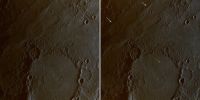
MESSENGER's Narrow Angle Camera (NAC) of the Mercury Dual Imaging System (MDIS) captured this image during the flyby of January 2008. The Sun is illuminating this Region at a low angle, accentuating the modest ridges and other low topography on these nearly flat plains. Low ridges trend from the top-center of the image to the left edge (white arrows). The ghostly remains of craters are visible, filled to their rims by what may have been volcanic lavas (red arrows). The faint remnant of an inner ring within the large crater in the bottom half of this picture can be seen (blue arrow); the area interior to this ring was also flooded, possibly by lava, nearly to the point of disappearance. Clusters of secondary craters on the floor of the large crater and elsewhere (yellow arrows) formed when clumps of material were ejected from large impacts beyond the view of this image, which is about 350 Km (approx. 220 miles) across.
Image Mission Elapsed Time (MET): 108826972MareKromium
|
|

Mercury-PIA11013.jpgMapping a "Volcano"68 visiteMESSENGER Science Team members are busy studying in detail the newly discovered volcanoes on Mercury (see also PIA10942). This figure, recently published in Science magazine, shows a NAC mosaic of the largest volcano currently identified on Mercury and a geologic sketch map of the major features in the surrounding area.
The “irregularly-shaped depressions” are believed to correspond to volcanic vents, and the “margin of the dome-like feature” marks the outer limits of lava flows from the vents that are thought to have covered up the underlying surface of “hummocky plains”.
The unlabeled double line outlines bright material associated with the volcano, believed to be pyroclastic deposits ejected during volcanic eruptions at the vents. A “highly-embayed impact crater” also appears to have had lava flow up to its rim, while a slightly more distant impact crater is “relatively fresh” and unchanged by any lava.
The volcano is located just inside the rim of the Caloris Impact Basin (see also PIA10383), labeled as “Caloris Basin Rim Units” on this map. Maps such as this are aiding scientists as they work to understand the history of volcanism on Mercury.
Date Acquired: January, 14th, 2008
Image Mission Elapsed Time (MET): Mosaic of 108826812 and 108826877
Instrument: Narrow Angle Camera (NAC) of the Mercury Dual Imaging System (MDIS)
Spacecraft Altitude: about 10.500 Km (approx. 6500 miles)MareKromium
|
|

ZZ-Mercury-Craters-Praxiteles_Crater-PIA12052.jpgPraxiteles Crater (enhanced Natural Colors; credits: Lunar Explorer Italia)68 visiteMESSENGER's high-resolution images obtained during the mission's second Mercury flyby have revealed a number of irregularly shaped depressions on the floor of Praxiteles Crater. These depressions are intriguing indications of possible past volcanic activity within this Crater. View the previously released NAC image of Praxiteles for additional discussion.
The image shown here is similar to one recently published in the 1st of May issue of the "Science" magazine. This image was created by first mosaicking together the highest-resolution NAC images available of Praxiteles (one of which is shown in the previous web release), to produce complete coverage of the Crater. Independently, an enhanced-color image of Praxiteles was created by using images from all 11 WAC narrow-band color filters. (Visit last week's web release for more examples of enhanced-color images see PIA12051).
The WAC images provide important color information, but the WAC resolution is considerably less than that of the mosaicked NAC images. Thus, by overlaying a slightly transparent version of the WAC enhanced-color image on the high-resolution NAC mosaic, the high-resolution color view of Praxiteles crater shown here was produced. This overlay-color view helps associate the color features with the morphologic surface features. The fact that the irregularly shaped depressions on the floor of Praxiteles are associated with bright orange and yellow color features provides evidence that the depressions may be related to past volcanic activity in this area of Mercury.
Date Acquired: October 6, 2008
Instrument: Wide Angle Camera (WAC) and Narrow Angle Camera (NAC) of the Mercury Dual Imaging System (MDIS)
Resolution: 210 meters/pixel (0,13 miles/pixel)
Scale: Praxiteles Crater has a diameter of about 182 Km (approx. 113 miles) MareKromium
|
|

ZZ-Mercury-Craters-Balanchine_Crater-PIA17057-PCF-LXTT-IPF-1.jpgBalanchine Crater (CTX Frame - Absolute Natural Colors; credts for the additional process. and color.: Dr Paolo C. Fienga/Lunar Explorer Italia/Italian Planetary Foundation)68 visiteThe Impact Crater located at the center of this scene (such as the one whose Floor is largely covered by extremely bright - and therefore, here, slightly over-exposed - Hollows) has been named "Balanchine", after the choreographer George Balanchine (Leningrad, 1904/New York City - NY - 1983). Now, if you carefully take a look at the Ejecta Blanket which emanates from Balanchine Crater, you may ask yourself what could have caused such an Asymmetric Pattern. Obviously, an absolutely definitive answer to this kind of question, as you should know, cannot be given by anybody, but one reasonable possibility is that the irregularly shaped Ejecta Pattern of Balanchine Crater formed (maybe just in part) on top of a similarly sized, and, of course, pre-existing, Impact Crater.
In this scenario, the older Impact Crater could have unearthed the Lower Reflectance dark-gray Deposit (as a matter of fact, in Absolute Natural Colors this Material looks almost black - blue in the Original NASA false color image-mosaic) from beneath the Surface, while, some time (perhaps a few millions of years) afterwards, a certain portion of them was (unevenly) redistributed all over the Mercurian Surface by the impact that formed Balanchine.
The Cracks that are well visible in the lower left (Sx) quadrant of the mosaic, on the other hand, are part of the Complex System of Graben that cuts the Floor of the giant Caloris Basin, in which Balanchine Crater is located. North is up.
Date acquired: June 29th, 2011
Images Mission Elapsed Time (MET): 217863931, 217863927, 217863923
Images ID: 441964, 441963, 441962
Instrument: Wide Angle Camera (WAC) of the Mercury Dual Imaging System (MDIS)
Center Latitude: 39,05° North
Center Longitude: 175,80° East
Resolution: 282 meters/pixel
Solar Incidence Angle: 39,6° (meaning that the Sun, at the time that the picture was taken, was about 50,4° above the imaged Local Mercurian Horizon)
Emission Angle: 6,3°
Sun-Mercury-Messenger (or "Phase") Angle: 40,9°
This picture (which is an Original NASA - MESSENGER Spacecraft Map Projected false color image-mosaic published on the NASA - Planetary Photojournal with the ID n. PIA 17057) has been additionally processed, contrast enhanced, magnified and then re-colorized in Absolute Natural Colors (such as the colors that a human eye would actually perceive if someone were onboard the NASA - MESSENGER Spacecraft and then looked down, towards the Surface of Mercury), by using an original technique created - and, in time, dramatically improved - by the Lunar Explorer Italia Team. Different colors, as well as different shades of the same color, mean, among other things, the existence of different Elements (Minerals) present on the Surface of Mercury, each having a different Albedo (---> Reflectivity) and Chemical Composition.MareKromium
|
|

B-Mercury-PIA02414.jpgMercury or the Moon?67 visiteCaption NASA originale:"After passing Mercury the first time and making a trip around the Sun, Mariner 10 again flew by Mercury on September 21, 1974, at 1:59 PMPDT. This encounter brought the spacecraft in front of Mercury in the Southern Hemisphere.
Much of Mercury looks like the lunar highlands, a scene carved by billions of years of impact craters. This image (FDS 166724)was taken when Mariner 10 was near its closest approach to the planet during the second encounter, from about 50.000 Km. This image is found near the center of the area not imaged during the first encounter".
|
|

B-Mercury-PIA02948.jpgOld Basin Filled with by Smooth Plains (natural colors - elab. Lunexit)67 visiteCaption NASA:"Old basin, 190 km in diameter, filled by smooth plains at 43° South Latitude and 55° West Longitude. The basin's hummocky rim is partly degraded and cratered by later events. Mariner 10 frame 166607".MareKromium
|
|

ZO-Mercury01_Messenger.jpgApproaching Mercury66 visiteDa "NASA - Picture of the Day", del 16 Gennaio 2008:"Two days ago, the MESSENGER Spacecraft became only the second in Human History to swoop past Mercury. The last spacecraft to visit the Sun's closest Planet was Mariner 10, over 35 years ago.
Mariner 10 was not able to photograph Mercury's entire surface, and the images it did send back raised many questions. Therefore, much about planet Mercury remains unknown. This week's MESSENGER flyby was only the first of three. Over the next few years MESSENGER will swing past Mercury twice more and finally orbit in 2011, but MESSENGER is currently moving too fast to enter orbit around Mercury now.
This image was taken by MESSENGER two days ago upon approach to Mercury.
Many detailed images of Mercury are expected to be sent back over the next few days. The data acquired by MESSENGER will help better understand how Mercury's surface was formed, and why it is so dense".MareKromium
|
|

ZZ-Mercury-Cliffs-209522.jpgMercury's Long Cliffs66 visiteAs the MESSENGER team continues to study the HR images taken during the Mercury flyby encounter on January 14, 2008, scarps (cliffs) that extend for long distances are discovered. This frame, taken by the Narrow Angle Camera (NAC) of the Mercury Dual Imaging System (MDIS), shows a Region of Mercury's surface previously unseen by spacecraft and a large scarp crossing vertically through the scene, on the far right of the image. This scarp is the northern continuation of the one seen in the NAC image released on January 16. The width of this image is about 200 Km (approx. 125 miles), showing that these scarps can be hundreds of kilometers long on Mercury.
The presence of many long and high scarps, as discovered from pictures from the Mariner 10 Mission in 1974 and 1975, suggests a history for Mercury that is unlike that of any of the other Planets in the Solar System. These giant scarps are believed to have formed when Mercury’s interior cooled and the entire Planet shrank slightly as a result.
However, Mariner 10 was able to view less than half the planet, so the global extent of these scarps has been unknown. MESSENGER images, like this one, are providing the first high-resolution looks at many areas on Mercury's surface, and science team members are busy mapping these newly discovered scarps to see whether they are common everywhere on the planet.
Mission Elapsed Time (MET) of image: 108826206
MareKromium
|
|

ZZ-Mercury-Terminator-PIA10609.jpgMercurian Rupes (MULTISPECTRUM; credits: Lunexit)66 visiteWhen MESSENGER flew by Mercury on January 14, 2008, the Mercury Dual Imaging System (MDIS) snapped images of a large portion of Mercury's surface that had not been previously seen by spacecraft. On these images, new examples of long cliffs were identified and viewed for the first time. This image, taken by the Narrow Angle Camera (NAC), shows one of those cliffs in the bottom right corner. The cliff can be followed from the bottom edge of the image, cutting through and deforming an impact crater, and curving out of the image frame on the middle right edge.
This cliff is the northern continuation of the cliff visible in the images previously released on January 16 (PIA10174) and January 27 (PIA10194). This image shows an area of Mercury's surface about 200 Km (about 125 miles) across, and by tracing this cliff through the three images, it can be seen that it extends for hundreds of kilometers.
Cliffs that mark geologic escarpments on Mercury are called "rupes", which is simply the Latin word for cliff. On Mercury, rupes are named after the ships of famous explorers, and names include Discovery Rupes, for a ship of Captain Cook, Santa Maria Rupes, for a ship of Christopher Columbus, and Victoria Rupes, for a ship of Ferdinand Magellan. (The word rupes is both singular and plural).
The MESSENGER Team proposed to the International Astronomical Union, which has the final say on all names of landforms on planets and satellites, that this cliff be named the Beagle Rupes, after the ship on which naturalist Charles Darwin sailed around the world.
Today the MESSENGER Team received word that the proposed name has received formal approval.
Image Mission Elapsed Time (MET): 108827037
MareKromium
|
|

ZO-Mercury-Flyby2_Messenger_big.jpgMercury as Revealed by MESSENGER (Enhanced Natural Colors; credits for the additional process. and color.: Dr Paolo C. Fienga/Lunar Explorer Italia/Italian Planetary Foundation)66 visiteCaption NASA:"The Planet Mercury has been known since history has been recorded, but parts of the Solar System's Innermost Planet have never been seen like this before. Two days ago the robotic MESSENGER Spacecraft buzzed past Mercury for the second time and imaged terrain mapped previously only by comparatively crude radar.
The above image was recorded as MESSENGER looked back 90 minutes after passing, from an altitude of about 27.000 Km. Visible in the above image, among many other newly imaged features, are unusually long rays that appear to run like meridians of longitude out from a young crater near the northern limb.
MESSENGER is scheduled to fly past Mercury once more before firing its thrusters to enter orbit in 2011".MareKromium
|
|

B-Mercury-PIA02411.jpgMercury's "Kuiper Crater"65 visiteCaption NASA originale:"The Mariner 10 Television-Science Team has proposed the name "Kuiper" for this very conspicuous bright Crater (top center) on the rim of a larger older crater.
Prof. Gerard P. Kuiper, a pioneer in planetary astronomy and a member of the Mariner 10 TV team, died December 23, 1973, while the spacecraft was en route to Venus and Mercury. Mariner took this picture (FDS 27304) from about 88.450 Km (55.000 miles), some 2 1/2 hours before it passed Mercury on March 29, 1974. The bright-floored crater, 41 Km (25 miles) in diameter, is the center of a very large bright are which could be seen in pictures sent from Mariner 10 while Mercury was more than two million miles distant. The larger crater is 80 Km (50 miles) across".
|
|

ZO-Mercury03_Messenger-208855main_half_merc_350.jpgCrescent Mercury65 visiteAs NASA’s MESSENGER neared Mercury on January 14, 2008, the Spacecraft took this image of the Planet’s full crescent.
The image shows portions of Mercury previously seen by Mariner 10, but when Mariner 10 flew by the Planet at each of its encounters, the Sun was nearly overhead. For this MESSENGER flyby, in contrast, the Sun is shining obliquely on Regions near the day/night boundary (called the Terminator) on the right-hand side of the crescent, revealing the surface topography.
This image illustrates how MESSENGER, during its future flybys and subsequent orbital mission, will teach scientists much about the portion of Mercury already imaged by Mariner 10.MareKromium
|
|
| 248 immagini su 21 pagina(e) |
|
|
|
|
|
|
17 | |
|
|
|
|
|





