| |

| Piú viste - Mercury |
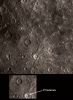
ZZ-Mercury-Craters-Enwonwu_Crater-PIA11784-1.jpgEnwonwu: a young Mercurian Crater (Natural Colors; credits: Lunar Explorer Italia)73 visiteThe feature indicated by the white arrow in this NAC image is the newly named crater Enwonwu (see also PIA11762). It is named in honor of Benedict (Ben) Chukwukadibia Enwonwu, the 20th Century modernist Nigerian sculptor and painter.
Enwonwu Crater displays a Central Peak and a set of bright rays emanating from the Crater Rim. The rays cross the surrounding surface and neighboring craters, indicating that Enwonwu Crater was formed comparatively recently in Mercury’s history. The brightness of the rays also suggests relative youth, as over time rays darken and disappear on Mercury's Surface.
These relationships provide useful indicators for determining the relative ages of features and the sequence of events that have shaped the Surface of Mercury.
Date Acquired: January 14, 2008
Image Mission Elapsed Time (MET): 108829024
Instrument: Narrow Angle Camera (NAC) of the Mercury Dual Imaging System (MDIS)
Resolution: 590 meters/pixel (0,37 miles/pixel)
Scale: Enwonwu Crater is about 38 Km (approx. 24 miles) in diameter
Spacecraft Altitude: about 23.000 Km (approx. 14.300 miles)MareKromium
|
|

ZZ-Mercury-Global_View_of_the_Surface-PIA11795_fig1.jpgVarious Mercurian Surface Features (natural colors; credits: Lunar Explorer Italia)73 visiteThis NAC image displays a number of interesting geologic features characteristic of Mercury’s Surface.
The Crater indicated by the yellow arrow has unusual bright material on its floor, likely due to rocks of a different chemical composition. Bright material also has been seen in the craters Sander and Kertész.
The pink arrows point to a pair of larger and older craters that have been flooded with now solidified volcanic lava, similar to flooding seen at the impact basin Raphael. In the lower right-hand corner of the image is a large peak-ring Basin, about 210 Km (approx. 130 miles) in diameter, which also appears to have been flooded with lava. There is also a small Scarp (or "Cliff") within that Basin that cuts through a smaller crater at the edge of the Basin's inner ring, at the point indicated by the blue arrow.
Scarps on Mercury are often seen intersecting Impact Craters, such as this dramatic, previously released image from the mission's second Mercury flyby (see, for example, PIA11358).
The green arrows on the left side of the image indicate a series of Secondary Crater Chains. Chains of small craters such as these are formed when ejecta are expelled from a Primary Crater after the initial impact. Secondaries are widespread across Mercury's Surface, as was also discussed in the caption to this previously released image (see PIA10178).
Unraveling Mercury's Geologic History requires investigating the complex and overlapping relationships of Volcanic Plains, Impacts and Scarps seen on the Planet's Surface.
Date Acquired: October 6, 2008
Image Mission Elapsed Time (MET): 131774026
Instrument: Narrow Angle Camera (NAC) of the Mercury Dual Imaging System (MDIS)
Resolution: 540 meters/pixel (0,33 miles/pixel)
Scale: This image is about 550 Km (approx. 340 miles) across
Spacecraft Altitude: about 21.000 Km (approx. 13.000 miles)MareKromium
|
|

ZZ-Mercury-Terminator-PIA12045.jpgMercurian Terminator (Natural Colors; credits: Lunar Explorer Italia)73 visiteThis high-resolution NAC image shows a view of Mercury's Dawn Terminator, the division between the sunlit dayside and dark nightside of the planet, as seen as the MESSENGER Spacecraft departed the Planet during the mission's second Mercury flyby.
This frame is just one of 195 images that make up the second NAC mosaic obtained following closest approach (see PIA11767). A mosaic is a series of images that form a larger picture, in this case a high-resolution view of a portion of Mercury's Northern Hemisphere. This image is also just one of the 1287 total images acquired during Mercury flyby 2.
Last week, all of the images (as well as data from MESSENGER's other instruments) collected during Mercury flyby 2 were made publicly available on NASA's Planetary Data System (PDS) website, giving scientists around the world access to this exciting new dataset.
Date Acquired: January 14, 2008
Image Mission Elapsed Time (MET): 108829034
Instrument: Narrow Angle Camera (NAC) of the Mercury Dual Imaging System (MDIS)
Resolution: 590 meters/pixel (0,37 miles)
Scale: Moody is approx. 80 Km (about 50 miles) in diameter
Spacecraft Altitude: about 23.100 Km (approx. 14.300 miles)MareKromium
|
|

ZZ-Mercury-Craters-Unnamed_Rayed_Crater-PIA12068.jpgRayed Crater Cluster (possible Natural Colors; credits: Lunar Explorer Italia)73 visiteThis NAC image from MESSENGER’s second Mercury flyby shows a crater with a set of light-colored rays radiating outward from it. Such rays are formed when an impact excavates material from below the surface and throws it outward from the crater.
These bright rays, consisting both of ejecta and the secondary craters that form when the ejected material re-impacts the surface, slowly begin to fade as they are exposed to the harsh space environment.
Mercury and other airless planetary bodies are constantly being bombarded with Micrometeorites and Energetic Ions, an effect known as "Space Weathering".
Craters with bright rays are thought to be relatively young because the rays are still visible, suggesting that they have had less exposure to Weathering processes. The crater in the center of this image has rays that have already begun to fade, implying that it is older than some other rayed craters on Mercury’s surface. Images of younger craters with much brighter and more striking rays have been previously released (see PIA11355).
Date Acquired: October 6, 2008
Image Mission Elapsed Time (MET): 131771863
Instrument: Narrow Angle Camera (NAC) of the Mercury Dual Imaging System (MDIS)
Resolution: 240 meters/pixel (0,15 miles/pixel)
Scale: Image is approximately 240 Km (about 150 miles) wide
Spacecraft Altitude: about 9500 Km (approx. 5900 miles)MareKromium
|
|

ZZ-Mercury-Volcanic_Regions-PIA12284.jpgEvidence of Volcanism on Mercury73 visiteSome impact craters on Mercury have non-circular, irregularly shaped depressions or pits on their floors. Such craters have been termed "Pit-Floor Craters", and MESSENGER team members have suggested that such Pits formed by the collapse of subsurface magma chambers. If this suggestion is correct, the pits are evidence of volcanic processes at work on the Solar System's innermost Planet. With high-resolution images from MESSENGER's 3rd Mercury flyby, more pit-floor craters are being identified on Mercury's Surface.
This NAC image shows a good view of a Pit-Floor Crater imaged last week prior to closest approach. The large crater near the center of the image contains an elongated bean-shaped depression on its floor and is a Pit-Floor Crater. The slightly smaller crater to the South also contains a pair of depressions on its floor, though from this image alone it cannot be determined if the depressions are pits or overlapping impact craters. Other examples of pit-floor craters discovered in MESSENGER images include Beckett, Gibran, and another newly imaged crater from Mercury flyby 3.
Date Acquired: September 29, 2009
Image Mission Elapsed Time (MET): 162744290
Instrument: Narrow Angle Camera (NAC) of the Mercury Dual Imaging System (MDIS)
Resolution: 390 meters/pixel (0.24 miles/pixel)
Scale: this image is about 400 Km (approx. 250 miles) from top to bottom
Spacecraft Altitude: about 15.200 Km (approx. 9400 miles)MareKromium
|
|

ZZ-Mercury-Terminator-PIA12279.jpgStrange Neighbors73 visiteThe MESSENGER Spacecraft was flying toward Mercury at 3,7 Km/second (8300 miles/hour) when it captured this image. The Sun was just above the horizon, and the deep shadows it cast emphasized the texture and topography of the terrain along the Terminator (day/night boundary). The large crater at upper left has a rough rim and walls, and the floor of this crater has a sunken inner circular area. At the center of the sunken floor section is an irregular depression (or pit) that is entirely in shadow in this view. Just to the South-South/West is the right half of another large crater whose rim intersects that of the crater with the sunken floor. The southern crater is about the same diameter as its northern neighbor, but instead of exhibiting a sunken floor with a pit, it has been filled nearly to its rim with smooth material likely of volcanic origin. These two close neighbors, one empty and one full, attest to the surprisingly complicated geological history of the little planet closest to the Sun.
Date Acquired: September 29, 2009
Image Mission Elapsed Time (MET): 162744138
Instrument: Narrow Angle Camera (NAC) of the Mercury Dual Imaging System (MDIS)
Resolution: 400 meters/pixel (0,25 miles/pixel)
Scale: This image is about 220 Km (approx. 140 miles) wide
Spacecraft Altitude: about 15.700 Km (approx. 9800 miles)MareKromium
|
|

ZZ-Mercury-Limb-PIA17787-PCF-LXTT-IPF.jpgMercurian Horizon (Absolute Natural Colors; credits for the additional process. and color.: Dr Paolo C. Fienga/Lunar Explorer Italia/Italian Planetary Foundation)73 visiteThree well known Mercurian Impact Craters are prominently featured in this view, taken by the NASA - MESSENGER Spacecraft on November, 16, 2013. The fascinating Peak-Ringed Impact Basin named Wang Meng (whose diameter is approx. 165 Km - such as about 102,465 miles) is visible toward the Mercurian Horizon, slightly to the left portion of the frame, while the Pit-Floored Impact Crater Glinka can be seen near the bottom left of the picture. Last, but not least, the Impact Crater known as Judah Ha Levi is about half way in between the first two that we mentioned herebefore.
Date acquired: November, 16th, 2013
Image Mission Elapsed Time (MET): 26888421
Image ID: 5205547
Instrument: Wide Angle Camera (WAC) of the Mercury Dual Imaging System (MDIS)
Center Latitude: 10,04° North
Center Longitude: 251,20° East
This picture (which is an Original NASA - MESSENGER Spacecraft's b/w and NON-Map-Projected image published on the NASA - Planetary Photojournal with the ID n. PIA 17787) has been additionally processed, contrast enhanced, Gamma corrected, magnified to aid the visibility of the details and then colorized in Absolute Natural Colors (such as the colors that a human eye would actually perceive if someone were onboard the NASA - MESSENGER Spacecraft and then looked down, towards the Limb of Mercury), by using an original technique created - and, in time, dramatically improved - by the Lunar Explorer Italia Team. Different colors, as well as different shades of the same color, mean, among other things, the existence of different Elements (Minerals) present on the Surface of Mercury, each having a different Albedo (---> Reflectivity) and Chemical Composition.MareKromium
|
|

ZZ-Mercury-Global_View_of_the_Surface-PIA10607.jpgMercurian Symphony (MULTISPECTRUM-2; credits: Lunexit)72 visiteCaption NASA:"When Mariner 10 flew by Mercury in 1974, morning sunlight was just striking Mozart Crater so that most of the feature was hidden in darkness near the Terminator. During MESSENGER's Mercury flyby on January 14, 2008, Mozart was in full sunlight, allowing the Crater to be seen in detail for the first time, as shown in this image snapped by the Narrow Angle Camera (NAC) of the Mercury Dual Imaging System (MDIS). Named in honor of the classical composer Wolfgang Amadeus Mozart, Mozart is the large crater near the center of the image. The Crater's diameter is about 225 Km (such as approx. 140 miles). The arc of dark hills visible on the Crater's floor probably represents remnants of a central peak ring, similar to that shown in the January 30 image release (PIA10378). Clues to the origin of the dark material on the peak ring and the curious dark streaks radiating outward from the Crater will be provided by 11-color image data collected by the Spacecraft's Wide Angle Camera (WAC).
A close inspection of the area around Mozart Crater shows many long chains of secondary craters, formed by impact of material thrown out during the formation of the main crater.
Mozart Crater is located just South of the Caloris Basin and can be identified in the false color image previously released (PIA10398).
Members of the MESSENGER Science Team are currently studying and characterizing the small craters on Mercury in order to provide new insight into the cratering process as it operates on the different planets in the Solar System.
Image Mission Elapsed Time (MET): 108830250
MareKromium
|
|

ZZ-Mercury-Craters-Unnamed_Southern_Rayed_Crater-PIA11371.jpgSpectacular "Rayed-Crater" (Enhanced Natural Colors; credits for the additional process. and color.: Dr Paolo C. Fienga - Lunexit Team)72 visiteThis NAC image shows a bright crater with an extensive system of impact ejecta rays; the crater is also clearly visible on the Southern portion of Mercury near the Limb of the Planet in the departure full-planet image (see PIA11245).
This impact crater and its associated system of rays were originally detected in 1969 as a “bright feature” in radar images at 12,5-centimeter wavelength obtained by the Goldstone Observatory in California. Subsequently, about a decade ago, radar images acquired by the Arecibo Observatory in Puerto Rico clearly revealed this feature to be a crater with a fresh system of rays of rough material radiating outward from it. This feature has been referred to simply as Feature “A”.
MESSENGER’s recent Mercury flyby provided the first Spacecraft images of Feature “A”, enabling this relatively young crater with its impressive set of rays to be seen here in close-up detail.
Date Acquired: October 6, 2008
Image Mission Elapsed Time (MET): 131773947
Instrument: Narrow Angle Camera (NAC) of the Mercury Dual Imaging System (MDIS)
Resolution: 530 meters/pixel (0,33 miles/pixel)
Scale: The bright rayed crater is approx. 80 Km (about 50 miles) in diameter
Spacecraft Altitude: approx. 20.600 Km (about 12.800 miles)MareKromium
|
|

ZZ-Mercury-Craters-Unnamed_Double-Ring_Crater-PIA12368.jpgUnnamed Double-Ring Basin (Natural Colors; credits: Lunexit)72 visiteThis spectacular approx. 290-Km-diameter Double-Ring Basin seen in detail for the first time during MESSENGER's 3rd flyby of Mercury bears a striking resemblance to Raditladi Basin, observed during the 1st flyby.
This still-unnamed basin is remarkably well preserved and appears to have formed relatively recently, compared with most basins on Mercury. The low numbers of superposed impact craters and marked differences in color across the basin (seen in this enhanced color image released earlier this week) suggest that the smooth area within the innermost ring may be the site of some of the most recent volcanism on Mercury.
Date Acquired: September 29, 2009
Instrument: Narrow Angle Camera (NAC) of the Mercury Dual Imaging System (MDIS)
Scale: This double-ring basin is approx. 290 Km (about 180 miles) in diameterMareKromium
|
|

ZZ-Mercury-Craters-Tolstoj_Basin-PIA16663-PCF-LXTT-IPF.jpgTolstoj Basin and Surroundings (Absolute Natural Colors; credits for the additional process. and color.: Dr Paolo C. Fienga/Lunar Explorer Italia/Italian Planetary Foundation)72 visiteThis image of the Limb of the Planet Mercury shows, among other fascinating Surface Features, the location of the Impact Basin Tolstoj (approximately 350 Km - such as about 217,35 miles - in diameter). The interior of Tolstoj is filled with smooth Plains while the exterior is largely made of the so-called Low Reflectivity Material (or LRO, for short). Just to give to our Readers an idea of the real dimensions and proportions of what is visible on this part of Mercury, you have to consider that today's frame is approx. 2770 Km (such as about 1720,17 miles) across.
Date acquired: February 12th, 2013
Image Mission Elapsed Time (MET): 212797716
Image ID: 202274
Instrument: Wide Angle Camera (WAC) of the Mercury Dual Imaging System (MDIS)
Center Latitude: 8,04° South
Center Longitude: 200,07° East
Solar Incidence Angle: 60,1° (meaning that the Sun, at the time that the picture was taken, was about 29,9° above the imaged Local Mercurian Horizon)
Emission Angle: 48,1°
Sun-Mercury-Messenger (or "Phase") Angle: 96,8°
This picture (which is an Original NASA - MESSENGER Spacecraft's b/w Map-Projected frame published on the NASA - Planetary Photojournal with the ID n. PIA 16663) has been additionally processed, contrast enhanced, magnified and then colorized in Absolute Natural Colors (such as the colors that a human eye would actually perceive if someone were onboard the NASA - MESSENGER Spacecraft and then looked down, towards the Surface of Mercury), by using an original technique created - and, in time, dramatically improved - by the Lunar Explorer Italia Team. Different colors, as well as different shades of the same color, mean, among other things, the existence of different Elements (Minerals) present on the Surface of Mercury, each having a different Albedo (---> Reflectivity) and Chemical Composition.MareKromium
|
|

ZZ-Mercury-Craters-Unnamed_Crater-PIA18247-PCF-LXTT-IPF.jpgUnnamed Crater with Hollows (Absolute Natural Colors; credits for the additional process. and color.: Dr Paolo C. Fienga/Lunar Explorer Italia/Italian Planetary Foundation)72 visiteThis frame, obtained by the NASA - MESSENGER Spacecraft on Frebruary, 25, 2014, which shows us a Mercurian Northern Hemisphere's Unnamed Impact Crater - approx. 12,5 Km - such as about 7,76 miles in diameter -, suggested a question that we would like to ask you as much as ourselves: do those extremely common and bright (---> highly reflective) Mercurian Surface Features known as "Hollows" form preferentially on those Crater Walls (---> Inner and Outer Slopes as wll as thier Rims) which receive a more direct (---> and therefore intense) Sunlight?
In the Northern Hemisphere of Mercury, the Northern Walls of the Impact Craters are frequently flooded by a very intense Sunlight (meaning that they are almost always VERY well illuminated), while their Southern Walls only receive grazing Sunlight and therefore they are more often in Shadow; on the other hand (and we just say, "obviously"), in the Mercurian Southern Hemisphere, the Impact Craters' Northern Walls are the ones which receive just grazing Sunlight (and therefore are much less illuminated) while the Southern Walls get more direct (and therefore stronger) Sunlight. Said that, Planetary Scientists, on the base of their observations (mostly founded on the NASA - MESSENGER Spacecraft's images), believe that the greater the Solar Heating is experienced by the Walls of any given Impact Crater, the more Hollows will form on its (both Inner and Outer) Slopes and Rims (in other words: the direct Solar Illumination should reasonably be an important - if not decisive - factor in the formation of Hollows on the Walls of the Impact Craters located on both Mercury's Hemispheres).
Images like the one here can help us to answer this question and what we see in today's APOD is found in an area of focus (---> interest) for the current NASA - MESSENGER Spacecraft's Low-Altitude Imaging Campaign. Perhaps, in the (near) future, we may know more about all this: let's just wait an see what happens...
Date acquired: February, 25th, 2014
Image Mission Elapsed Time (MET): 35646241
Image ID: 5828285
Instrument: Narrow Angle Camera (NAC) of the Mercury Dual Imaging System (MDIS)
Center Latitude: 42,92° North
Center Longitude: 330,90° East
Solar Incidence Angle: 43,5° (meaning that the Sun, at the time that the picture was taken, was about 46,5° above the imaged Local Mercurian Horizon)
Emission Angle: 46,1°
Sun-Mercury-Messenger (or "Phase") Angle: 30,1
This picture (which is an Original NASA - MESSENGER Spacecraft's b/w and NON-Map-Projected image published on the NASA - Planetary Photojournal with the ID n. PIA 18247) has been additionally processed, contrast enhanced, Gamma corrected, magnified to aid the visibility of the details and then colorized in Absolute Natural Colors (such as the colors that a human eye would actually perceive if someone were onboard the NASA - MESSENGER Spacecraft and then looked outside, towards the Surface of Mercury), by using an original technique created - and, in time, dramatically improved - by the Lunar Explorer Italia Team. Different colors, as well as different shades of the same color, mean, among other things, the existence of different Elements (Minerals) present on the Surface of Mercury, each having a different Albedo (---> Reflectivity) and Chemical Composition.MareKromium
|
|
| 248 immagini su 21 pagina(e) |
|
|
|
|
|
15 | |
|
|
|
|
|
|





