| |

| Piú viste - Mercury |

ZZ-Mercury-Craters-Atget_Crater-PIA10934.jpgAtget Crater (natural colors; credits: Lunexit)74 visiteRecently named for the French photographer Eugène Atget, Atget Crater, seen in the middle of the lower portion of this NAC image, is distinctive on Mercury's Surface due to its dark color. Atget Crater is located within Caloris Basin, near Apollodorus Crater and Pantheon Fossae, which are also both visible in this image to the North-West of Atget. The dark color of the floor of Atget is in contrast to other craters within Caloris Basin that exhibit bright materials on their floors, such as the craters Kertész and Sander. Other craters on Mercury, such as Basho and Neruda, have halos of dark material but the dark material does not cover the crater floors. Understanding the variety of bright and dark materials associated with different craters will provide insight into Mercury's composition and the processes that acted on Mercury's Surface.
Date Acquired: January 14, 2008
Image Mission Elapsed Time (MET: 108828540
Instrument: Narrow Angle Camera (NAC) of the Mercury Dual Imaging System (MDIS)
Resolution: 520 meters/pixel (0,32 miles/pixel)
Scale: This image shows a scene about 530 Km (approx. 330 miles) across
Spacecraft Altitude: about 20.300 Km (approx. 12.600 miles)MareKromium
|
|

ZZ-Mercury-Rupes-PIA11012.jpgMercurian Rupes74 visiteGiant scarps (cliffs), called rupes (see PIA10609), are believed to have formed when Mercury’s interior cooled and the entire Planet shrank slightly as a result. This figure, recently published in Science magazine, shows one of these scarps (white arrows) that is about 270 Km (approx. 170 miles) long.
This portion of Mercury’s surface was seen during the Mariner 10 flybys, but this scarp, despite its large size, was not visible in the Mariner 10 photos because the Sun was nearly overhead at the time and, consequently, the scarp did not cast a discernable shadow.
In contrast, MESSENGER acquired a mosaic of this area (see PIA10605) before the spacecraft’s closest approach to the Planet, when this portion of the Surface was near the Terminator, the line between the sunlit dayside and the dark night side of the Planet. Such lighting produced long shadows, enabling this rupes to be recognized for the first time.
Date Acquired: January 14, 2008
Image Mission Elapsed Time (MET): Mosaic of images from 108821370, 108821375, 108821397 and 108821402
Instrument: A: Narrow Angle Camera (NAC) of the Mercury Dual Imaging System (MDIS)MareKromium
|
|

ZZ-Mercury-Craters-Sveinsdottir_Crater-PIA11078.jpgSveinsdóttir Crater in 3D74 visiteThis graphic shows a portion of the fault scarp Beagle Rupes cutting through the highly elliptical crater Sveinsdóttir in a three-dimensional (3D) representation.
By combining information from multiple images of the same portion of Mercury's surface taken under different viewing angles, the topography of the surface was determined. A high-resolution image was then overlaid on the topography map, resulting in this 3D image.
In total, over 80 MESSENGER images were used to create this 3D view of Mercury's surface.
As the MESSENGER mission continues, many more images will be acquired, and these additional images will provide views of Mercury's surface from a variety of illumination conditions and viewing geometries. These myriad views, anchored by topographic profiles to be acquired by MESSENGER's laser altimeter, will enable large portions of the surface of Mercury to be studied in 3D.
Date Acquired: January 14, 2008
Image Mission Elapsed Time (MET) : NAC image from 108830230 resampled on a topographic map made from more than 80 NAC and WAC images.
Instrument: Narrow Angle Camera (NAC) and Wide Angle Camera (WAC) of the Mercury Dual Imaging System (MDIS)
Scale: Sveinsdóttir Crater is about 120 by 220 Km (approx. 75 by 140 miles). MareKromium
|
|

ZU-PIA12135.jpgGood-bye Mercury!74 visiteThese images were taken by MESSENGER as the spacecraft departed Mercury after completing its 2nd flyby on October 6, 2008. During this sequence, images were taken every 5 minutes.
A portion of the same sequence, totaling 198 images in all, has also been made into a movie (see PIA11412). MESSENGER will make its third and final flyby of Mercury on September 29, 2009, and will become the first Spacecraft ever to orbit Mercury in March 2011.
Date Acquired: October 6, 2008
Image Mission Elapsed Time (MET): 131788060-131840260
Instrument: Narrow Angle Camera (NAC) of the Mercury Dual Imaging System (MDIS)
Scale: Mercury’s diameter is 4880 Km (approx. 3030 miles)
Spacecraft Distange from Target: from 95.000 up to 370.000 Km (such as from about 59.000 up to 230.000 miles)MareKromium
|
|
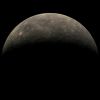
ZW-Mercury-PIA12365.jpgRising Mercury (Natural Colors; credits: NASA and Lunexit)74 visiteAs MESSENGER approached Mercury for the mission's 3rd and final flyby of the Solar System's innermost planet, the WAC acquired images through all 11 of its narrow-band color filters. The 1000, 700, and 430 nanometer filters were combined in red, green, and blue to create this color image, the last close-up color view that will be acquired until MESSENGER goes into orbit around Mercury in March of 2011. Only 6% of Mercury's Surface in this image had not been viewed previously by spacecraft, and most of the measurements made by MESSENGER's other instruments during this flyby were made prior to closest approach. The observations from MESSENGER's third flyby of Mercury nonetheless revealed fresh surprises. Check out the NASA Science Update Telecon held today for details about some of these new surprises.
Date Acquired: September 29, 2009
Instrument: Wide Angle Camera (WAC) of the Mercury Dual Imaging System (MDIS)
WAC Filter: 9, 1, 6 (1000, 700, and 430 nanometers)
Resolution: 5 Km/pixel (about 3 miles/pixel)
Scale: Mercury's diameter is approx. 4880 Km (about 3030 miles) MareKromium
|
|

ZZ-Mercury-Craters-Crater_Field-PIA13823-1.jpgSome Mercurian Surface Features explained (False Colors; credits: 74 visiteCaption NASA:"During MESSENGER's second Fly-By of Mercury, MDIS acquired a strip of HR images obtained with each of the WAC's 11 different color filters. The graphic shown here displays the resulting enhanced-color mosaic and gives considerable detail about the images, how the mosaic was created and the Geologic Features that can be seen.
Currently, these images are the Highest-Resolution color images ever obtained of the Solar System's innermost Planet, but not for long! On March 18, 2011, MESSENGER will enter into orbit about Mercury and the mission's extensive, year-long science observation campaign will begin.
That campaign includes capturing color images of Mercury's Surface at higher resolution than ever before".MareKromium
|
|

ZZ-Mercury-Limb-PIA14250-PCF-LXTT-1.jpgCrescent Mercury (Natural Colors; credits for the additional process. and color.: Dr Paolo C. Fienga - Lunexit Team)74 visiteMercury forms a beautiful crescent shape in this image, acquired as the MESSENGER Spacecraft was high above Mercury's Southern Hemisphere. On the left side is the Terminator, dividing the day from night. On the right side is the sunlit Limb, separating Mercury from the darkness of (the Inner) Space.
This image was acquired as part of MDIS's limb imaging campaign. Once per week, MDIS captures images of Mercury's Limb, with an emphasis on imaging the Southern Hemisphere Limb. These Limb images provide information about Mercury's shape and complement measurements of topography made by the Mercury Laser Altimeter (MLA) of Mercury's Northern Hemisphere.
On March 17, 2011 (March 18, 2011, UTC), MESSENGER became the first Spacecraft ever to orbit the planet Mercury. The mission is currently in its commissioning phase, during which Spacecraft and instrument performance are verified through a series of specially designed checkout activities. In the course of the one-year primary mission, the Spacecraft's 7 scientific instruments and radio science investigation will unravel the history and evolution of the Solar System's innermost Planet.
Date acquired: May, 24th, 2011
Image Mission Elapsed Time (MET): 214697006
Image ID: 290397
Instrument: Wide Angle Camera (WAC) of the Mercury Dual Imaging System (MDIS)
WAC filter: 7 (748 nanometers)
Center Latitude: 53,01° South
Center Longitude: 116,7° East
Resolution: 2827 meters/pixel
Scale: Mercury's radius is about 2440 Km (approx. 1520 miles)MareKromium
|
|

ZZ-Mercury-Craters-Rachmaninoff_Crater-PIA16399-PCF-LXTT-IPF.jpgFeatures of Rachmaninoff Cratrer (Absolute Natural Colors; credits for the additional process. and color.: Dr Paolo C. Fienga/Lunar Explorer Italia/Italian Planetary Foundation)74 visiteRachmaninoff is a spectacular Double-Ring Impact Basin on Mercury, and this Absolute Natural Color view of it, is one of the highest resolution color image sets acquired of the Basin's Floor. Visible around the edges of the frame is a circle of Mountains that make up Rachmaninoff's Peak-Ring Structure, which surrounds concentric Troughs located on the on the Basin Floor. The color of the Basin's Floor inside the Peak-Ring differs from the darker material outside of it, as can also be seen in other images of this Feature.
Date acquired: July 31, 2012
Image Mission Elapsed Time (MET): 252265403, 252265399, 252265395
Image ID: 2305612, 2305611, 2305610
Instrument: Wide Angle Camera (WAC) of the Mercury Dual Imaging System (MDIS)
WAC filters: 9, 7, 6 (996, 748, 433 nanometers) in red, green, and blue
Center Latitude: 27,64° North
Center Longitude: 57,58° East
Resolution: 149 meters/pixel
Scale: Rachmaninoff's Inner Ring is approximately 140 Km (about 87 miles) in diameter
Solar Incidence Angle: 39,7° (meaning that the Sun was about 50,3° above the imaged Local Horizon at the time that the picture was taken)
Emission Angle: 19,2°
Sun-Mercury-MESSENGER (or "Phase") Angle: 59,0°MareKromium
|
|

ZZ-Mercury-Craters-Theophanes_Crater-PIA16868-PCF-LXTT-IPF.jpgTheophanes Crater (Absolute Natural Colors; credits for the additional process. and color.: Dr Paolo C. Fienga/Lunar Explorer Italia/Italian Planetary Foundation)74 visiteThis image, taken by the NASA - MESSENGER Spacecraft in the early October 2012, shows the ancient Mercurian Impact Crater Theophanes (whose diameter is approx. 46 Km - such as a little more than 28,5 miles), which was originally imaged by the NASA - Mariner 10 Spacecraft.
This Impact Crater was named after the Byzantine iconographer known as "Theophanes the Greek". Though he was born in Constantinople, the Capitol of the Byzantine Empire, around the AD 1340, Theophanes spent most of his life in Russia, where he moved in the AD 1370, and it was right there that he gained notoriety as an icon painter. Some of his more prominent works include Our Lady of the Don and the Transfiguration of Christ. He is also known as the teacher and mentor of the great medieval Russian painter Andrei Rublev, the eponym of another Impact Crater located in the Southern Hemisphere of Mercury.
As you can se, the Hollows which characterize Thophanes Crater are all concentrated in a relatively flat area going from the North-East of Theophanes' Complex Central Uplift, until its upper margin (---> Inner Rim), but only in that portion of its Floor that is located in between (approx.) 1 to 2 o'clock. The reason of such a peculiar configuration of Theophanes' Hollows is (obviuosly) so far unknown, even though we, as IPF, have a theory about it, which we shall try to explain in the future.
Date acquired: October, 3rd, 2012
Image Mission Elapsed Time (MET): 257735204
Image ID: 2694715
Instrument: Narrow Angle Camera (NAC) of the Mercury Dual Imaging System (MDIS)
Center Latitude: 5,04° South
Center Longitude: 217,2° East
Resolution: 74 meters/pixel
Solar Incidence Angle: 69,3° (meaning that the Sun, at the time that the pictures were taken, was about 20,7° above the imaged Local Mercurian Horizon)
Emission Angle: 2,2°
Sun-Mercury-Messenger (or "Phase") Angle: 71,6°
This picture (which is an Original NASA - MESSENGER Spacecraft b/w frame published on the NASA - Planetary Photojournal with the ID n. PIA 16868) has been additionally processed and then colorized in Absolute Natural Colors (such as the colors that a human eye would actually perceive if someone were onboard the NASA - MESSENGER Spacecraft and then looked down, towards the Surface of Mercury), by using an original technique created - and, in time, dramatically improved - by the Lunar Explorer Italia Team. Different colors, as well as different shades of the same color, mean, among other things, the existence of different Elements (Minerals) present on the Surface of Mercury, each having a different Albedo (---> Reflectivity) and Chemical Composition.MareKromium
|
|

ZZ-Mercury-Craters-Waters_Crater-PIA15389-PCF-LXTT-IPF.jpgWaters Crater, in context (Possible Absolute Natural Colors; credits for the additional process. and color.: Dr Paolo C. Fienga/Lunar Explorer Italia/Italian Planetary Foundation)74 visiteIn this High Resolution Image-Mosaic, obtained by putting together three frames taken by the NASA - MESSENGER Spacecraft on May, 16, 2011, we can see, once again, the approx. 15-Km (such as about 9,315 miles) diameter Impact Crater named Waters that, as you can easily understand just by looking at the picture, should be relatively young, as indicated by the Bright Rays that cross the neighboring (---> meaning located in its proximities) Surface Features. As we have already drawn to your attention in the past, an unusually-looking "Tongue-like Feature", most likely made of Impact Melt - and which shows a very dark gray color, when compared to the nearby Mercurian Surface - appears to have flowed out of the Crater itself, most likely at the time of - or just right after - its formation.
Date acquired: May, 16th, 2011
Images Mission Elapsed Time (MET): 214069807, 214069811, 214069815
Images ID: 261719, 261720, 261721
Instrument: Wide Angle Camera (WAC) of the Mercury Dual Imaging System (MDIS)
Center Latitude: 8,82° South
Center Longitude: 254,90° East
Solar Incidence Angle: 41,8° (meaning that the Sun, at the time that the picture was taken, was about 48,2° above the imaged Local Mercurian Horizon)
Emission Angle: 25,6°
Sun-Mercury-Messenger (or "Phase") Angle: 67,4°
This picture (which is an Original NASA - MESSENGER Spacecraft's false colors and Map-Projected image-mosaic published on the NASA - Planetary Photojournal with the ID n. PIA 15389) has been additionally processed, contrast enhanced, Gamma corrected, magnified to aid the visibility of the details and then re-colorized in Absolute Natural Colors (such as the colors that a human eye would actually perceive if someone were onboard the NASA - MESSENGER Spacecraft and then looked outside, towards the Surface of Mercury), by using an original technique created - and, in time, dramatically improved - by the Lunar Explorer Italia Team. Different colors, as well as different shades of the same color, mean, among other things, the existence of different Elements (Minerals) present on the Surface of Mercury, each having a different Albedo (---> Reflectivity) and Chemical Composition.
MareKromium
|
|

B-Mercury-PIA02424.jpgA VERY LARGE crater on Mercury73 visiteCaption NASA originale:"This image (FDS 166), acquired during the spacecraft's first encounter with Mercury, features a 140 Km diameter crater and it's surrounding zone of secondary craters. The narrow width of the rim facies, the prominent subradial secondary crater chains and grooves are representative of the larger mercurian craters".
|
|

ZZ-Mercury-Craters-Xiao_Zhao_Crater-PIA10668.jpgXiao Zhao's Rays paint Mercury's Surface73 visiteRecently named after the 12th century Chinese artist, Xiao Zhao crater on the central left side of this image is small in comparison with many other craters on Mercury and even with many other craters in this scene. However, Xiao Zhao's long bright rays make it a readily visible feature. The fresh, bright rays, which were created by material ejected outward during the impact event that formed the crater, indicate that Xiao Zhao is a relatively young crater on Mercury's surface.
Date Acquired: January 14, 2008
Image Mission Elapsed Time (MET): 108828473
Instrument: Narrow Angle Camera (NAC) of the Mercury Dual Imaging System (MDIS)
Resolution: 500 meter/pixel (0.3 miles/pixel)
Scale: Xiao Zhao crater is 23 kilometers (14 miles) in diameter
Spacecraft Altitude: 19,760 kilometers (12,280 miles)
MareKromium
|
|
| 248 immagini su 21 pagina(e) |
|
|
|
|
|
14 | |
|
|
|
|
|
|





