| |

| Piú viste - Mercury |
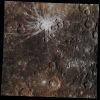
ZZ-Mercury-Craters-Mena_and_Cezanne_Crater-PIA16341-PCF-LXTT-IPF.jpgMena and Cezanne Crater (Absolute Natural Colors; credits for the additional process. and color.: Dr Paolo C. Fienga/Lunar Explorer Italia/Italian Planetary Foundation)87 visiteIn this Image-Mosaic, the Bright Rays of Mena Crater and the distinctive color difference of Cezanne Crater (with the surrounding area) are well highlighted. These two distinctive Impact Features provide beautiful contrast to this Absolute Natural Color image, giving the viewer more insight into reflectance variations (---> Albedoes) on Mercury's Surface. Also note the extremely old, degraded and larger, infilled Unnamed Crater visible on the center right of the frame, which is crossed by at least three major Crater Chains.
Date acquired: June 04, 2012
Image Mission Elapsed Time (MET): 247336883, 247336875, 247336879
Image ID: 1955368, 1955366, 1955367
Instrument: Wide Angle Camera (WAC) of the Mercury Dual Imaging System (MDIS)
WAC filters: 9, 7, 6 (996, 748, 433 nanometers) in red, green, and blue
Center Latitude: 3,78° South
Center Longitude: 235,8° East
Resolution: 552 meters/pixel
Scale: Cezanne Crater, such as the Crater in the bottom center, is about 67 km (approx. 41 miles) in diameter.
Solar Incidence Angle: 55,6° (meaning that the Sun was about 34,4° above the imaged Local Horizon at the time the pictures were taken)
Emission Angle: 0,0° (meaning that the MESSENGER Spacecraft, at the time that the pictures were taken, was absolutely perpendicular to the Mercurian Surface visible in the center of the frame)
Sun-Mercury-MESSENGER (or "Phase") Angle: 55,6°MareKromium
|
|
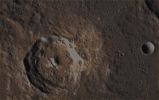
ZZ-Mercury-Craters-Unnamed_Crater-PIA17290-PCF-LXTT-IPF-1.jpgUnnamed and (relatively) Fresh Impact Crater (EDM - Absolute Natural Colors; credits for the additional process. and color.: Dr Paolo C. Fienga/Lunar Explorer Italia/Italian Planetary Foundation)87 visiteThis Absolute Natural Color Image-Mosaic shows us a bright (and, of course, relatively speaking, "fresh") Complex Mercurian Impact Crater - approx. 33 Km (such as about 20,49 miles) in diameter - that exhibits Terraced and Multi-Layered Inner Walls and Slopes - with some Collapse Feature (Mass-Wasting?) here and there -, an also quite Complex Central Peaks' System and, last but not least, the (more than just) possible evidence of a large Pyroclastic Deposit located on it's Eastern Side (---> Dx of the Crater for the Observer), and mostly concentrated in the Region going from about 1 to 4 o'clock of its Outer Surroundings.
Date acquired: November, 6th, 2011
Images Mission Elapsed Time (MET): 229105596, 229105592, 229105588
Images ID: 980566, 980565, 980564
Instrument: Wide Angle Camera (WAC) of the Mercury Dual Imaging System (MDIS)
Center Latitude: 25,42° North
Center Longitude: 266,80° East
Solar Incidence Angle: 52,3° (meaning that the Sun, at the time that the picture was taken, was about 37,7° above the imaged Local Mercurian Horizon)
Emission Angle: 16,8°
Sun-Mercury-Messenger (or "Phase") Angle: 69,1°
This picture (which is a crop from an Original NASA - MESSENGER Spacecraft's false colors Map-Projected image-mosaic published on the NASA - Planetary Photojournal with the ID n. PIA 17290) has been additionally processed, contrast enhanced, magnified and then re-colorized in Absolute Natural Colors (such as the colors that a human eye would actually perceive if someone were onboard the NASA - MESSENGER Spacecraft and then looked down, towards the Surface of Mercury), by using an original technique created - and, in time, dramatically improved - by the Lunar Explorer Italia Team. Different colors, as well as different shades of the same color, mean, among other things, the existence of different Elements (Minerals) present on the Surface of Mercury, each having a different Albedo (---> Reflectivity) and Chemical Composition.MareKromium
|
|

ZZ-Mercury-Craters-Machaut_Crater-CN0131770808M_web.pngMachaut Crater (natural colors; credits: Lunexit)86 visiteDate Acquired: October 6, 2008
Image Mission Elapsed Time (MET): 131770808
Instrument: Narrow Angle Camera (NAC) of the Mercury Dual Imaging System (MDIS)
Resolution: 100 meters/pixel (0,06 miles/pixel)
Scale: This image is about 100 Km across (approx. 60 miles)
Spacecraft Altitude: about 3900 Km (approx. 2400 miles)
Of Interest: Machaut is the name of a crater, approx. 106 Km (about 66 miles) in diameter, first seen under high-Sun conditions by Mariner 10 in the 1970s. The crater is named for the medieval French composer and poet Guillaume de Machaut.
This NAC image shows an amazing new view of Machaut taken during MESSENGER’s second flyby of Mercury. The slanting rays of the Sun cast shadows that reveal numerous small craters and intricate features.
The largest crater within Machaut appears to have been inundated by lava flows similar to those that have filled most of the floor of the larger feature. The adjacent, slightly smaller crater was formed at a later time and excavated material below the lava-formed surface.
MESSENGER science team members will also be studying the shallow ridges that crisscross Machaut’s floor.MareKromium
|
|

ZZ-Mercury-Craters-Tiziano_Vecellio_Crater-PIA11765-2.jpgTiziano Vecellio Crater (Natural Colors; credits: Lunar Explorer Italia)86 visitenessun commentoMareKromium
|
|

ZZ-Mercury-Volcanic_Features-Vents-PIA16627-PCF-LXTT-IPF.jpgVolcanic Vents near Caloris' Outer Edge - Credits for the additional process. and color.: Dr Paolo C. Fienga/Lunar Explorer Italia/Italian Planetary Foundation)85 visiteThis image highlights the velvety texture that surrounds several Volcanic Vents located near the Outer Rim of the huge Impact Basin known as "Caloris Basin", on Mercury. This (apparently) soft texture, like freshly fallen snow, is formed by the emplacement of tiny beads of Lava that were explosively erupted and then quenched and solidified just before they reached the Surface. This diffuse Deposit heavily blankets several Impact Craters and older Vents, while it becomes thinner as long as it goes farther away from the Source of the Eruption. A large amount of the typical Mercurian Surface Features known as "Hollows" is also very well visible on the Rims of a number of Unnamed (and relatively modest in size) Impact Craters. This whole scene is approx. 106 Km across.
Date acquired: November, 17th, 2012
Image Mission Elapsed Time (MET): 261627279
Image ID: 2971208
Instrument: Narrow Angle Camera (NAC) of the Mercury Dual Imaging System (MDIS)
Center Latitude: 22,03° North
Center Longitude: 146,4° East
Resolution: 54 meters/pixel
Solar Incidence Angle: 39,1° (meaning that the Sun, at the time that the pictures were taken, was about 50,9° above the imaged Local Mercurian Horizon)
Emission Angle: 61,4°
Sun-Mercury-Messenger (or "Phase") Angle: 90,9°
This picture (which is an Original NASA - MESSENGER Spacecraft b/w frame published on the NASA - Planetary Photojournal with the ID n. PIA 16627) has been additionally processed and then colorized in Absolute Natural Colors (such as the colors that a human eye would actually perceive if someone were onboard the NASA - MESSENGER Spacecraft and then looked down, towards the Surface of Mercury), by using an original technique created - and, in time, dramatically improved - by the Lunar Explorer Italia Team. Different colors, as well as different shades of the same color, mean, among other things, the existence of different Elements (Minerals) present on the Surface of Mercury, each having a different Albedo (---> Reflectivity) and Chemical Composition.MareKromium
|
|

Mercury from Mariner 10.jpgMercury close-up from Mariner 10 (2)83 visiteIl che vuol dire che le zone interne di quei crateri polari, che hanno le pareti esterne sufficientemente elevate, giacciono nel buio e nel gelo perpetuo: oltre i -210°C!
Circa la possibile origine del ghiaccio d'acqua, l'ipotesi più probabile è che esso sia stato "portato" su Mercurio, un poco alla volta, dalle meteore e dalle comete che hanno impattato il Pianeta.
Oppure può anche darsi che si tratti di vapore acqueo proveniente dall'interno stesso di Mercurio il quale, una volta giunto in superficie (forse a seguito di eventi sismici), si è istantaneamente congelato.
|
|

Hero Rupes-PIA02413.jpgHero Rupes83 visiteCaption NASA originale:"After passing Mercury the first time and making a trip around the Sun, Mariner 10 again flew by Mercury on September 21 at 1:59 PMPDT. This encounter brought the spacecraft in front of Mercury in the southern hemisphere.
Hero Rupes, the large scarp visible running across the bottom of the image, is thought to thought to have been formed by global tectonic forces, possibly due to shrinkage of the planet as it cooled. Mariner 10 was looking obliquely across Mercury's southern hemisphere when it acquired this dramatic shot near the beginning of its southern hemisphere pass (FDS166618)".
|
|

ZZ-Mercury-Craters-DeGas-PCF-LXTT.jpgBright-white Deposits inside Degas Crater (Absolute Natural Colors; credits for the additional process. and color: Dr Paolo C. Fienga - Lunexit Team)83 visitenessun commentoMareKromium
|
|

ZZ-Mercury-Limb-PIA16429-PCF-LXTT-IPF.jpgMercurian Horizon (Absolute Natural Colors; credits for the additional process. and color.: Dr Paolo C. Fienga/Lunar Explorer Italia/Italian Planetary Foundation)83 visiteImages of Mercury's Limb provide information about the shape and topography of Mercury, but they also provide a sense of what it would be like to fly over the Innermost Planet, and to look out of the Spacecraft's window and toward the distant Horizon. See anywhere good to land?
Date acquired: July 24, 2012
Image Mission Elapsed Time (MET): 251598850
Image ID: 2258481
Instrument: Narrow Angle Camera (NAC) of the Mercury Dual Imaging System (MDIS)
Center Latitude: 18,25° South
Center Longitude: 353,70° East
Scale: the bottom of this scene is approximately 150 Km (about 93 miles) across, from left to right
Solar Incidence Angle: 58,6° (meaning that the Sun was about 31,4° above the imaged Local Horizon at the time the picture was taken)
Emission Angle: 80,0°
Sun-Mercury-MESSENGER (or "Phase") Angle: 138,6°MareKromium
|
|

ZZ-Mercury-Limb-PIA16820-PCF-LXTT-IPF.jpgSouthern Craters (Absolute Natural Colors; credits for the additional process. and color.: Dr Paolo C. Fienga - Lunar Explorer Italia/Italian Planetary Foundation)83 visiteThe set of 3 (three) frames shown here in Absolute Natural Colors and forming this image mosaic, was acquired by the NASA - MESSENGER Spacecraft as part of a sequence intended to monitor any changes in the calibration of the Multispectral Wide Angle Camera onboard the Spacecraft over time. However, the final result of this "calibration" also gives us a simply beautiful view of a wide portion (the whole scene is approx. 1900 Km - such as a little less of 1180 miles - across) of Mercury's heavily cratered Southern Hemisphere. Furthermore, the Impact Craters Magritte, Neruda, and Sher-Gil can be easily spotted within this scene. North is towards the top-left of the image.
Date acquired: December, 17th, 2012
Images Mission Elapsed Time (MET): 264237810, 264237814, 264237830
Images ID: 3157538, 3157539, 3157543
Instrument: Wide Angle Camera (WAC) of the Mercury Dual Imaging System (MDIS)
Center Latitude: 59,16° South
Center Longitude: 149,3° East
Resolution: 1663 meters/pixel
Solar Incidence Angle: 59,2° (meaning that the Sun, at the time that the pictures were taken, was about 30,8° above the imaged Local Mercurian Horizon)
Emission Angle: 28,8°
Sun-Mercury-Messenger (or "Phase") Angle: 78,1°
This picture (which is an Original NASA - MESSENGER Spacecraft color image mosaic published on the NASA - Planetary Photojournal with the ID n. PIA 16820) has been additionally processed and then re-colorized in Absolute Natural Colors (such as the colors that a human eye would actually perceive if someone were onboard the NASA - MESSENGER Spacecraft and then looked outside, towards the Surface of Mercury), by using an original technique created - and, in time, dramatically improved - by the Lunar Explorer Italia Team. Different colors, as well as different shades of the same color, mean, among other things, the existence of different Elements (Minerals) present on the Surface of Mercury, each having a different Albedo (---> Reflectivity) and Chemical Composition.MareKromium
|
|

ZZ-Mercury-Craters-Balanchine_Crater-PIA17057-PCF-LXTT-IPF-2.jpgBalanchine Crater (EDM - Absolute Natural Colors; credts for the additional process. and color.: Dr Paolo C. Fienga/Lunar Explorer Italia/Italian Planetary Foundation)83 visiteThe Impact Crater visible at the center of this scene (such as the one whose Floor is largely covered by extremely bright - and therefore, here, slightly over-exposed - Hollows) has been named "Balanchine", after the choreographer George Balanchine (Leningrad, 1904/New York City - NY - 1983). Now, if you carefully take a look at the Ejecta Blanket which emanates from Balanchine Crater, you may ask yourself what could have caused such an Asymmetric Pattern. Obviously, no one can give an absolutely definitive answer to this kind of question, as you should know, but a reasonable possibility is that the irregularly shaped Ejecta Pattern of Balanchine Crater formed (perhaps just in part) on top of a similarly sized, and pre-existing, Impact Crater.
In this scenario, the older Impact Crater could have unearthed the Lower Reflectance dark-gray Deposit (which, by the way, appear blue in the Original NASA false color image-mosaic) from beneath the Surface, while, some time (perhaps a few millions of years) afterwards, a certain portion of them was (unevenly) redistributed all over the Mercurian Surface by the impact that formed Balanchine.
Date acquired: June 29th, 2011
Images Mission Elapsed Time (MET): 217863931, 217863927, 217863923
Images ID: 441964, 441963, 441962
Instrument: Wide Angle Camera (WAC) of the Mercury Dual Imaging System (MDIS)
Center Latitude: 39,05° North
Center Longitude: 175,80° East
Resolution: 282 meters/pixel
Solar Incidence Angle: 39,6° (meaning that the Sun, at the time that the picture was taken, was about 50,4° above the imaged Local Mercurian Horizon)
Emission Angle: 6,3°
Sun-Mercury-Messenger (or "Phase") Angle: 40,9°
This picture (which is a crop taken from an Original NASA - MESSENGER Spacecraft Map Projected false color image-mosaic published on the NASA - Planetary Photojournal with the ID n. PIA 17057) has been additionally processed, contrast enhanced, magnified and then re-colorized in Absolute Natural Colors (such as the colors that a human eye would actually perceive if someone were onboard the NASA - MESSENGER Spacecraft and then looked down, towards the Surface of Mercury), by using an original technique created - and, in time, dramatically improved - by the Lunar Explorer Italia Team. Different colors, as well as different shades of the same color, mean, among other things, the existence of different Elements (Minerals) present on the Surface of Mercury, each having a different Albedo (---> Reflectivity) and Chemical Composition.MareKromium
|
|

ZZ-Mercury-Craters-Mena_Crater-PIA17786-PCF-LXTT-IPF-01.jpgMena Crater, in detail (Possible Absolute Natural Colors; credits for the additional process. and color.: Dr Paolo C. Fienga/Lunar Explorer Italia/Italian Planetary Foundation)83 visiteIn this simple, and yet very interesting picture, taken by the NASA - MESSENGER Spacecraft on November, 13, 2013, we can get a relatively close look at the fresh, Bright-Rayed Impact Crater known as Mena (note: due to the distance between the Spacecraft and the Mercurian Surface, the Bright Rays of Mena Crater can just be barely seen in this image).
As you may want to notice, solidified Impact Melt formed some kind of a "Heart-shaped" and smooth Pond that is mostly concentrated on the South/Western Side of the Crater Floor; the quite obvious (---> very clear, easy to see) asymmetry existing between the aforementioned South/Western Side of the Floor and some (actually, a large) portion of its North/Eastern one, is due to the fact that Mena Crater did not form on a Flat Surface, but on the Sloping Rim of a much older Impact Crater (as it will be better seen tomorrow's contextual APOD).
Date acquired: November, 13th, 2013
Image Mission Elapsed Time (MET): 26657614
Image ID: 5189176
Instrument: Narrow Angle Camera (NAC) of the Mercury Dual Imaging System (MDIS)
Center Latitude: 0,24° South
Center Longitude: 235,30° East
Solar Incidence Angle: 54,7° (meaning that the Sun, at the time that the picture was taken, was about 35,3° above the imaged Local Mercurian Horizon)
Emission Angle: 23,4°
Sun-Mercury-Messenger (or "Phase") Angle: 71,0°
This frame (which is an Original NASA - MESSENGER Spacecraft's b/w and NON Map-Projected image published on the NASA - Planetary Photojournal with the ID n. PIA 17786) has been additionally processed, contrast enhanced, magnified to aid the visibility of the details, Gamma corrected and then colorized in Absolute Natural Colors (such as the colors that a human eye would actually perceive if someone were onboard the NASA - MESSENGER Spacecraft and then looked down, towards the Western Edge of the Mercurian Impact Crater "Mena"), by using an original technique created - and, in time, dramatically improved - by the Lunar Explorer Italia Team. Different colors, as well as different shades of the same color, mean, among other things, the existence of different Elements (Minerals) present on the Surface of Mercury, each having a different Albedo (---> Reflectivity) and Chemical Composition.MareKromium
|
|
| 248 immagini su 21 pagina(e) |
|
|
|
|
|
10 | |
|
|
|
|
|
|





