| Piú viste - Artistic Views of the Solar System |

MARS8.jpgSunset on Mars136 visitenessun commento
|
|

mars-dust-devil-large-bg.jpgMartian Dust Devil135 visiteAh, Martian Summer! Finally, the days are long, just like on dear old Earth. And daytime highs rocket all the way up to a balmy 20°C (68°F) from the Summer nighttime low of -90°C (-130°F), meaning you and your fellow astronauts can warm up your machinery earlier to get a good start on mining operations.
But those warm daytime temperatures also bring alive the Martian devils. Dust devils, that is.
You were caught in one just yesterday - and a devilishly terrifying experience it was! This was no little Arizona desert whirlwind, only a few tens of meters high and a few meters across and past you in seconds.
No, what hit you yesterday was a monster column towering kilometers high and hundreds of meters wide, 10 times larger than any tornado on Earth. Red-brown sand and dust whipping around faster than 30 meters per second (70 miles per hour) dropped visibility to zero, scouring your faceplate, driving dust into every fold and wrinkle of your spacesuit.
For 15 minutes you huddled and endured the buffeting. The scariest part was the incessant crackling and flashing of miniature lightning bolts nipping at you and your rover, and the loud static on your radio that prevented you from calling for help.
Could this really happen?
|
|

000-0-Mars.jpgMeteor strike on Mars134 visiteMars may have lost much of its atmosphere during asteroid impacts early in its history.
The Beagle 2 lander will look for signatures of life on Mars, whether long-dead or still-living, by measuring the ratio of two different types of carbon in the rocks. Biological processes on Earth favour the lighter isotope of carbon, carbon-12, over the heavier carbon-13. Hence, a high carbon-12 to carbon-13 ratio is taken as evidence of life and has been found in rocks up to 4 billion years old, even where geological processing has occurred. The hope is that the same occurred on Mars.
|
|

Landing on Titan (3).jpgSaturn, through the fog of Titan133 visiteTitan's surface may hold lakes of liquid ethane and methane, sprinkled over a thin veneer of frozen methane and ammonia. Most of the brownish-orange color comes from more heavily processed hydrocarbons present in Titan's atmosphere and on its surface. Artistic license has been used to exaggerate the size of the orbiter, the sharpness of the icy features, the tilt of Saturn's rings, and the visibility of the planet through Titan's atmosphere.
|
|

Enceladus~2.jpgEnceladian Geysers131 visiteDa "NASA - Picture of the Day" dell'8 Giugno 2006:"In this stunning Saturnian vista - one in a series of artist's visions of volcanos on alien worlds - icy geysers erupt along narrow fractures in inner moon Enceladus. The majestic plumes were actually discovered by instruments on the Cassini Spacecraft during close encounters with bright and shiny Enceladus last year. Researchers now suspect the plumes originate from near-surface pockets of liquid water with temperatures near 273 kelvins (0° Celsius) - hot when compared to the distant moon's surface temperature of 73 kelvins (- 200° C). A dramatic sign that tiny, 500km-diameter Enceladus is surprisingly active, these ice volcanos hold out another potential site in the search for water and origin of life beyond planet Earth.
Enceladus' ice volcanos also likely produce Saturn's faint but extended E-Ring".
|
|

En route to Titan.jpgHuygens Probe: en route to Titan128 visiteThe Huygens Probe, after deploying from the Cassini Orbiter, en route into the murky atmosphere of Saturn's largest moon, Titan.
|
|
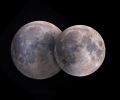
The_Moon-Super_and_Micro_Moon_Mukherjee_3000.jpgSuper and Micro Moon (Credits: Soumyadeep Mukherjee)127 visiteWhat is so micro about tonight's blue micromoon? Just after sunset, a full moon will appear slightly smaller and dimmer than usual. The reason is that the Moon's fully illuminated phase occurs within a short time of apogee - when the Moon is farthest from the Earth in its elliptical orbit. In fact, tonight's micromoon will be the farthest, smallest, and dimmest Moon this year. But tonight's micromoon is notable for yet another reason: it is also a blue moon, meaning that it is the second full moon in the same month (moon-th). Pictured here, a supermoon -- when the full moon appears near its largest -- is compared to a micromoon as photographed from Kolkata, India in May and December of 2021. Although the next micromoon occurs next month, and the next blue moon at the end of 2028, the next blue micromoon will not occur until 2053.MareKromium
|
|

MarsAtmosphere.jpgHow Mars lost its atmosphere...125 visitenessun commento
|
|

Landing on Titan (2).jpgLanding on Titan (2)123 visiteThe Huygens probe descends through Titan's murky, brownish-orange atmosphere of nitrogen and carbon-based molecules, beaming its findings to the distant Cassini orbiter. The probe is equipped with a variety of scientific sensors to measure the physical properties of the moon's atmosphere; it also carries an imaging device to return pictures of Titan's possibly hydrocarbon-lake-dotted surface.
|
|

ZZ-Pluto & Charon.jpgPluto & Charon123 visitenessun commento
|
|
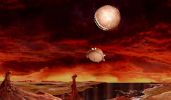
Landing on Titan.jpgLanding on Titan122 visiteBecause it's in a deep freeze state, Titan's atmosphere is thought to contain chemicals similar to those found on Earth's early days. Data from the Huygens probe combined with Cassini's measurements may offer clues about how life began on Earth.
|
|

Earth From Mars.jpgMy "Day", your "Night"121 visiteThough Earthlings will be able to get a good look at Mars during close approach, NASA's 2 Rovers on Mars will not be able to see Earth. That's because at the moment, Earth is on the daytime side of Mars. As shown in the top half of this artist's rendering, when it's nighttime on Earth, it's daytime on Mars. After Earth passes Mars, the Rovers will be able to see the sunlit side of Earth again just before dawn. The bottom half of this illustration shows what the Rovers would see if they looked toward Earth.
|
|
| 91 immagini su 8 pagina(e) |
 |
|
4 | |
|
|
|








