| Piú viste - Artistic Views of the Solar System |

Deep_Impact.pngDeep Impact157 visite"...così, anche per mezzo delle Equazioni di Riemann-Hake, alla fine si arrivò ad una dimostrazione matematica della Necessità (Teorica) dell'Area Spaziale di Deformazione Logica precognizzata da Twistermann. Quest'Area divenne nota, in seguito, come "Mondo Distorto", sebbene non fosse né distorto, né un vero e proprio mondo. E, suprema ironia, l'importantissimo Terzo Postulato di Twistermann (secondo il quale l'Area Spaziale di Deformazione Logica doveva essere considerata come quella regione dell'Universo agente come "contrappeso" di caos verso la Struttura Primaria e coerente della Realtà) venne ritenuto superfluo in sede di dimostrazione..."
Dalla voce "Mondo Distorto" - Enciclopedia Galattica del Sapere Universale, 483ma Edizione.MareKromium
|
|

Saturn from Titan - artistic view.jpgSaturn from Titan156 visitenessun commento
|
|

MARS1.jpgSunshine on Mars154 visitenessun commento
|
|

Asbolus.jpg8405 Asbolus151 visiteThis is an artist's impression of object called 8405 Asbolus: a 48-mile-wide (about 80 Km) chunk of ice and dust that lies between Saturn and Uranus. Astronomers using NASA's HST were surprised to find that one side of the object (also called a "Centaur") looks like it has a fresh crater less than 10 MY old, exposing bright underlying ice. Actually, Hubble didn't directly see the Crater - the object is too small and far away - but a measure of its Surface Composition shows a complex chemistry that could be explained by the presence of a huge Impact Crater. The event that caused the Impact Crater on 8405 Asbolus may be the same one that knocked it out of the Kuiper's Belt (which is a "Ring of Comet Nuclei" located just beyond Pluto's orbit).
|
|

Gusev Crater.jpgGusev Crater: an artistic interpretation150 visite"...The landing site and the Columbia Hills are within Gusev Crater, a bowl about 150 Km (about 95 miles) in diameter. It was selected for the Spirit mission because the shape of the terrain suggests the crater once held a lake. Volcanic deposits appear to have covered any sign of ancient lakebed geology out on the plain, but scientists say the hills expose older layers that have been lifted and tipped by a meteorite impact or other event...".
"Spirit has climbed to the hilltop and looked over the other side, but NASA did not do this just to say we can do it. The Mars rovers are addressing fundamental questions about Martian history and planetary environments," said NASA's Mars Exploration Program Director Doug McCuistion.
The crest of "Husband Hill" offers Spirit's views of possible routes into a basin to the south with apparently layered outcrops. Shortly after Spirit landed, it observed a cluster of seven hills about 3 kilometers (2 miles) east of its landing site. NASA proposed naming the range "Columbia Hills" in tribute to the last crew of Space Shuttle Columbia. The tallest of the hills commemorates Rick Husband, Columbia's commander.
|
|
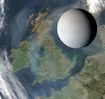
Enceladus-PIA07724.jpgEnceladus, Great Britain and Northern France147 visiteSaturn's moon Enceladus is only 505 Km (approx. 314 miles) across, small enough to fit within the length of the United Kingdom, as illustrated here. The intriguing icy moon also could fit comfortably within Arizona or Colorado.
|
|

Titan by day.jpgA beautiful day on Titan146 visitenessun commento
|
|

TitanandHuygens_968A4_L.jpgTitan, Huygens and Saturn in the sky143 visiteUna "visione" davvero bellissima di Titano: forse la migliore.
|
|

Volcanoes-Olympus_and_Clouds.jpgOlympus, in a Sea of Clouds (Painting by Gordon Legg, based on Viking Orbiter mosaic P17444. From NASA SP-444, 1980) 141 visiteThis painting, based on a mosaic of black-and-white Viking Orbiter images of Olympus Mons, shows the volcano's flanks and complex caldera protruding above thin clouds of water ice. MareKromium
|
|
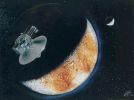
PLUTO&CHARON3.jpgPluto, Charon and New Horizons140 visitenessun commento
|
|

Quaoar.jpgQuaoar138 visitenessun commento
|
|

Planets in my mind-294.jpgPlanets in my mind...137 visiteIn questa immagine, un omaggio ai Pianeti che orbitano dentro di noi.
Pianeti dai colori fantastici ed affascinanti, popolati dai nostri sogni e dalle nostre paure; Pianeti che vivono nelle e delle nostre Fantasie.
Pianeti che non verranno mai scoperti nè battezzati da nessuno scienziato; Pianeti che non verranno mai visti da nessun telescopio (nè terrestre, nè spaziale).
Pianeti che non vedranno Sonde orbitargli attorno e sui quali non camminerà mai nessun astronauta.
Sono i Pianeti della nostra Mente, in una visione "frattale" dell'Amico ed Artista, Michael Wirtz.
(Gennaio 2005)
|
|
| 91 immagini su 8 pagina(e) |
 |
3 | |
|
|
|
|








