| Piú viste - Pluto and Charon: The "Double Planet" |
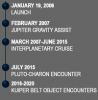
ZZ-ZZ-ZZ-ZZ-ZZ-ZZ-ZZ-ZZ-ZZ-ZZ-Timeline.jpgThe "Timeline" to Pluto...and beyond81 visiteLa schedula temporale (o "Timeline") che illustra il prossimo futuro della Sonda New Horizons, dal giorno della partenza, passando attraverso l'incontro con Giove (che le servirà da "Fionda Gravitazionale"), sino al passaggio ravvicinato con Plutone, nel Luglio 2015 e poi...L'immersione nella Fascia di Kuiper e l'incontro (probabile) con uno o due oggetti, tra il 2016 ed il 2020.
New Horizons, come tutte le Sonde destinate ad attraversare il Sistema Solare, sarà precisa e puntuale al suo appuntamento con la Storia: non ci sono dubbi.
Siatelo anche Voi!...
|
|

ZN-The Moons of Pluto.jpgNew "moons" for Pluto? Early news79 visiteDunque il Sistema (Binario) Plutone-Caronte starebbe per diventare (o forse è già ufficiosamente diventato) un Sistema Quaternario il quale fa, letteralmente, a pugni con le nostre stra-consolidate idee e speculazioni sull'origine e le caratteristiche di Plutone e dei piccoli Corpi Celesti trans-Nettuniani.
Un plauso al Sito "Multidimensione", sul quale abbiamo rintracciato la notizia in prima battuta, e complimenti allo "Chef" (che presumiamo essere il Web-Master).
|
|

ZZ-ZZ-ZZ-ZZ-20100727_LORRINeptune_lg.jpgOn the Way to Pluto: Neptune's on sight!79 visiteCaption NASA:"The New Horizons Long Range Reconnaissance Imager (LORRI) observed Neptune on June 23, 2010, as part of a test of the critical Optical Navigation Annual Checkout (ACO).
In this 100-millisecond exposure, taken when the Spacecraft was 23,2 Astronomical Units (about 2,15 Billion Miles) from Neptune, the Planet appears slightly larger than a star. At the time of this observation, the Solar Phase Angle was 34° and the Solar Elongation Angle (Planet-Spacecraft-Sun) was 95°.
Only New Horizons can observe Neptune at such large Solar Phase Angles, which can be used to study the light-scattering properties of Neptune's Atmosphere".MareKromium
|
|

ZZ-ZZ-ZZ-ZZ-20100727_LORRIM_lg.jpgOn the Way to Pluto: Messier 779 visiteCaption NASA:"The New Horizons team calibrates the Long Range Reconnaissance Imager (LORRI) by taking pictures of the Open Star Cluster Messier 7 (M 7). This is the first LORRI image of M 7 taken during Annual Checkout (ACO); the 100-millisecond manual exposure was taken on June 25, 2010. A preliminary comparison of this image to a 2008 LORRI picture of M7 indicated no degradation or change in LORRI's performance".MareKromium
|
|

ZZ-ZZ-ZZ-ZZ-ZZ-ZZ-ZZ-Pluto-PIA19937-PCF-LXTT-IPF.jpgSputnik Planum (Absolute Natural Colors; credits for the additional process. and color.: Dr Paolo C. Fienga - Lunexit Team) 78 visiteThis Synthetic Perspective view of Pluto, based on the latest High-Resolution images to be downlinked from the NASA - New Horizons Spacecraft, shows us what you would see if you were approximately 1100 miles (such as about 1770,284 Km) above Pluto's Equatorial Area, looking North/East - over the dark/orangish and heavily cratered Region informally named Cthulhu Regio - toward the bright, smooth, expanse of Icy Plains which have, for now, been informally called Sputnik Planum.
The entire expanse of Terrain seen in this image is roughly 1100 miles (such as about 1770,284 Km ) across. The images were taken as the NASA - New Horizons Spacecraft flew past Pluto on July 14, 2015, from a distance of about 50.000 miles (such as approx. 80.467 Km).
The image (which is an Original NASA - New Horizons Spacecraft's b/w and NON Map-Projected frame published on the NASA - Planetary Photojournal with the ID n. PIA 19937) has been additionally processed, magnified to aid the visibility of the details, contrast enhanced and sharpened, Gamma corrected and then colorized (according to an educated guess carried out by Dr Paolo C. Fienga-LXTT-IPF) in Absolute Natural Colors (such as the colors that a normal human eye would actually perceive if someone were onboard the NASA - New Horizons Spacecraft and then looked ahead, towards the Dwarf-Planet Pluto), by using an original technique created - and, in time, dramatically improved - by the Lunar Explorer Italia Team.MareKromium
|
|

ZZ-ZZ-ZZ-ZZ-ZZ-ZZ-ZZ-Pluto-PIA19947-PCF-LXTT-IPF.jpg15 Minutes after Pluto - Closer View (Absolute Natural Colors; credits for the additional process. and color.: Dr Paolo C. Fienga - Lunexit Team)74 visiteJust 15 minutes after its Closest Approach to Pluto - which occurred on July, 14, 2015 -, the NASA - New Horizons Spacecraft looked back toward the Sun and captured this simply beautiful Near-Sunset View of the rugged, Icy Mountains and flat Ice Plains extending all over around and to Pluto's Horizon and Terminator Line.
The smooth expanse of the Icy Plains which have (so far) been informally named Sputnik Planum (watch to the right - Dx - of the picture) is flanked to the West (left - Sx) by rugged Mountains that reach up an altitude of approx. 11.000 feet (such as, roughly, 3352,8 meters), including the (even in this case, so far) informally named Norgay Montes (visible in the foreground) and the Hillary Montes, visible on the Skyline (---> Outer Edge/Horizon of Pluto). To the right (Dx), such as to the East of Sputnik Planum, some rougher (---> highly irregular) Terrain is cut by - what they appear to be - Glaciers. Furthermore, the backlighting, highlights several Layers of Haze in Pluto's tenuous - but quite uniform and highly distended - Atmosphere.
This image was taken from a distance of about 11.000 miles (such as approx. 17.702,74 Km) from the Surface of Pluto; finally, the whole scene is roughly 230 miles (about 370,1482 Km) wide.
The image (which is an Original NASA - New Horizons Spacecraft's b/w and NON Map-Projected frame published on the NASA - Planetary Photojournal with the ID n. 19947) has been additionally processed, magnified to aid the visibility of the details, contrast enhanced and sharpened, Gamma corrected and then colorized (according to an educated guess carried out by Dr Paolo C. Fienga-LXTT-IPF) in Absolute Natural Colors (such as the colors that a normal human eye would actually perceive if someone were onboard the NASA - New Horizons Spacecraft and then looked outside, towards the Dwarf-Planet Pluto), by using an original technique created - and, in time, dramatically improved - by the Lunar Explorer Italia Team.MareKromium
|
|

ZB-T-Surface map of Pluto.jpgSurface Map of Pluto73 visiteQuando si parla del Sistema Plutone-Caronte in molti (anche noi...) parlano - a nostro avviso impropriamente - di "Sistema Binario", con ciò intendendo il fatto che i due corpi celesti in questione hanno dimensioni similari e si muovono ad una modesta (sempre in termini cosmici) distanza media l'uno dall'altro. In realtà il rapporto che lega Plutone a Caronte è comunque un rapporto di "maggiore" a "minore" o, se preferite, di "Parent Planet" a "moon" (o "satellite") e quindi parlare di Sistema Binario è errato.
Per Sistema Binario, infatti, si dovrebbe intendere un rapporto "alla pari" fra i 2 corpi il quale - prescindendo anche dalle loro effettive dimensioni - si fonda su un principio di "Equilibrio Gravitazionale" fra di essi. Un "equilibrio" in virtù del quale non c'è nè un Parent Planet, nè una moon, bensì 2 corpi celesti "connessi ma indipendenti", i quali si muovono armonicamente e sincronicamente l'uno rispetto all'altro secondo traiettorie definite dalle loro reciproche interazioni gravitazionali.
|
|

ZZ-New Horizon.jpgLet's go to Pluto!!!72 visiteDestination: Pluto. The New Horizons spacecraft roared off its launch pad at Cape Canaveral in Florida, USA, last week toward adventures in the distant Solar System. The craft is one of the fastest spaceships ever launched by humans, having passed the Moon only 9 hours (!) after launch and is on track to buzz Jupiter in early 2007.
Even traveling over 75.000 Km per hour, the New Horizons craft will not arrive at Pluto until 2015.
Pluto is the only remaining planet that has never been visited by a spacecraft or photographed up close. After Pluto, the robot spaceship will visit one or more Kuiper Belt Objects orbiting the Sun even further out than Pluto.
In the picture, the New Horizons craft launches into space atop a powerful Atlas V rocket.
|
|

ZZ-ZZ-ZZ-ZZ-ZZ-ZZ-ZZ-ZZ-Pluto_and_Charon-01-NewHorizons-1422.jpgSo close, and yet so far...72 visitenessun commentoMareKromium
|
|

ZYZ-Pluto_s System.2jpg.jpgThe "colors" and a Schematic of Pluto's System71 visiteThe new HST/ACS observations made on March 2nd reveal that all three of Pluto's satellites are neutrally colored, unlike reddish Pluto itself. Pluto's reddish color is believed to be due to reddening agents created by the effects of sunlight acting on its Nitrogen and Methane surface ices. Charon's surface is known to consist primarily of water ice; the similar color of P1 and P2 may indicate they too have water ice surfaces.
The color similarity of Pluto's two small satellites to one another and to Charon is consistent with their all having been born as a result of a single giant impact, as previously indicated by their orbits and Charon's large mass.
|
|

ZZ-ZZ-ZZ-ZZ-ZZ-ZZ-Z-Pluto-Map.jpgA few names for the Main Features of Pluto70 visiteEcco i nomi di alcune delle aree e Regioni di maggior interesse di Plutone. Su molte, devo dire che la scelta é stata felice. Su qualcuna.... Beh, decidete Voi.
Alcyonia Lacus, a possible frozen Nitrogen Lake on Pluto's Surface, is named for the bottomless lake in or in the vicinity of Lerna, a region of Greece known for springs and swamps; the Alcyonian lake was one of the entrances to the underworld in Greek mythology.
Elcano Montes is a mountain range honoring Juan Sebastián Elcano (1476–1526), the Spanish explorer who in 1522 completed the first circumnavigation of the Earth (a voyage started in 1519 by Magellan).
Hunahpu Valles is a system of canyons named for one of the Hero Twins in Mayan mythology, who defeated the lords of the underworld in a ball game.
Khare crater honors planetary scientist Bishun Khare (1933–2013), an expert on the chemistry of planetary atmospheres who did laboratory work leading to several seminal papers on tholins – the organic molecules that probably account for the darkest and reddest regions on Pluto.
Kiladze crater honors Rolan Kiladze (1931–2010), the Georgian (Caucasus) astronomer who made pioneering early investigations the dynamics, astrometry and photometry of Pluto.
Lowell Regio is a large region honoring Percival Lowell (1855–1916), the American astronomer who founded Lowell Observatory and organized a systematic search for a planet beyond Neptune.
Mwindo Fossae is a network of long, narrow depressions named for the Nyanga (Eastern Dem. Rep. Congo/Zaire) epic hero who traveled to the Underworld and after returning home became a wise and powerful king.
Piccard Mons is Mountain and suspected Cryo-Volcano that honors Auguste Piccard (1884–1962), a 20th century inventor and physicist best known for his pioneering balloon flights into Earth's Upper Atmosphere.
Pigafetta Montes honors Antonio Pigafetta (c. 1491–c. 1531), the Italian scholar and explorer who chronicled the discoveries made during the first circumnavigation of the Earth, aboard Magellan's ships.
Piri Rupes is a long cliff honoring Ahmed Muhiddin Piri (c. 1470–1553), also known as Piri Reis, an Ottoman navigator and cartographer known for his world map. He also drew some of the earliest existing maps of North and Central America.
Simonelli Crater honors astronomer Damon Simonelli (1959–2004), whose wide-ranging research included the formation history of Pluto.
Wright Mons honors the Wright brothers, Orville (1871–1948) and Wilbur (1867–1912), American aviation pioneers credited with building and flying the world's first successful airplane.
Vega Terra is a large land mass named for the Soviet Vega 1 and 2 missions, the first Spacecraft to fly balloons on another planet (Venus) and to image the Nucleus of a Comet (1P/Halley).
Venera Terra is named for the Venera missions sent to Venus by the Soviet Union from 1961–1984; they included the first human-made device to enter the Atmosphere of another Planet, to make a soft landing over there and to return images from an alien planetary surface.MareKromium
|
|

ZZ-ZZ-ZZ-ZZ-ZZ-ZZ-ZZ-ZZ-ZZ-Pluto-PIA21863.jpgFlying over Pluto...70 visiteNote: the topographic reliefs visible here have been exaggerated by a factor of 2 to 3 to emphasize topography; the Surface colors have also been enhanced to bring out detail. Digital mapping and rendering were performed by Paul Schenk and John Blackwell of the Lunar and Planetary Institute in Houston".
MareKromium
|
|
| 76 immagini su 7 pagina(e) |
 |
3 | |
|
|
|





