| Piú viste - Pluto and Charon: The "Double Planet" |

PLUTO.jpgPluto in "true color"220 visiteOvviamente non sappiamo molto di Plutone, ma le più recenti scoperte parlano di vasti depositi di acqua ghiacciata sulla sua superficie. Sappiamo pure che Plutone possiede un'atmosfera (composta da azoto, metano ed altri gas in misura minore) oltremodo sottile la quale, inevitabilmente, "ghiaccia" all'afelio del Pianeta (afelio--->il punto più lontano dal Sole).
Il lancio della Sonda New Horizons è stato concepito secondo tempistiche le quali dovrebbero portarla a ridosso di Plutone prima che la sua atmosfera ghiacci totalmente e quindi permetterci di studiarla (un minimo) ed analizzarne le componenti.
Facts-bites about Pluto&Charon:
Pluto orbits the Sun once every 248 years.
A person on Pluto would weigh 1/15 what they weigh on Earth - for comparison, the astronauts on the Moon had 1/6 of their Earth weight.
Pluto is named after the Greek god of the underworld.
The symbol for Pluto ("PL") is tribute to Percival Lowell, who started the search for the ninth planet in the early 1900s.
Charon is 20 times closer to Pluto than our moon is to Earth.
Pluto was discovered in 1930 by American astronomer Clyde Tombaugh.
American astronomers James Christy and Robert Harrington discovered Charon in 1978.
Charon is named after the mythological boatman who ferried souls across the river Styx to Pluto for judgment.
At 1,470 miles (about 2,370 kilometers) across, Pluto could fit between Washington, D.C. and Denver, Colorado.
Charon is half of Pluto's diameter - making it the largest satellite relative to the planet it orbits.
Pluto is an ice dwarf - a "new" type of planet common to the deep outer solar system.
Pluto-Charon is the solar system's only known binary planet.
Pluto's surface is among the most contrasty in the solar system.
Pluto has weather, winds, hazes, chemistry and an ionosphere.
Pluto's estimated surface temperature falls between --378 to --396 degrees F (-228 to -238 C).
Pluto is one of only two planets that rotates on its side - Uranus is the other.
Pluto's surface has nitrogen, methane and carbon monoxide ices on it.
A radio signal moving at the speed of light takes about 4 hours to reach Pluto from Earth.
The Kuiper Belt is a collection of icy, rocky objects residing beyond Neptune's orbit.
The first Kuiper Belt Object was discovered in 1992.
Some Kuiper Belt Objects (like Pluto) have an average reddish color, while others are gray.
|
|

ZZ-ZZ-ZZ-ZZ-ZZ-ZZ-Nix-O.jpgCrescent Nix160 visitenessun commentoMareKromium
|
|
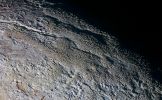
ZZ-ZZ-ZZ-ZZ-ZZ-ZZ-Pluto03-Tartarus_Dorsa.pngTartarus Dorsa159 visiteDa notare la stranissima (apparentemente) Texture e la direzionalità di questa imponente Catena Montuosa Plutoniana. Davvero suggestiva...MareKromium
|
|

A - Pluto and Charon - HST.jpgPluto and Charon from the Hubble Space Telescope132 visiteAggiornamento del 19 Agosto 2006: il Sistema "Plutone-Caronte", sino a ieri considerato un sistema equiparabile a quello Terra-Luna (in cui Plutone, al pari della Terra, è il Corpo Maggiore e Caronte, invece ed al pari della Luna, quello minore e dunque SOLO Satellite del primo), in accordo ad una decisione dell'International Astronomical Union (IAO) è stato ora rubricato come "Doppio Pianeta".
Caption IAU originale:"Both Pluto and Charon each are large enough (massive enough) to be spherical. Both bodies independently satisfy the definition of “planet”. The reason they are called a “double planet” is that their common centre of gravity is a point that is located in free space outside the surface of Pluto. Because both conditions are met: each body is “planet-like” and each body orbits around a point in free space that is not inside one of them, the system qualifies to be called a “Double Planet”.
|
|
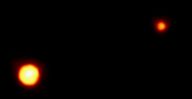
PLUTO&CHARON.jpgPluto & Charon (1) from the Hubble Space Telescope129 visitePluto Statistics: discovered by Clyde W. Tombaugh on February, 18, 1930.
Mass (Kg): 1.27e+22
Mass (if Earth = 1): 2,125e-03
Equatorial radius (Km): 1,137
Equatorial radius (if Earth = 1): 0,1783
Mean density (gm/cm^3): 2,05
Mean distance from the Sun (Km): 5.913.520.000
Mean distance from the Sun (if Earth = 1): 39,5294
Rotational period (in days): 6,3872
Orbital period (in years): 248,54
Mean orbital velocity (Km/sec): 4,74
Orbital eccentricity: 0,2482
Tilt of axis (in degrees): 122,52°
Orbital inclination (in degrees): 17,148°
Equatorial surface gravity (in mt/sec^2): 0,4
Equatorial escape velocity (in Km/sec):1,2
Visual geometric albedo: 0,3
Magnitude (Vo): 15,12
Atmospheric composition: Methane and Nitrogen
Una delle poche immagini in nostro possesso che rappresentano il Sistema (Binario) Plutone-Caronte.
Posto ad una distanza pari a circa 40 volte la distanza Terra/Sole, Plutone (un mondo gelido - si pensa che la temperatura media al suolo sia intorno ai - 233° C - ed eternamente immerso nella notte) si trova ai confini del Sistema Solare, a ridosso della cd "Fascia di Kuiper".
Per lo studio di questo affascinante Sistema e per "spiare" ciò che si trova oltre i suoi confini, è stata progettata la Sonda "New Horizons" la quale dovrebbe partire nel 2006 e raggiungerlo nel Luglio 2015, se tutto andrà bene.
|
|

PLUTO&CHARON2.jpgPluto & Charon (2) from the European Southern Obs.127 visiteLa Sonda, a quel punto, "sfiorerà" Plutone (passandogli a circa 9600 Km di distanza) e Caronte (transito previsto a circa 27.000 Km), prima di dirigersi (e perdersi...) nella Fascia di Kuiper, alla ricerca sia di oggetti oscuri - che, con non grandissima fantasia, sono stati chiamati "KBO", ovvero Kuiper's Belt Objects (o anche "TNO", e cioè Trans Neptunian Objects) -, sia di risposte a tutti quei quesiti che ogni Scienziato, ogni volta che guarda il Cielo, non può non porsi.
|
|

ZZ-ZZ-ZZ-ZZ-ZZ-ZZ-Nix.jpgFeatures of Nix121 visiteUna piccola ed affascinante luna del Sistema Plutoniano: Nix. Da notare come il cambiamento di filtro e l'esaltazione dei contrasti ci portano da una visione sostanzialmente "piatta" ad una oltremodo dettagliata e densa di punti di interesse. Per esempio: il dettaglio in basso a Dx, direi ad ore 04:30 circa, secondo Voi, di che cosa potrebbe essere rappresentativo?
Un Cratere da Impatto? Ne dubito.
Una "voragine" apertasi a causa di influssi mareali? Non ne ho idea.
Ma non posso non notare le somiglianze fra questo piccolissimo Corpo Celeste ed una altrettanto piccola luna di Urano. Indovinate quale...MareKromium
|
|

ZZ-ZZ-ZZ-ZZ-ZZ-20110401_0515.jpgWhere's New Horizons? April 2011 (1) - Current Position (beyond Uranus' Orbit)119 visiteThis image shows New Horizons' "Current Position". The green segment of the line shows where New Horizons has traveled since launch; the red indicates the Spacecraft's path toward Jupiter, Pluto and beyond. Positions of stars with magnitude 12 or brighter are shown from this perspective, which is above the Sun and "north" of Earth's orbit.
Notes: what Is an AU? The graphics on these pages note New Horizons' distance from Earth, Jupiter and Pluto in AU, or Astronomical Units. One AU is the average distance between the Sun and Earth, such as about 93 Million Miles (MMs) or 149,6 Million Kilometers (MKM).
Heliocentric Velocity. The Current Position graphic also notes the Spacecraft's "Heliocentric Velocity" - such as its speed with respect to the Sun - in Kilometers per second (Km/sec). One Km/sec is equivalent to 0,62 miles per second (Mi/sec), or 2237 miles per hour (mph).
New Horizons crossed the orbit of Uranus at approximately 18:00 EDT on March 18, 2011, with the Spacecraft more than 1,8 Billion Miles (nearly 2,9 Billion Kilometers) from Earth. Uranus was 2,4 BMs (3,8 BKM) from New Horizons at the time and the Spacecraft was cruising in "Electronic Sleep Mode".MareKromium
|
|

ZZ-ZZ-ZZ-ZZ-ZZ-Nhsv-20110401_0515.jpgWhere's New Horizons? April 2011 (3) - Full Trajectory - Side View 114 visiteAlso this image shows New Horizons' Current Position along its full planned trajectory. The green segment of the line shows where New Horizons has traveled since launch; the red indicates the Spacecraft's future path. Positions of stars with magnitude 12 or brighter are shown from this perspective, which is slightly above the Orbital Plane of the Planets. MareKromium
|
|

Pluto.jpgPluto & Charon (Ground View + HST View)113 visiteA dire il vero, il rischio maggiore per New Horizons (più dei rischi di un viaggio di quasi 6 miliardi di Km) è che i fondi necessari al suo lancio non vengano raccolti in tempo per soddisfare la citata "finestra di lancio". Inoltre, ad essere onesti, siamo rimasti molto sorpresi dai tempi stimati per il raggiungimento di Giove (poco più di un anno) e quindi di Plutone.
Nuovi sistemi di propulsione, finestra di lancio (ultra) ottimale - con possibilità di effettuare qualche "swing" attorno ad altri Pianeti durante il viaggio e dunque accelerare), nostro errore di valutazione o informazioni eccessivamente ottimistiche?
Vedremo!...
|
|

ZZ-ZZ-ZZ-ZZ-ZZ-Nhov20110401_0515.jpgWhere's New Horizons? April 2011 (2) - Full Trajectory: Overhead View 112 visiteThis image shows New Horizons' Current Position along its full planned trajectory. The green segment of the line shows where New Horizons has traveled since launch; the red indicates the Spacecraft's future path. Positions of stars with magnitude 12 or brighter are shown from this perspective, which is above the Sun and "north" of Earth's orbit.MareKromium
|
|

ZZ-ZZ-ZZ-ZZ-ZZ-ZZ-ZZ-ZZ-Pluto-nh_01_stern_05_pluto_hazenew-PCF-LXTT-IPF-0.jpgFarewell to Pluto - Part I (Absolute Natural Colors; credits for the additional process. and color.: Dr Paolo C. Fienga/Lunar Explorer Italia/Italian Planetary Foundation)110 visiteEven though it is (just slightly) unevenly backlit by the Sun, Pluto’s Atmosphere shows its "foggy" silhouette like a Luminous Halo in this beautiful image taken by the NASA - New Horizons Spacecraft around midnight (EDT) on July, 15, 2015.
This global portrait of the Plutonian Atmosphere was captured when the NASA - New Horizons Spacecraft was already about 1,25 Million Miles (such as approx. 2.011.675 Million KiloMeters) away from Pluto, and it shows us Atmospherical Structures (quite similar, in our opinion, as IPF, to the ones visible all around the Saturnian moon Titan) as small as roughly 12 miles (approx. 19,312 Km) across. The image, which has been received on Earth on July, 23, 2015, is displayed with the North Pole of Pluto at the top of the frame.
The image (which is an Original NASA - New Horizons Spacecraft's b/w and NON Map-Projected frame published on the NASA - Mew Horizons Page of July, 24, 2015 and with the ID n. nh_01_stern_05_pluto_hazenew) has been additionally processed, magnified to aid the visibility of the details, contrast enhanced and sharpened, Gamma corrected and then colorized (according to an educated guess carried out by Dr Paolo C. Fienga-LXTT-IPF) in Absolute Natural Colors (such as the colors that a normal human eye would actually perceive if someone were onboard the NASA - New Horizons Spacecraft and then looked ahead, towards the Dwarf-Planet Pluto), by using an original technique created - and, in time, dramatically improved - by the Lunar Explorer Italia Team.MareKromium
|
|
| 76 immagini su 7 pagina(e) |
1 |
 |
|
|
|
|





