| Piú viste - Neptune and His Moons |

Triton-PEI.jpgMoments of Triton...64 visiteThis set of images shows the best views of Neptune's moon Triton taken by Voyager 2 as the spacecraft withdrew from the Neptune system on August 25, 1989. The top four images were constructed from various color image bands as Voyager receded from Triton.
The third image from the left is sharper than the other four, because it was taken with the Narrow Angle Camera, with Triton filling two thirds of the frame. The thin crescent first image, while much closer, spanned about a quarter of the frame. The second image was somewhat smaller, and the last was very small. The first of the four images was composed of Blue, Green, and Orange filter images. The second utilized Violet, Green, and Orange Filtered images. In both composites, the Orange image was of poorer quality. In the fourth image, no orange was available, and the green and blue images were badly smeared, though somewhat salvageable. A clear filtered image (also smeared) was substituted for orange. They were combined and used as a color overlay for a slightly overexposed, but sharp clear filtered view. The third image is composed of a Violet and a Green wide-angle image. Like all the images in the first and second composites, and like the images used to color the fourth composite, these images were underexposed. However, they were very sharp. The orange image came from a poor quality wide angle orange image. The resulting color image was combined with a well exposed clear filter image to provide the detail
The Narrow Angle images used in these mosaics were the first obtained after closest approach, with the exception of a single clear filter image obtained while the disk was about twice as big as what could be framed in the camera's field of view. It is very noisy, and by far the worst underexposure of them all, and could not be processed to the point in which the whole image could be made presentable. However, a few sections were salvaged. The first (lower left) was binned to make up for noisiness and sharpened. It was then merged with the color data from the third image above. A cloud can be seen near the limb. To its right is an image of the cloud that has not been as heavily processed. The cloud itself is better presented, as it was far brighter than the surrounding area and hence more securely detected. Its shadow can be faintly made out to its right.
The next two images are the same, but one to the right was merged with color data. The image is towards the center of the crescent, the brightest area, in which white spots can be seen. Although a few of them may be impact craters, this area, as most of the crescent, is over the south polar cap, and thus frost covered, and the appearance of this area most closely resembles the cantaloupe terrain seen on the other hemisphere before closest approach. The final image (lower right) hints of surface topography near the terminator. It seems it is one of the more rugged parts of Triton. The large, foreshortened circular feature slightly below the center of the image is a dimple similar those found in the cantaloupe terrain. The other features are too ambiguous to determine whether or not they are of the same nature.
|
|

Neptune-HST2.JPGNeptune and a few of His Moons (HST; Natural Colors; credits: NASA)64 visitenessun commentoMareKromium
|
|

Triton-PIA12184.jpgVolcanic Plains on Triton (possible Natural Colors; credits: Lunexit)64 visiteCaption NASA:"This view of the Volcanic Plains of Neptune's moon Triton was produced using topographic maps derived from images acquired by NASA's Voyager Spacecraft during its August 1989 flyby, 20 years ago this week (August 2009).
Triton, Neptune's largest moon, was the last solid object visited by the Voyager 2 Spacecraft on its epic 10-year tour of the Outer Solar System.
This regional view shows a variety of Terrains on Triton, including the smooth Volcanic Plains in the foreground, formed by icy lavas. Parts of this Surface have been eroded, forming mounds and depressions with relief of tens to a few hundred meters (several hundred feet). The round pits and mounds across the center of the scene are probably volcanic explosion or collapse craters, the largest of which (at bottom center) is approx. 250 meters deep (820 feet) and approx. 15 Km (about 9 miles) across.
Many of these pits are aligned in chains similar to those seen in basaltic volcanic areas on Earth, such as Craters of the Moon National Monument in Idaho, except the lavas on Triton are water and other ices that erupted onto the Surface.
In the distance is one of two large walled smooth plains of unknown origin. These plains are roughly 200 Km (about 124 miles) across.
The Surface of Triton is very rugged, scarred by rising blobs of ice (Diapirs), Faults and Volcanic Pits and Lava Flows composed of water and other ices. The Surface is also extremely young and sparsely cratered. It may even be younger than the Surface of Europa, one of the first objects visited by the Voyager Spacecraft and could be geologically active today.
Although locally very rugged, Triton has no large mountains or deep basins and regional relief is low, a consequence of its high internal heat and the low strength of most ices. This scene is on the order of 500 Km (about 310 miles) across and is taken from a new flyover movie across the Equatorial Regions of Triton commemorating the Voyager 20-year anniversary of this flyby.
Vertical relief has been exaggerated by a factor of 25 to aid interpretation".MareKromium
|
|

ZA-Neptune_s Rings-PIA02202_modest.jpgThe Rings of Neptune (full system) 263 visiteCaption NASA originale:"This pair of Voyager 2 images (FDS 11446.21 and 11448.10), two 591-s exposures obtained through the clear filter of the wide angle camera, show the full ring system with the highest sensitivity. Visible in this figure are the bright, narrow N53 and N63 rings, the diffuse N42 ring, and (faintly) the plateau outside of the N53 ring (with its slight brightening near 57.500 Km)".
|
|

Triton-PIA02246_modest.jpgTriton from Voyager 2 (real colors)63 visiteCaption NASA originale:"Features as small as 100 Km across can be seen in this color image of Neptune's satellite Triton, photographed by Voyager 2 on Aug. 20, 1989, while it was still 5.4 MKM (3.3 million miles) from Neptune. Triton's overall pinkish color may be due to reddish materials produced by irradiation of methane gas and ice on the satellite. The dark areas near the top of the image seem to be part of a belt of dark markings observed near Triton's equator at different longitudes. Generally, darker areas on Triton appear to be somewhat redder in color than brighter areas. The central longitude in the image is 123°. Here the south pole is at about 6 o'clock, approximately one sixth of the way up from the bottom. The color image was made from three black and white frames, taken through clear, violet and green filters".
|
|

Triton-PIA01537_modest.jpgGeologic processes on Triton (1)63 visiteCaption NASA originale:"This image of Triton was taken from a distance of about 130.000 Km (80.000 miles) at 12:20 a.m. PDT Aug. 25 1989. The image was received at JPL four hours later at about 4:20 a.m. The smallest detail that can be seen is about 2,5 Km (or 1,5 miles) across. The long linear feature extending vertically across the image is probably a graben (a narrow down dropped fault block) about 35 Km (20 miles) across. The ridge in the center of the graben probably is ice that has welled up by plastic flow in the floor of the graben. The surrounding terrain is a relatively young icy surface with few impact craters".
|
|
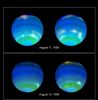
AA-Neptune-HST-PIA01542.jpgThe weather on Neptune - HST63 visite Caption NASA originale:"Using powerful ground and space-based telescopes, scientists have obtained a moving look at some of the wildest, weirdest weather in the Solar System. Combining simultaneous observations of Neptune made by HST and NASA's Infrared Telescope Facility on Mauna Kea, a team of scientists led by Lawrence A. Sromovsky (University of Wisconsin-Madison) has captured the most insightful images to date of a planet whose blustery weather - monster storms and equatorial winds of 900MPH! - bewilders scientists. Blending a series of HST images, Sromovsky's team constructed a time-lapse rotation movie of Neptune, permitting scientists to watch the ebb and flow of the distant planet's weather. And while the observations are helping scientists tease out clues to the planet's stormy weather, they also are deepening some of Neptune's mysteries. The weather on Neptune, is an enygma: the mechanism that drives its near-supersonic winds and giant storms has yet to be discerned! On Earth, weather is driven by energy from the sun as it heats the atmosphere and oceans. On Neptune, the sun is 900 times dimmer and scientists have yet to understand how Neptune's weather-generating machinery can be so efficient".
|
|

t Neptune Space.jpgNeptune's System63 visiteUn magnifico e realistico collage che ci mostra Nettuno e le sue Lune maggiori, insieme, per una "Foto Ricordo" di un viaggio indimenticabile...
|
|

Neptune_and_Despina-transit_combo_despinabrightened.jpgNeptune and Despina63 visiteDalla Rubrica "NASA - Picture of the Day", del giorno 3 Settembre 2009:"Despina is a tiny moon of Neptune. A mere 148 Km across, diminutive Despina was discovered in 1989, in images from the Voyager 2 Spacecraft taken during its encounter with the Solar System's most distant Gas Giant Planet. But looking through the Voyager 2 data 20 years later, amateur image processor (and philosophy professor) Ted Stryk discovered something no one had recognized before -- images that show the shadow of Despina in transit across Neptune's blue cloud tops.
His composite view of Despina and its shadow is composed of four archival frames taken on August 24, 1989, separated by 9 minutes. Despina itself has been artificially brightened to make it easier to see.
In ancient Greek mythology, Despina is a daughter of Poseidon (the Roman god Neptune)".MareKromium
|
|

Triton-PIA02213_modest.jpgThe limb of Triton (natural colors - elab. NASA)62 visiteCaption NASA originale:"This natural color image of the limb of Triton was taken early in the morning of Aug. 25, 1989, when the Voyager 2 spacecraft was at a distance of about 210.000 Km (128.000 miles) from the icy satellite. The largest surface features visible area about 3 miles across. The picture is a composite of images taken through the violet, green and clear filters.
The image shows a geologic boundary between a rough, pitted surface to the right and a smoother surface to the left".
|
|

Triton-PIA01538_modest.jpgGeologic processes on Triton (2)62 visiteCaption NASA originale:"Part of the complex geologic history of icy Triton, Neptune's largest satellite, is shown in this Voyager 2 photo, which has a resolution of 900 meters (2.700 feet) per picture element. The photo was received as part of a Triton-mapping sequence between 3:30 and 5:30 a.m. (PDT). This view is about 500 Km (300 miles) across.
It encompasses 2 depressions, possibly old impact basins, that have been extensively modified by flooding, melting, faulting and collapse. Several episodes of filling and partial removal of material appear to have occurred. The rough area in the middle of the bottom depression probably marks the most recent eruption of material. Only a few impact craters dot the area, which shows the dominance of internally driven geologic processes on Triton".
|
|

Triton-PIA00061_modest.jpgTriton's Northern Hemisphere in HR62 visiteCaption NASA originale:"This is one of the most detailed views of the surface of Triton taken by Voyager 2 on its flyby of the large satellite of Neptune early in the morning of Aug. 25, 1989. The picture was stored on the tape recorder and relayed to Earth later. Taken from a distance of only 40.000 Km (25.000 mi), the frame is about 220 Km (140 miles) across and shows details as small as 750 meters (0.5 miles). Most of the area is covered by a peculiar landscape of roughly circular depressions separated by rugged ridges. This type of terrain, which covers large tracts of Triton's Northern Hemisphere, is unlike anything seen elsewhere in the Solar System. The depressions are probably not impact craters: they are too similar in size and too regularly spaced. Their origin is still unknown, but may involve local melting and collapse of the icy surface. A conspicuous set of grooves and ridges cuts across the landscape, indicating fracturing and deformation of Triton's surface. The rarity of impact craters suggests a young surface by solar system standards, probably less than a few billion years old".
|
|
| 96 immagini su 8 pagina(e) |
 |
|
|
|
|
7 |
|





