| |

| Piú viste - Neptune and His Moons |

Neptune-V2.pngCrescent Neptune (August 1989)448 visite(ANSA) - ROMA, 18 AGOSTO 2022 - Compie 45 anni la sonda Voyager 2, la più longeva dell'era spaziale.
Lanciata il 20 agosto 1977, la sonda ha superato i confini del Sistema Solare nel 2018 ed è ancora attiva nello Spazio Interstellare, dal quale ha recentemente inviato dati mai visti (vedi Nota 1). Con la sua gemella Voyager 1, lanciata 15 giorni più tardi, la Voyager 2 è la protagonista di una missione da record. Gestite dal Jet Propulsion Laboratory (Jpl) della Nasa, le due sonde sono anche messaggeri molto speciali, che stanno portando nello spazio interstellare un biglietto da visita della Terra e dei suoi abitanti: un disco placcato in oro progettato per durare oltre un miliardo di anni, che contiene le immagini e suoni della vita sul nostro pianeta, diagrammi di leggi scientifiche fondamentali e saluti in molte lingue.
Entrambe le Sonde Voyager hanno attraversato il Sistema Solare rincorrendosi, con la Voyager 1 che ha raggiunto Giove e Saturno prima della sua compagna, mentre la Voyager 2 è stata la prima e finora l'unica sponda ad avvicinarsi a Urano, nel 1986, e poi a Nettuno, nel 1989, inviando a Terra le prime immagini ravvicinate di quei pianeti lontani, Nel 2013 la Voyager 1 era stata la prima a inoltrarsi nello spazio interstellare, seguita sei anni dopo dalla sua gemella. "Entrambe le sonde continuano a inviare all'umanità osservazioni da territori inesplorati", osserva la vice-responsabile scientifica del progetto, Linda Spilker, del Jpl. Le due Voyager "continuano a fare scoperte soprendenti", ha aggiunto la responsabile della missione Suzanne Dodd. "Non sappiamo per quanto tempo ancora la missione proseguirà, ma siamo sicuri che continuerà a regalarci molte sorprese scientifiche" (vedi Nota 2).
Nota 1: quali?
Nota 2: quali?
Come al solito: sensazionalismo di portata, condito dal nulla. Bellissima immagine comunque. L'aura più luminosa e bluastra che copre la porzione Sx del frame potrebbe essere un effetto del Sole. Ma non ho info al riguardo.MareKromium
|
|

NEPTUNE2.jpgNeptune from Voyager 2176 visiteAnche Nettuno, al pari dei suoi 3 "Gemelli Gassosi", è dotato di un sistema di anelli, ma esso è molto più sottile rispetto a quelli posseduti dagli altri tre Giganti.
Nettuno, inoltre, al pari di Giove, possiede un "Occhio". Se Giove, infatti, è caratterizzato dalla sua "Macchia Rossa", Nettuno è caratterizzato, a sua volta, da una "Macchia Blu", in tutto e per tutto simile, comunque (e colore a parte), a quella del suo Gemello Gigante.
|
|

Triton3.jpgThin clouds on Triton148 visiteDeboli e sottilissime nuvole (strati) caratterizzano, saltuariamente, il cielo di Tritone. Un Mondo lontano e gelido che riceve, mediamente, poco più di 1/400mo della luce che la Terra riceve dal Sole, eppure...Eppure Tritone possiede un'atmosfera ed essa mostra (come risulta evidente da questa immagine) di essere "viva" e capace di esprimere "fenomeni" quali nuvole e venti. Probabilmente passerà un secolo (o anche di più) prima che qualche Governo finanzi una Missione ricognitiva del Sistema di Nettuno e - magari - simile, in termini di contenuti, alla Missione "Cassini-Saturno". Certamente, quando avremo avuto risposte significative alle domande che ci stiamo ponendo in questo momento, coloro che scrivono sulle pagine di Lunar Explorer non ci saranno più.
Ma è questo, forse, il fascino della Scienza: Essa non si ferma mai e, se c'è la Volontà, qualcuno riprende sempre il lavoro interrotto da altri e, prima o poi, lo conduce al termine...
Original caption:"This image of Triton shows a thin cloud layer along the limb of the moon. The image was obtained as Voyager 2 swept past Triton at a speed of 27 kilometers per second and passed within 39,800 kilometers. Voyager discovered that Triton possessed a thin atmosphere of 15 microbars or 0.000015 times the surface pressure on Earth at sea level. The limb of Triton also showed a thin haze about 13 kilometers from the surface of the planet and thin patches of clouds as shown by this image".
|
|
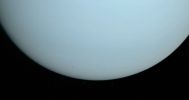
Z-Thalassa_and_Despina.jpgThalassa and Despina transiting (Credits: NASA/JPL - Voyager 2 Mission; Credits for the additional process.: "zelario12" - https://creativecommons.org/licenses/by-sa/2.0/deed.en)137 visitenessun commentoMareKromium
|
|
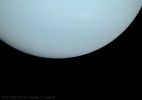
Z-Despina.jpgDespina transiting Neptune (Credits: NASA/JPL - Voyager 2 Mission; Credits for the additional process.: "zelario12" - https://creativecommons.org/licenses/by-sa/2.0/deed.en)131 visiteImmagine molto "datata", ma sempre molto bella ed ottimamente elaborata da tale "zelario12", al quale faccio i miei complimenti.MareKromium
|
|

Neptune-PIA21629.jpgNeptune from the Saturnian Sky (Natural Colors; credits: NASA/JPL-Caltech/Space Science Institute)127 visiteCaption NASA:"On August 25, 1989, NASA's Voyager 2 made its historic Fly-By of Neptune and its largest moon, Triton. The Cassini Spacecraft took this image to celebrate the anniversary of that event.
Neptune appears in this Natural Color composite as a pale blue disk (similar to Cassini's image of Uranus from 2014), just below and to the right of image center. Most of the faint specks in the image are background stars, although some are likely Cosmic Rays (charged particles that strike the camera detector).
By imaging Neptune, Cassini's Solar System family portrait-taking is complete. The Mission's Planetary Photojournal includes all of the major Planets except Mercury, which is too close to the Sun to be imaged, as well as dwarf planet Pluto.
This view was acquired by the Cassini narrow-angle camera on Aug. 10, 2017, at a distance of approximately 2,72 Billion Miles (such as approx. 4,38 BKM) from Neptune. Red, blue and green filter images were combined to create this Natural Color image".MareKromium
|
|

NEPTUNE5.jpgNeptune from Voyager 2113 visite...luminose che agiscono sulla lunghezza d'onda del rosso).
Il movimento delle meravigliose formazioni nuvolose che caratterizzano gli strati superiori dell'atmosfera del Pianeta, come riprese dalla Sonda Voyager 2, ci hanno anche permesso di calcolare la velocità approssimativa dei venti che le muovono.
E così, a seguito di questo semplice calcolo, è stato possibile accertare che i venti di Nettuno sono i più forti dell'intero Sistema Solare: essi soffiano, infatti, a circa 2000 Km orari!
|
|
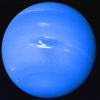
A-Neptune-PCF-LXTT.jpgBlue, Blue Neptune! (Natural Colors; credits for the additional process. and color.: Dr Paolo C. Fienga - Lunexit Team)112 visiteNeptune Data and Statistics
Discovered by Johann Gotfried Galle
Date of discovery = AD 1846
Mass (kg) = 1.024e+26
Mass (Earth = 1) = 1,7135e+01
Equatorial radius = 24.746 Km
Equatorial radius (Earth = 1) = 3,8799e+00
Mean density (gm/cm^3) = 1,64
Mean distance from the Sun = 4.504.300.000 Km
Mean distance from the Sun (Earth = 1) = 30,0611
Rotational period (hours) = 16,11
Orbital period (years) = 164,79
Mean orbital velocity = 5,45 Km per second
Tilt of axis = 29,56°
Orbital inclination = 1,774°
Equatorial surface gravity (m/sec^2) = 11,0
Equatorial escape velocity = 23,50 Km per second
Magnitude (Vo) = 7,84
Mean cloud temperature = from - 193°C to - 153°C
Atmospheric pressure (bars) = from 1 to 3
Atmospheric composition: Hydrogen 85%; Helium 13% and Methane 2% MareKromium
|
|

NEPTUNE3.jpgNeptune from Voyager 2111 visiteUn ciclopico ed ultrasecolare uragano anche per Nettuno, quindi?
Sembra di si, anche se delle risposte più accurate potranno venire solo da esami ed osservazioni, rispettivamente, maggiormente prolungati e ravvicinate.
Ci sono Missioni alle viste per Nettuno?
Purtroppo no, e allora dobbiamo rimetterci all'HST e dobbiamo altresì sperare che qualcuno alla NASA si ricordi di rendere note le informazioni e le scoperte riguardanti questo mondo azzurro e bianco, così bello e rassicurante - in apparenza - eppure così lontano, violento (da tanti punti di vista) e diverso dal nostro.
|
|
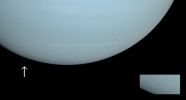
Z-Naiad.jpgNaiad transiting Neptune (Credits: NASA/JPL - Voyager 2 Mission; Credits for the additional process.: "zelario12" - https://creativecommons.org/licenses/by-sa/2.0/deed.en)111 visitenessun commentoMareKromium
|
|

TRITON.jpgTriton from Voyager 2 (enhanced real colors)107 visiteLa superficie di Tritone, come ripresa dal Voyager 2, in colori reali ma con esaltazione dei contrasti.
Canali, crepacci, montagne e grandi crateri da impatto sono facilmente visibili, al pari di una strana distesa semi-pianeggiante che interrompe nettamente e bruscamente il paesaggio del pianeta, facendolo passare dall'estremamente accidentato e montuoso al (relativamente) liscio e pianeggiante. Forse questo paesaggio così affascinante ed "alieno" è il prodotto di eventi sismici aventi carattere planetario e risalenti alla "gioventù" del corpo celeste.
|
|

Triton-PIA00317-PCF-LXTT-IPF.jpgThe Southern Regions of Triton (Absolute Natural Colors; credits for the additional process. and color.: Dr Paolo C. Fienga/Lunar Explorer Italia/Italian Planetary Foundation)106 visiteThis wonderful and highly detailed global Absolute Natural Color image mosaic of Triton was obtained in the AD 1989 by the NASA - Voyager 2 Spacecraft during its Fly-By of the Neptunian System.
With a radius of approx. 1350 Km (such as a little more than 838 miles) and therefore some 22% smaller than Earth's Moon, Triton is by far the largest Natural Satellite of Neptune. Furthermore, Triton is one of the only 3 (three) objects in the Solar System known to have a Nitrogen-dominated Atmosphere (the others are our Home Planet Earth and the Saturnian giant moon, Titan). Triton has the coldest Surface known anywhere in the Solar System (38 K, or about - 391 degrees Fahrenheit, or - 235° Celsius): it is so cold that most of Triton's Nitrogen is condensed as Frost, making it the only Celestial Body in the whole Solar System that is known to have a Surface mainly composed of Nitrogen Ice.
The pinkish deposits constitute a vast South Polar Cap, that is believed to contain Methane Ice, which somehow reacted under Sunlight so to form pink or red Compounds. The Dark Streaks overlying these pink ices are believed to be an Icy and - perhaps - Carbonaceous Dust deposited from huge Geyser-like Plumes, some of which were found to be active during the Voyager 2 Fly-By. The light gray colored band visible in this image extends all the way around Triton, near the Equator and it may consist of relatively fresh Nitrogen Frost Deposits. The vaguely greenish areas of Triton (central and upper right side) include what is known as "The Cantaloupe Terrain", whose origin is still unknown, and a set of "Cryovolcanic" Landscapes apparently produced by Icy-cold Liquids (now totally frozen) that were erupted from Triton's interior.
This frame (which is the Original NASA - Voyager 2 color image mosaic published on the NASA - Planetary Photojournal with the ID n. PIA 00317) has been additionally processed and then re-colorized, according to an educated guess carried out by Dr Paolo C. Fienga (LXTT-IPF), in Absolute Natural Colors (such as the colors that a human eye would actually perceive if someone were onboard the NASA - Voyager 2 Spacecraft and then looked outside, towards the Neptunian moon Triton), by using an original technique created - and, in time, dramatically improved - by the Lunar Explorer Italia Team. Different colors, as well as different shades of the same color, mean, among others, the existence of different Elements present on the Surface of Triton, each having a different Albedo (---> Reflectivity) and Chemical Composition.MareKromium
|
|
| 96 immagini su 8 pagina(e) |
1 |
|
|
|
|
|
|
|
|





