| Piú viste - Uranus and His Moons |

UranusfromHST-2.JPGUranus, from HST (Natural, but enhanced, Colors; credits: NASA)92 visitenessun commentoMareKromium
|
|

Titania_s Limb-V2-PIA01978_modest.jpgTitania's limb (3)91 visiteIl bordo di Titania, semi-immerso nell'oscurità, costituisce un target molto suggestivo da ammirare ed inoltre, proprio grazie ai giochi di luce ed ombra che si formano, risulta leggermente più facile percepire - anche se, a volte, in maniera ingannevole - la "profondità" o il "rilievo" di alcuni dettagli superficiali. Guardate, infatti, il bordo superiore di Titania e noterete, ad ore 1 dell'immagine, una chiara protuberanza di forma "conica". Un dettaglio curioso e suggestivo, ancora una volta. Di che cosa si tratta? Forse di una "spire", simile a quelle che abbiamo visto sulla Luna . O forse qualcosa di completamente diverso...
|
|

AB-Ariel-V2-PIA01351.jpgAriel, from 2,52 MKM91 visiteCaption NASA originale:"Distinct bright patches are visible on Ariel, the brightest of Uranus' 5 largest satellites. Voyager 2 obtained this image Jan. 22, 1986, from a distance of 2,52 MKM (1,56 MMs). The clear-filter image, obtained with the narrow-angle camera, shows a resolution of 47 Km (approx. 29 miles). This image shows several distinct bright areas that reflect nearly 45% of the incident sunlight; on average, the satellite displays a reflectivity of about 25-30%. The bright areas are probably fresh water ice, perhaps excavated by impacts. The South Pole of Ariel is slightly off center of the disk in this view. Voyager 2 obtained its best views of the satellite on Jan. 24, 1986 at a closest-approach distance of about 127.000 km (approx. 79.000 mi)".
|
|
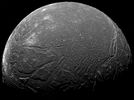
Ariel.jpgAriel (HR)91 visiteLa tormentata superficie di Ariel si rivela in tutto il suo (comunque grande) fascino.
Una serie di impressionanti fratture tettoniche (forse un raffreddamento troppo rapido?) caratterizza l'Est e l'Ovest di questo mondo lontano; svariati mega-canyons, lunghi e profondi, passano attraverso l'equatore di Ariel, frammentandosi e ramificandosi poi in centinaia di crepacci minori; distese simili ai "mari" della Luna contraddistinguono una buona parte della sua superficie la quale, inoltre, sembra avere delle aree (alla Vostra Sx - Eastern limb) la cui albedo (alta) appare molto diversa rispetto al resto del Pianeta.
Da notare che, a differenza di quanto accade per le altre lune di Urano (come per la maggior parte delle lune dei quattro Giganti Gassosi), non riusciamo a distinguere che un modesto numero di crateri da impatto e questa circostanza è sicuramente strana: che Ariel sia passata, magari, attraverso una parziale e "recente" (in senso geologico) ridefinizione della sua superficie?
|
|

AB-Ariel-vg2_p29523.jpgAriel (HR)91 visitenessun commento
|
|

Uranus_and_Ariel.jpgUranus and Ariel: the Eclypse91 visiteCaption NASA originale:"This image is a never-before-seen astronomical alignment of a moon traversing the face of Uranus, and its accompanying shadow. The white dot near the center of Uranus' blue-green disk is the icy moon Ariel. The 700-mile-diameter satellite is casting a shadow onto the cloud tops of Uranus. To an observer on Uranus, this would appear as a solar eclipse, where the moon briefly blocks out the Sun as its shadow races across Uranus's cloud tops.
Though such "transits" by moons across the disks of their parents are commonplace for some other Gas Giant Planets, such as Jupiter, the satellites of Uranus orbit the planet in such a way that they rarely cast shadows on the Planet's Surface. Uranus is tilted so that its spin axis lies nearly in its orbital plane".
|
|

Uranus-Hurricane02.jpgUranian Hurricane (detail 2)91 visitenessun commento
|
|

VD-Bianca-V2.jpgBianca - Voyager 290 visiteUn'immagine scarsamente significativa? Secondo noi no. Non è certamente un frame magnifico, ma non sempre per vedere (e per capire!) qualcosa di grande e di complesso dobbiamo fare affidamento sulla sola "bellezza". Urano, in questo frame, è vicino alla Sonda, è luminoso ed appare sovraesposto (sembra più il Sole che un pianeta...); gli Anelli di Urano si mostrano piuttosto bene ed evidenziano tanti dettagli. Bianca è solo un puntino, apparentemente insignificante, ma che, con la sua sola presenza, comunque contribuisce a mantenere in equilibrio una parte del Sistema degli Anelli di Urano (essa è, dunque, per Urano, una "Shepherd Moon", così come lo sono Mimas ed Hyperion - oltre ad altre Lune interne minori - per Saturno"). Interessante, vero?!?
|
|

Miranda-PIA02217.jpgMiranda90 visiteCaption NASA originale:"Mosaic of HR images of Miranda. One wide-angle and eight narrow-angle camera images of Miranda were combined in this view. The controlled mosaic was transformed to an orthographic view centered on the South Pole. The trapezoidal region (about 200 Km on a side) occurs near the South Pole and is located near the center of the mosaic. The trapezoid's outer boundary and its internal patterns of ridges and band of contrasting albedo display numerous sharp corners".
|
|

UMBRIEL-vg2_p29502-A.jpgUmbriel's extremely unusual surface feature (HR - context image)90 visiteIl rilievo (che definire "fortemente anomalo" è riduttivo) che caratterizza il versante prossimo al Polo Nord di Umbriel è, almeno dalle immagini che sono in nostro possesso, del tutto inesplicabile.
Alcuni Ricercatori (anche nel Gruppo Lunar Explorer Italia) ipotizzano che si tratti di una montagna dalle dimensioni davvero incredibili (almeno in rapporto al corpo celeste a cui essa accede - immaginate come il Monte Everest apparirebbe dallo spazio se fosse alto 70 o più Km e largo 300, tanto per rendere l'idea...), mentre altri Studiosi ritengono che quello che si vede in questa immagine è solo il risultato di una deformazione del frame la quale potrebbe essere imputabile ad un vizio di trasmissione e/o di ricevimento ed elaborazione dati (il che equivarrebbe a dire che il rilievo in questione non esiste).
Altri ancora interpretano questo rilievo come una "plume" vulcanica (?) o una gigantesca formazione nuvolosa.
Purtroppo, il mistero non sarà risolto tanto facilmente...
|
|

Oberon-vg2_2683623.jpgLeaving Oberon (HR)90 visitenessun commento
|
|

Uranus-2007-01.jpgGoing, Going, Gone: Hubble captures Uranus's Rings on Edge (4)90 visitenessun commentoMareKromium
|
|
| 109 immagini su 10 pagina(e) |
 |
|
|
|
6 | |
|
|
|





