| Piú viste - Uranus and His Moons |

Miranda-PIA01354-PCF-LXTT.jpgVerona Rupes (Absolute Natural Colors; credits for the additional process. and color.: Dr Paolo C. Fienga - Lunexit Team)247 visitenessun commentoMareKromium
|
|

Miranda-PIA00042-PCF-LXTT.jpgMiranda (Absolute Natural Colors; credits for the additional process. and color.: Dr Paolo C. Fienga - Lunexit Team)239 visitenessun commentoMareKromium
|
|

Miranda-PIA00044-Verona_Rupes-PCF-LXTT.jpgVerona Rupes (Super Close-Up - Absolute Natural Colors; credits for the additional process. and color.: Dr Paolo C. Fienga - Lunexit Team)231 visitenessun commentoMareKromium
|
|

Miranda-Verona_Rupes.jpgVerona Rupes169 visiteCaption NASA:"Could you survive a jump off the tallest cliff in the Solar System?
Quite possibly. Verona Rupes on Uranus' moon Miranda is estimated to be 20 kilometers deep - ten times the depth of the Earth's Grand Canyon. Given Miranda's low gravity, it would take about 12 minutes for a thrill-seeking adventurer to fall from the top, reaching the bottom at the speed of a racecar -- about 200 Km-per- hour.
Even so, the fall might be survivable given proper airbag protection. The featured image of Verona Rupes was captured by the passing Voyager 2 Robotic Spacecraft in 1986.
How the giant cliff was created remains unknown, but is possibly related to a large impact or tectonic surface motion". MareKromium
|
|

ARIEL.jpgAriel (real colors)156 visiteIn questa immagine di Ariel (a colori reali) si vede ancora più chiaramente la differenza di luminosità e di caratteristiche superficiali esistente fra la quasi globalità del corpo celeste ed il suo Polo Sud, in particolare.
Impressionante davvero, in questa immagine ripresa da una distanza di circa 130.000 Km, il dettaglio costituito dai crepacci visibili, ancora una volta, in basso e sempre a ridosso della Linea del Terminatore.
|
|

AA-Uranus and Neptune.jpgUranus, Neptune and their Moons together!!!152 visiteUn'immagine davvero meravigliosa ottenuta dalla 2MASS Southern Facility il giorno 7 Giugno 1998. Come gentilmente richiesto dalla 2MASS, riconosciamo i loro diritti sull'immagine e riportiamo integralmente la seguente "caption":
"Atlas Image [or Atlas Image mosaic] obtained as part of the Two Micron All Sky Survey (2MASS), a joint project of the University of Massachusetts and the Infrared Processing and Analysis Center/California Institute of Technology, funded by the National Aeronautics and Space Administration and the National Science Foundation"
|
|

MIRANDA.jpgMiranda from Voyager 2144 visiteIn questo nuovo frame potete apprezzare il fatto che Miranda ha più la forma di un uovo che quella di una sfera. Le fotografie che possediamo di questo corpo celeste ci fanno vedere un mondo profondamente segnato da impatti: impatti che hanno provocato profondissime "cicatrici" le quali, come si diceva in sede di commento all'immagine precedente, sono ancora ben visibili.
La enorme depressione a cui avevamo già accennato è ora visibile con maggiore chiarezza, sulla Vostra Sn. A giudicare dalle sue fattezze possiamo supporre che si sia (forse) trattato di un "urto radente", ossìa il corpo celeste che ha impattato Miranda avrebbe dovuto avere, al momento del contatto, un angolo di incidenza, rispetto al piano dell'orizzonte di Miranda stessa, molto basso (inferiore ai 35°?). Ed è forse per questo motivo che, nonostante la catastrofica collisione, Miranda è, si, rimasta profondamente segnata, ma NON si è completamente disintegrata...
|
|
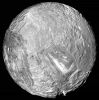
Miranda.jpgMiranda (full disk)143 visiteLe "Verona Rupes" sono in basso, leggermente alla Dx dell'Osservatore.MareKromium
|
|

OBERON.jpgOberon from Voyager 2142 visiteA parte i consueti segni (crateri) lasciati da un innumerevole quantitativo di impatti, risulta abbastanza agevole notare l'esistenza di "mari" simili a quelli della nostra Luna. Si tratta di ampie distese, relativamente lisce, che si estendono per circa un quarto della superficie totale del Satellite. Da osservare, inoltre, la protuberanza semiconica che appare sul bordo del Satellite, alla Sn dell'Osservatore, a ore 8 (un rilievo alto circa 6 Km).
Si tratta di una montagna o di un antico vulcano?
|
|

URANUSFROMVOYAGER2.jpgUranus from Voyager 2138 visiteLa più accreditata parla di "frammenti di ghiaccio" frammisti a roccia. Anelli sottili e scuri che, probabilmente, sono il ricordo di una qualche catastrofe planetaria avvenuta in epoche remote.
Una "stranezza", se così si può dire, di Urano attiene il suo asse di rotazione il quale è enormemente inclinato (qualche Scienziato usa dire scherzosamente, infatti, che Urano NON orbita intorno al Sole: Urano si limita a ROTOLARE nello Spazio...) e, talvolta, punta direttamente verso il Sole.
|
|

TITANIA.jpgTitania from Voyager 2 (1)137 visiteQualche immagini di Titania.
Questo Satellite di Urano assomiglia decisamente ad Oberon e le sue caratteristiche superficiali lo rendono anche molto simile alla nostra Luna.
In questa immagine appare piuttosto chiaramente, verso il basso ed esattamente sulla linea del terminatore, un profondo canale (crepaccio?). Reminiscenze di antiche eruzioni ed eventi sismici collegati o è forse il segno dell'impatto con un altro corpo celeste che si è abbattuto su Titania con un angolo di incidenza estremamente basso? Onestamente non lo sappiamo. Gli Studiosi di Scienze Planetarie e gli Esperti di geologia potrebbero esserci di aiuto al riguardo. Noi abbiamo scambiato qualche parola con uno di questi e ci è stato detto che le "scalfitture" visibili sulla superficie di Titania dovrebbero essere il risultato di violentissimi cataclismi i quali hanno, in un certo senso, fratturato la crosta del Satellite.
Ma relativamente all'origine (interna od esterna?) di questi eventi la risposta, ovviamente, non può essere data.
|
|

AB-Ariel-V2-PIA01356_modest.jpgAriel (detail mgnf)131 visiteIn questo terzo frame potete vedere davvero bene un dettaglio, rilevabile quasi a ridosso della Linea del Terminatore, di alcuni dei crepacci che avevamo intravisto nella prima immagine. Questa ripresa ravvicinata ci permette - con l'aiuto delle ombre che si sono formate sui rilievi - di percepire non solo la profondità, ma anche l'estremo intreccio di questa rete di solchi.
|
|
| 109 immagini su 10 pagina(e) |
1 |
 |
|
|
|
|
|
|
|





