| |

| Piú viste - Jupiter: the "King" and His Moons |
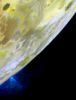
Io-Masubi plume-GAL-PIA02502_modest.jpgThe "Masubi" plume74 visiteA plume of gas and particles is ejected some 100 kilometers (about 60 miles) above the surface of Jupiter's volcanic moon Io in this color image, recently taken by NASA¹s Galileo spacecraft.
The plume is erupting from near the location of a plume first observed by the Voyager spacecraft in 1979 and named Masubi. However, during the course of the Galileo tour of Jupiter and its moons, a plume has appeared at different locations within the Masubi region.
This color image is the same as the previously released false color mosaic of Io, but with special processing to enhance the visibility of the plume. The plume appears blue because of the way small particles in the plume scatter light.
North is to the top of the picture, and the Sun illuminates the surface from almost directly behind the spacecraft. The resolution is 1.3 kilometers (0.8 miles) per picture element. The images were taken on July 3, 1999 at a distance of about 130,000 kilometers (81,000 miles) by the Galileo¹s camera.
|
|

Jupiter_s Aurora-HST-PIA03155_modest.jpgJupiter's Aurora - HST74 visiteCaption NASA originale:"Auroras are curtains of light resulting from high-energy electrons racing along the planet's magnetic field into the upper atmosphere.
The electrons excite atmospheric gases, causing them to glow.
The image shows the main oval of the aurora, which is centered on the magnetic north pole, plus more diffuse emissions inside the polar cap. The HST image shows also unique emissions from the magnetic "footprints" of 3 of Jupiter's largest moons.
Auroral footprints can be seen in this image from Io (along the lefthand limb), Ganymede (near the center), and Europa (just below and to the right of Ganymede's auroral footprint).
These emissions, produced by electric currents generated by the satellites, flow along Jupiter's magnetic field, bouncing in and out of the upper atmosphere".
|
|

Io-Ionian Mountains and calderas-PIA02526.jpgIonian Mountains and Calderas on Io (real colors)73 visitenessun commento
|
|

Io-Flares from V2-PIA01362_modest.jpgBlue flares and eruptions on the limb of crescent Io73 visiteAncora flares (di colore blu, questa volta), riprese da una distanza approssimativa di 1,2 milioni di kilometri da Io.
La ripresa, in questo caso (e si tratta comunque di un'immagine di splendida qualità e fattura), è stata effettuata dalla Sonda Voyager 2 il 9 Luglio 1979. Ci pensate? Più di 25 anni fa...
Voyager 2 took this picture of Io on the evening of July 9, 1979, from a range of 1.2 million kilometers. On the limb of Io are two blue volcanic eruption plumes about 100 kilometers high. These two plumes were first seen by Voyager 1 in March, 1979, and are designated Plume 5 (upper) and Plume 6 (lower). They have apparently been erupting for a period of at least 4 months and probably longer. A total of six plumes have been seen by Voyager 2, all of which were first seen by Voyager 1. The largest plume viewed by Voyager 1 (Plume 1) is no longer erupting. Plume 4 was not viewed on the edge of the moon's disc by Voyager 2 and therefore it is not known whether or not it is still erupting. This picture is one of a series taken to monitor the eruptions over a 6 hour period.
|
|

Amalthea-PIA01074.jpgFour views of Amalthea73 visiteThese 4 images of Amalthea were taken by Galileo's Solid State Imaging System at various times between February and June 1997. North is approx. up in all cases. Amalthea, whose longest dimension is about 247 Km (154 miles) across, is tidally locked (like Thebe) so that the same side of the moon always points towards Jupiter. In such a tidally locked state, one side of Amalthea always points in the direction in which Amalthea moves as it orbits about Jupiter. This is called the "leading side" of the moon and is shown in the top 2 images. The opposite side of Amalthea, such as the "trailing side," is shown in the bottom pair of images. The Sun illuminates the surface from the left in the top left image and from the right in the bottom left image. Such lighting geometries, similar to taking a picture from a high altitude at sunrise or sunset, are excellent for viewing the topography of the satellite's surface such as impact craters and hills. In the two images on the right, however, the Sun is almost directly behind the spacecraft. This latter geometry, similar to taking a picture from a high altitude at noon, washes out topographic features and emphasizes Amalthea's albedo (light/dark) patterns. It emphasizes the presence of surface materials that are intrinsically brighter or darker than their surroundings. The bright albedo spot that dominates the top right image is located inside a large south polar crater named Gaea.
|
|

Jupiter_s NorthPole-PIA07783.jpgThe North Pole of Jupiter73 visiteThe South Polar Regions shown here are less clearly visible because Cassini viewed them at an angle and through thicker atmospheric haze.
The round maps are polar stereographic projections that show the North or South Pole in the center of the map and the Equator at the edge.
|
|

Callisto-PIA02277-PCF-LXTT-IPF.jpgValhalla! (Absokute Natural Colors; credits for the additional process. and color.: Dr Paolo C. Fienga/Lunar Explorer Italia/Italian Planetary Foundation)73 visiteThis picture of the gigantic Multi-Ring Impact Basin named "Valhalla" and located on the Jovian moon Callisto, was taken by the NASA - Voyager 1 Spacecraft in the morning of March 6, of the AD 1979, at a distance of about 200.000 Km (such as approx. 124.000 miles) from the Surface of the farthermost of the 4 (four) so-called "Galilean" Natural Satellites (or moons) of the Gas-Giant Planet Jupiter. The complicated Circular Structure which characterizes Valhalla is, in a way (and according to NASA), relatively similar to other large Circular Impact Basins that can be seen on the Surface of the Earth's Moon as well as on the Planet Mercury but, as we already wrote and underlined in the past, we, as IPF, do believe that a true and strong resemblance between Valhalla and another Multi-Ring Impact Basin can only be found with the huge Tyre Crater; a Multi-Ring Impact Crater that is located, as you know, on the Jovian moon Europa.
Usually, the inner portions of these Multi-Ring Impact Basins are generally surrounded by Radially Lineated Ejecta and several Concentric Mountainous Ring Structures, which are thought to have formed during the Impact Event itself. However, the Callistoan Valhalla Multi-Ring Impact Basin consists of a Light-Floored Central Basin, that is approx. 300 Km (such as a little more than 186 miles) in diameter, surrounded by at least 8 (eight) to 10 (ten) discontinuous and rhythmically spaced Ridges, but no Radially Lineated Ejecta can be seen. In any case, the great number of Rings observed around Valhalla is a fact which is consistent with the hypothesis that Callisto possesses a very low Planetary Density and, also, a low internal strength. Furthermore, if you look carefully on the upper right side of the frame, at about 2 o'clock, a beautiful and extremely long and regular Catena (---> Chain of Craters, probably originated by a Cometary Strike or a Meteor that was heavily fragmented at the time of the Impact) can be seen.
This frame (which is an Original NASA - Voyager 1 Spacecraft b/w image published on the NASA - Planetary Photojournal with the ID n. PIA 02277) has been additionally processed and then colorized, according to an educated guess, by Dr Paolo C. Fienga (LXTT-IPF), in Absolute Natural Colors (such as the colors that a human eye would actually perceive if someone were onboard the NASA - Voyager 1 Spacecraft and then looked outside, towards the Jovian moon Callisto), by using an original technique created - and, in time, dramatically improved - by the Lunar Explorer Italia Team. Different colors, as well as different shades of the same color, mean, among others, the existence of different Elements present on the Surface of Callisto, each having a different Albedo (---> Reflectivity) and Chemical Composition.MareKromium
|
|

IO 8.jpgIo from 8,3 MKM!72 visiteThis photo of Jupiter's satellite Io was taken by Voyager 1 about 4:30 p.m. (PST) March 2, 1979. The spacecraft was about 5 million miles (8.3 million kilometers away). Voyager 1 was mapping Jupiter with the cameras and infrared instrument at the time the picture was taken. The hemisphere seen here is the one that always faces away from Jupiter. This photo shows details on Io never before seen. The smallest features are about 38 miles (70 kilometers) across. Near the center and slightly to the right can be seen several round features with dark centers and bright rims. They may be the first craters ever observed on Io. At this resolution scientists still cannot tell much about the origin of the features, which could be impact craters or of internal (volcanic) origin. No ray or ejecta patterns are obvious at this resolution.
|
|

IO 5.jpgZal Patera, Io, in color72 visiteThe Zal Patera region of Jupiter's volcanic moon Io is shown in this combination of high-resolution black and white images taken by NASA's Galileo spacecraft on November 25, 1999 and lower resolution color images taken by Galileo on July 3, 1999. By combining both types of images, Galileo scientists can better understand the relationships between the different surface materials and the underlying geologic structures. For example, in the center toward the top of the picture, the edge of the caldera, or volcanic crater, is marked by the black flows, and it coincides with the edge of a plateau. Also, the red material(just above and to the right of the center of the image) is typically associated with regions where lava is erupting onto the surface. Here the red material follows the base of a mountain, which may indicate that sulfurous gases are escaping along a fault associated with the formation of the mountain.
Scientists can use the lengths of the shadows cast to estimate the height of the mountains. They estimate that the northernmost plateau, which bounds the western edge of Zal Patera, rises up to approximately 2 kilometers (6,600 feet) high. The mountain to the south of the caldera has peaks up to approximately 4.6 kilometers (15,000 feet) high, while the small peak at the bottom of the picture is approximately 4.2 kilometers (14,000 feet) high.
North is to the top of the image, which is centered at 33.7 degrees north latitude and 81.9 degrees west longitude. The higher resolution images have a sharpness of about 260 meters (or yards) per picture element, and they are illuminated from the left. These images were taken on November 25, 1999 at a range of 26,000 kilometers (16,000 miles). The color images are illuminated from almost directly behind the Galileo spacecraft. The resolution of the color images is 1.3 kilometers (0.8 miles) per picture element. They were taken on July 3, 1999 at a distance of about 130,000 kilometers (81,000 miles).
|
|
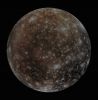
Callisto-PIA03456-PCF-LXTT-IPF.jpgApproaching Callisto (Absolute Natural Colors; credits for the additional process. and color.: Dr Paolo C. Fienga/Lunar Explorer Italia/Italian Planetary Foundation)72 visiteBright scars on a darker Surface testify to a long history of impacts on the Jovian moon Callisto, as it can be seen in this image obtained by the NASA - Galileo Spacecraft. The picture, taken in May 2001, is the only complete global Absolute Natural Color image of Callisto ever obtained by the NASA - Galileo Spacecraft, which orbited around Jupiter from December, 7, of the AD 1995 and until September 21, of the AD 2003, when the Spacecraft was destroyed during a controlled impact with Jupiter itself.
Of Jupiter's 4 (four) largest moons (also known as the "Galilean Moons"), Callisto orbits farthest from the Giant Gas Planet. Furthermore, Callisto's Surface is uniformly cratered but, as you can see for yourself, is not uniform in color or brightness at all. At present day, Planetary Scientists believe that the brighter areas are mainly Ice while the darker ones should be made of highly eroded (and Ice-poor) Rocky Materials.
This frame (which is an Original NASA - Galileo Spacecraft color frame published on the NASA - Planetary Photojournal with the ID n. PIA 03456) has been additionally processed and then re-colorized, according to an educated guess, by Dr Paolo C. Fienga (LXTT-IPF), in Absolute Natural Colors (such as the colors that a human eye would actually perceive if someone were onboard the NASA - Galileo Spacecraft and then looked outside, towards the Jovian moon Callisto), by using an original technique created - and, in time, dramatically improved - by the Lunar Explorer Italia Team. Different colors, as well as different shades of the same color, mean, among others, the existence of different Elements present on the Surface of Callisto, each having a different Albedo (---> Reflectivity) and Chemical Composition.MareKromium
|
|

Io-PIA02540.jpgRifting at Hi'iaka Patera (MULTISPECTRUM-2; credits: Lunexit)71 visiteCaption NASA:"NASA's Galileo Spacecraft acquired the images in this mosaic of Hi-iaka Patera (the irregularly shaped, dark depression at the center of the image) and two nearby mountains on November 25, 1999 during its 25th orbit. The sharp peak at the top of the image is about 11 Km (about 36.300 feet) high, and the two elongated plateaus to the West and South of the caldera are both about 3,5 Km (11.500 feet) high.
The ridges on the North-Western mountain are often seen on Ionian mountains and are thought to be formed as surface material slides downslope due to gravity.
At low resolution, many of the dark features, called pateras, appear to be calderas -- depressions formed by collapse into an empty magma chamber. However, higher resolution images such as this one suggest a different origin. In the case of Hi-iaka, the Northern and Southern Margins of the pateras have very similar shapes which appear to fit together. This may indicate that the crust has been pulled apart here and the resulting depression has subsequently been covered by dark lava flows. Furthermore, the two mountains bordering Hi-iaka Patera also appear to fit together. However, the similar shapes and heights of the pateras margins and mountains could be coincidental. Galileo scientists are currently investigating whether mountains and pateras are related to each other and what could cause the surface of Io to rift apart in such a manner.
North is to the top of the mosaic and the sun is illuminating the surface from the left. The resolution is 260 meters (about 280 yards) per picture element. Galileo took the images at a distance of 26.000 Km (approx. 16.000 miles) from Io".MareKromium
|
|

Io-Tupan Patera-fullcolor-PIA02599_modest.jpgIo: Tupan Patera70 visiteWonderful colors in a volcanic crater named Tupan Patera on Jupiter's moon Io, as seen in this image from NASA's Galileo spacecraft, show varied results of lava interacting with sulfur-rich materials.
The colorfulness of the image is only slightly enhanced from what the human eye would see on the scene. The red in the image includes a small amount of infrared energy. Tupan Patera, named after a Brazilian thunder god, was seen as an active hot spot in earlier Galileo observations, but those low-resolution views did not show details of volcanic activity. This image taken in October 2001 at a resolution of 135 meters (443 feet) per picture element reveals the complex nature of the crater.
Tupan is now clearly shown to be a volcanic depression, about 75 kilometers (47 miles) across, surrounded by cliffs about 900 meters (3000 feet) tall. In the center is a large area that must be higher than the rest of the crater floor because it has not been covered by the dark lavas. Much of the area is coated with a diffuse red deposit that Galileo scientists believe has condensed from sulfur gas escaping from volcanic vents. The floor of Tupan is covered with a surreal pattern of dark black, green, red, and yellow materials. The black material is recent, still-warm lava. The yellow is presumed to be a mix of sulfurous compounds, and the green appears to form where red sulfur has interacted with the dark lavas. While Galileo scientists have found previous evidence for both molten sulfur and molten rock on Io, this image shows the best evidence to date of chemical reactions taking place between the two.
The intermingled patches of sulfur and lava are difficult to explain. The yellowish sulfur may be melting from within the crater walls over solidified but warm lava. The sulfur may boil away from the areas too hot for liquid sulfur to sit on, leaving patches where the dark lava is still visible.
North is to the top of the image and the Sun illuminates the surface from the upper right.
|
|
| 325 immagini su 28 pagina(e) |
|
|
|
|
|
9 | |
|
|
|
|
|
|





