| |

| Piú viste - Jupiter: the "King" and His Moons |

Io-Eruption on Tvashtar Catena-PIA02584_modest.jpgIo: eruption in Tvashtar Catena82 visiteThis pair of images taken by NASA's Galileo spacecraft captures a dynamic eruption at Tvashtar Catena, a chain of volcanic bowls on Jupiter's moon Io. They show a change in the location of hot lava over a period of a few months in 1999 and early 2000.
The image on the left uses data obtained on Nov. 26 and July 3, 1999, at resolutions of 183 meters (600 feet) and 1.3 kilometers (0.8 miles) per pixel, respectively. The red and yellow lava flow itself is an illustration based upon imaging data. The image on the right is a composite using a five-color observation made on Feb. 22, 2000, at 315 meters (1030 feet) per pixel.
These are among the most fortuitous observations made by Galileo because this style of volcanism is too unpredictable and short-lived to plan to photograph.
Short-lived bursts of volcanic activity on Io had been previously detected from Earth-based observations, but interpreting the style of volcanic activity from those lower-resolution views was highly speculative. These Galileo observations confirm hypotheses that the initial, intense thermal output comes from active lava fountains. Galileo's high-resolution observations of volcanic activity on Io have also confirmed other hypotheses based on earlier, low-resolution data. These include interpretations of slowly spreading lava flows at Prometheus and Amirani and an active lava lake at Pele. These tests of earlier hypotheses increase scientists' confidence in interpreting volcanic activity seen in low-resolution remote sensing data of Earth as well as Io. However, these data are still of insufficient resolution to adequately test the more quantitative models that have been applied to volcanic eruptions on Earth and Io.
These images also show other geologic features on Io, such as the scalloped margins of the plateau to the northeast of the active lavas. These margins appear to have formed by sapping, a process usually associated with springs of water. Liquid sulfur dioxide might be the fluid responsible for sapping on Io. A better understanding of sapping on Io will influence how scientists interpret similar features on Mars(where the viability of carbon dioxide or water as the sapping fluid remains controversial).
|
|

Europa-Icy cliffs-PIA01182.jpgIcy cliffs on Europa (extreme detail mgnf)82 visiteThis image, taken by the camera onboard NASA's Galileo spacecraft, is a very HR view of the Conamara Chaos region on Jupiter's moon Europa. It shows an area where icy plates have been broken apart and moved around laterally. The top of this image is dominated by corrugated plateaux ending in icy cliffs over a hundred meters (a few hundred feet) high. Debris piled at the base of the cliffs can be resolved down to blocks the size of a house. A fracture that runs horizontally across and just below the center of the Europa image is about the width of a freeway.
North is to the top right of the image, and the sun illuminates the surface from the east. The image is centered at approx. 9° North Latitude and 274° West Longitude. The image covers an area approx. 1,7 by 4 Km (about 1 by 2,5 miles). The resolution is 9 mt (roughly 30 feet) per picture element. This image was taken on December 16, 1997 at a range of 900 Km (about 540 miles) by Galileo's Solid State Imaging System.
|
|

Jupiter_Storm.jpgThe Dark S.E.B. of Jupiter is back!82 visiteDalla Rubrica "NASA - Picture of the Day" del giorno 29 Npvembre 2010:"Why are planet-circling clouds disappearing and reappearing on Jupiter?
Although the ultimate cause remains unknown, planetary meteorologists are beginning to better understand what is happening. Earlier this year, unexpectedly, Jupiter's Dark Southern Equatorial Belt (SEB) disappeared. The changes were first noted by amateurs dedicated to watching Jupiter full time. The South Equatorial Band has been seen to change colors before, although the change has never been recorded in such detail. Detailed professional observations revealed that high-flying light-colored Ammonia-based clouds formed over the planet-circling Dark Belt. Now those Light Clouds are dissipating, again unveiling the lower Dark Clouds.
Pictured above two weeks ago, far InfraRed images - depicted in false-color red - show a powerful storm system active above the returning Dark Belt. Continued observations of Jupiter's current cloud opera, and our understanding of it, is sure to continue".MareKromium
|
|

Ganymede-V1-PIA02278-PCF-LXTT-IPF.jpgFeatures of Ganymede (Absolute Natural Colors; credits for the additional process. and color.: Dr Paolo C. Fienga/Lunar Explorer Italia/Italian Planetary Foundation)82 visiteThis picture of Ganymede was taken by the NASA - Voyager 1 Spacecraft on the afternoon of March 5, 1979, from a range of about 253.000 Km (such as approx. 151.800 miles). The picture, that is centered at about 66° South Latitude and 3° East Longitude, shows a portion of the South Western Limb Region of Ganymede. The smallest visible Surface Features are about 2,5 Km (roughly 1,5 miles) across. The Surface of this moon shows numerous ancient Impact Craters, many of which - like we have recently seen on Planet Mercury , thanks to the NASA - Messenger Spacecraft and Orbiter - have extensive Bright Ray Systems. The light Bands that we can see crossing the whole Surface of Ganymede contain alternating bright and dark lines which, probably, represent deformation of the Icy Material that form them. Despite the NASA - Voyager 1 Spacecraft data, some evidence relevant to the existence of a tenuous Oxygen-based Atmosphere (---> a so-called "Exosphere") on Ganymede (an Exhosphere which, by the way, very similar to the one found on the other Jovian moon Europa), was discovered by the Hubble Space Telescope (HST) in the AD 1995. The HST actually observed an Airglow of Atomic Oxygen in the far-UltraViolet at the wavelengths of 130,4 and 135,6 nanometers. Such an Airglow is excited when Molecular Oxygen gets dissociated by way of Electron Impacts (and that phenomenon is a further evidence about the existence of a significant Neutral Atmosphere around Ganymede, which is predominantly composed of O2 molecules). The Oxygen, however, is not a direct evidence of the presence, on Ganymede, of some possible Earth-like Lifeforms; as a matter of fact, the Oxigen that we find in the Atmosphere of this huge moon, is thought to be produced the when Water Ice that is largely present on the Surface of Ganymede gets split into Hydrogen and Oxygen through the action of Radiation, with the Hydrogen being more rapidly lost in the circum-Ganymedian Space due to its low Atomic Mass. Furthermore, the Airglow observed over Ganymede is not spatially homogeneous like the one existing over Europa. The HST also observed two bright spots located in the Northern and Southern Hemispheres of Ganymede, near ± 50° of Latitude, which is exactly the Boundary Region between the Open and the Closed Field Lines of the Ganymedian Magnetosphere. These bright spots, according to our present day knowledge, could have probably been tWO Ganymedian Polar Auroras, caused by Plasma Precipitation along the Open Field Lines of its Magnetosphere. The NASA - Voyager 1 Spacecraft Original b/w frame has been additionally processed and then colorized, according to an informed speculation carried out by Dr Paolo C. Fienga (LXTT-IPF), in Absolute Natural Colors (such as the colors that a human eye would actually perceive if someone were onboard the NASA - Voyager 1 Spacecraft and then looked outside, towards the Jovian moon Ganymede), by using an original technique created - and, in time, dramatically improved - by the Lunar Explorer Italia Team. Different colors, as well as different shades of the same color, mean, among others, the existence of different Elements present on the Surface of Ganymede, each having a different Albedo (---> Reflectivity) and Chemical Composition.MareKromium
|
|

Io-Sodium cloud-2-PIA01109.jpgA sodium cloud from Io (1)80 visiteUna "Nube di Sodio da Io", intitola questa serie di 4 immagini. Ma di che cosa si tratta realmente?
Ebbene, in questo specifico frangente si tratta della ripresa di una "ondata" (letteralmente) di vapori di sodio provenienti da Io a seguito di una delle (tante) eruzioni che lo caratterizzano. Nulla di speciale, insomma.
Ma c'è una curiosità, a proposito dei "vapori di Sodio", che ci farebbe piacere raccontare: solo pochi Appassionati e Cultori della Materia, infatti, conoscono e sanno che cosa significa, in termini di navigazione interplanetaria, "rilasciare una nube di Sodio". Ebbene si tratta di un esperimento relativo alla verifica empirica circa la correttezza della traiettoria assunta da una qualsiasi Sonda interplanetaria durante il suo percorso (un check, insomma, che i campi gravitazionali degli astri accanto ai quali essa deve passare, passa o è passata, non abbiano, in qualche modo, determinato delle "deviazioni" impreviste).
|
|

Jupiter-PIA14411.jpgJupiter, from Earth79 visitenessun commentoMareKromium
|
|

Io-lor_0035102969_0x630_sci_1.jpgMoments of Tvashtar (1)78 visitenessun commentoMareKromium
|
|

Jupiter_Io-PIA10102.jpgLike Father and Son... (approx. true colors; credits: NASA)78 visiteCaption NASA:"This is a montage of New Horizons images of Jupiter and its volcanic moon Io, taken during the Spacecraft's Jupiter flyby in early 2007. The Jupiter image is an infrared color composite taken by the spacecraft's near-infrared imaging spectrometer, the Linear Etalon Imaging Spectral Array (LEISA) at 1:40 UT on Feb. 28, 2007. The infrared wavelengths used (red: 1.59 µm, green: 1.94 µm, blue: 1.85 µm) highlight variations in the altitude of the Jovian cloud tops, with blue denoting high-altitude clouds and hazes, and red indicating deeper clouds. The prominent bluish-white oval is the Great Red Spot. The observation was made at a solar phase angle of 75° but has been projected onto a crescent to remove distortion caused by Jupiter's rotation during the scan.
The Io image, taken at 00:25 UT on March 1st 2007, is an approx. true-color composite taken by the panchromatic Long-Range Reconnaissance Imager (LORRI), with color information provided by the 0.5 µm ("blue") and 0.9 µm ("methane") channelsof the Multispectral Visible Imaging Camera (MVIC). The image shows a major eruption in progress on Io's night side, at the northern volcano Tvashtar. Incandescent lava glows red beneath a 330-kilometer high volcanic plume, whose uppermost portions are illuminated by sunlight. The plume appears blue due to scattering of light by small particles in the plume ".MareKromium
|
|
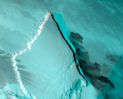
Io-Zal Patera-PIA02553.jpgThe "Zal" Patera77 visiteThis stereo image of Jupiter's moon Io shows the topography of a region on Io that includes the Zal Patera feature and a mountain or plateau that borders it to the west. It was created by combining two different views taken by NASA's Galileo spacecraft on November 25, 1999 (shown in red) and February 22, 2000 (shown in blue).
A mountain 120 kilometers (75 miles) wide rises to the west of the patera, a dark volcanic depression. By measuring the shadow, scientists were able to determine that the eastern margin of this mountain is about 1.5 kilometers (5000 feet) high. To the west and northwest, the mountain's margins are scalloped, which may indicate that a process called sapping is eroding them. Sapping occurs when fluid escapes from the base of a cliff, causing the material above it to collapse. Along the northwestern margin, the rough material at the base of the cliff maybe debris left over from the sapping process. Dark lava flows can be seen coming from a fissure to the east of the mountain.
Galileo scientists are in the process of generating topographic maps from these images. Such maps will reveal the heights and slopes of different landforms in this region, which will help scientists determine the strength and other properties of Io's surface materials. They will also be useful in understanding the processes of uplift and erosion on Io.
The picture is centered at 42.3 degrees north latitude and 76.9 degrees west longitude. North is to the top of the picture. The observations used to make the stereo image were made at ranges of 26,000 and 33,500 kilometers (16,200 and 20,900 miles) from Io. The resolution of the stereo image is about 335 meters (370 yards) per picture element.
|
|
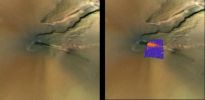
Io-Pele Volcano-PIA02560_modest.jpgThe "Pele" Volcano76 visitePele, one of Io's best-known volcanoes, was observed by the infrared spectrometer, an instrument onboard NASA's Galileo spacecraft, during the flyby of Jupiter's moon Io on February 22, 2000. The temperature map is shown here on the left in false color, superimposed on a visible color image of the Pele region obtained by the Voyager spacecraft in 1979. The red color represents the hottest lava flows. The purple colors are cooler materials. Preliminary results show that the temperatures of the hottest lava flows are at least 1,400 Kelvin (about 2,000 Fahrenheit), consistent with the temperatures of basaltic lava seen on the Kilauea volcano in Hawaii. It is possible that the eruption temperatures at Pele are even higher, as lava cools quickly once it starts to spread over the surface. The Voyager context image is 200 kilometers (124 miles) across.
|
|

Jupiter-Impact-2010-006.jpgAnother Impact on Jupiter?75 visiteAlcune immagini ad Alta Risoluzione scattate prima e dopo l'Evento Anomalo (impatto?) che ha coinvolto il Pianeta Giove.
Così come commentano gli Osservatori (che, come potete vedere, hanno ripreso il Gigante da svariate località), non c'era nessun segno visibile sul Gigante (nè in RGB, né UV, né Metano) il quale facesse da "testimone" della verificazione di un impatto.
Infatti, a parte le ben visibili turbolenze che usualmente caratterizzano l'Alta Atmosfera Gioviana e la chiara di una macchia scura circolare (si tratta dell'ombra di uno dei Satelliti Galileiani - probabilmente Ganimede), non vi è traccia alcuna di "cicatrici atmosferiche" le quali possano far supporre l'avvenuta verificazione di un Evento d'Impatto.MareKromium
|
|

Jupiter-Upper_Atmosphere-PIA16837-PCF-LXTT-IPF.jpgInside Jupiter's Atmosphere (Absolute Natural Colors; credits for the additional process. and color.: Dr Paolo C. Fienga/Lunar Explorer Italia/Italian Planetary Foundation)75 visiteThe Jupiter's "Dark Hot Spot" visible in this image - taken on December, 13 of the AD 2000 by the NASA - Cassini Spacecraft Imaging Science Subsystem (while Cassini was on its way to the Saturnian System) - is, in a manner of speaking, a "window" that opens deep inside into Jupiter's Upper Atmosphere. In fact, all around the Dark Hot Spot, there are Layers of higher Clouds, with shapes and colors that can help us to identify which Layer of the Jovian Amosphere they actually belong to.
For instance, the three small gray-bluish Clouds visible to to the right of the frame, are located in the Jovian Upper Troposphere, or perhaps even higher, into the Jovian Stratosphere. On the other hand, the large Gray Band located under the Dark Hot Spot (inside which can be - really - barely seen a few bizarre-looking dense Cloud Formations), is positioned in the Lower Troposphere of Jupiter. In addition, a high, gauzy orangish Haze seems to cover a large portion of the frame.
This picture (which is an Original NASA - Cassini Spacecraft b/w false-color frame published on the NASA - Planetary Photojournal with the ID n. PIA 16837) has been additionally processed and then re-colorized in Absolute Natural Colors (such as the colors that an average human eye would actually perceive if someone were onboard the NASA - CASSINI Spececraft and then looked outside, towards the Jupiter), by using an original technique created - and, in time, dramatically improved - by the Lunar Explorer Italia Team.
Note: we apologize to our Readers, but some of the details (i.e.: a so-called "Gyre" and a "Plume") which characterize part of the dense Cloud-Formations located in the Lower Troposphere of Jupiter can ONLY be seen by watching the false-color version of this frame, as edited by NASA, and found in the Planetary Photojournal. If seen through "human eyes", the aformentioned details disappear almost completely (only the Plume, in fact, can be barely spotted, left of center of the gray Clouds-Band).MareKromium
|
|
| 325 immagini su 28 pagina(e) |
|
|
|
|
|
8 | |
|
|
|
|
|
|





