| |

| Piú viste - Jupiter: the "King" and His Moons |

JupiterSystem-050107_09.jpgThe "Galilean Family" of Jupiter86 visiteThis montage shows the best views of Jupiter's four large and diverse "Galilean" satellites as seen by the Long Range Reconnaissance Imager (LORRI) on the New Horizons spacecraft during its flyby of Jupiter in late February 2007. The four moons are, from left to right: Io, Europa, Ganymede and Callisto. The images have been scaled to represent the true relative sizes of the four moons and are arranged in their order from Jupiter.
Io, 3,640 kilometers (2,260 miles) in diameter, was imaged at 03:50 Universal Time on February 28 from a range of 2.7 million kilometers (1.7 million miles). The original image scale was 13 kilometers per pixel, and the image is centered at Io coordinates 6 degrees south, 22 degrees west. Io is notable for its active volcanism, which New Horizons has studied extensively.
Europa, 3,120 kilometers (1,938 miles) in diameter, was imaged at 01:28 Universal Time on February 28 from a range of 3 million kilometers (1.8 million miles). The original image scale was 15 kilometers per pixel, and the image is centered at Europa coordinates 6 degrees south, 347 degrees west. Europa's smooth, icy surface likely conceals an ocean of liquid water. New Horizons obtained data on Europa’s surface composition and imaged subtle surface features, and analysis of these data may provide new information about the ocean and the icy shell that covers it.
New Horizons spied Ganymede, 5,262 kilometers (3,268 miles) in diameter, at 10:01 Universal Time on February 27 from 3.5 million kilometers (2.2 million miles) away. The original scale was 17 kilometers per pixel, and the image is centered at Ganymede coordinates 6 degrees south, 38 degrees west. Ganymede, the largest moon in the solar system, has a dirty ice surface cut by fractures and peppered by impact craters. New Horizons’ infrared observations may provide insight into the composition of the moon’s surface and interior.
Callisto, 4,820 kilometers (2,995 miles) in diameter, was imaged at 03:50 Universal Time on February 28 from a range of 4.2 million kilometers (2.6 million miles). The original image scale was 21 kilometers per pixel, and the image is centered at Callisto coordinates 4 degrees south, 356 degrees west. Scientists are using the infrared spectra New Horizons gathered of Callisto’s ancient, cratered surface to calibrate spectral analysis techniques that will help them to understand the surfaces of Pluto and its moon Charon when New Horizons passes them in 2015.
MareKromium
|
|

Io-Natural_Colors-NASA.jpgIo (True Colors - credits: Galileo Project, JPL, NASA)86 visiteCaption NASA:"The strangest moon in the Solar System is bright yellow.
This picture, an attempt to show how Io would appear in the "true colors" perceptible to the average human eye, was taken in july 1999 by the Galileo Spacecraft that orbited Jupiter from 1995 to 2003.
Io's colors derive from Sulphur and molten Silicate Rock. The unusual Surface of Io is kept very young by its system of active volcanoes. The intense tidal gravity of Jupiter stretches Io and damps wobbles caused by Jupiter's other Galilean moons.
The resulting friction greatly heats Io's interior, causing molten rock to explode through the Surface. Io's volcanoes are so active that they are effectively turning the whole moon inside out. Some of Io's volcanic lava is so hot that it glows in the dark".MareKromium
|
|
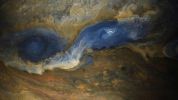
Jupiter-Juno-2024-6.jpgGas Storms86 visiteSome background information: after a journey lasting more than five years, the Juno spacecraft arrived in orbit around Jupiter on July 4, 2016. Distance from Earth: 1.74 billion miles. On October 24, it performed its eighth close flyby, passing through the planet's cloud cover and approaching to within just 3,400 kilometers of Jupiter's surface. Its mission? To collect data and images of the largest planet in our Solar System to transmit to Earth.
After a delay (Initial Phase) in data transmission, due to a solar conjunction in which communications between Jupiter and Earth were interrupted by its excessive proximity to the sun, the information, stored within the Juno probe, arrived at NASA, and the results are astonishing. The images show the planet's mysterious North and South Poles, as well as gigantic gas storms.
While we wait for new Fly-Vyes, we show you some beautiful images transmitted by the probe relating to the gas giant, the fifth planet of the Solar System.MareKromium
|
|
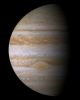
JUPITER from 10,1 MKM.jpgJupiter from 10,1 MKM85 visitePadre degli Dei e Signore incontrastato del Sistema Solare; troppo grande per essere solo un pianeta, ma troppo piccolo per diventare una stella. Con la sua luce giallo-arancio illumina i nostri cieli durante la notte ed è, assieme a Venere, uno dei primi astri ad essere visibile verso l'imbrunire ed è l'unico corpo celeste che può essere visto ad occhio nudo (sapendo dove guardare...) anche durante il giorno.
Questo è Giove.
|
|

Io_Europa-lor_0035136929_0x630_sci_1.jpgEuropa and Io in conjunction (1)85 visitenessun commentoMareKromium
|
|

Jupiter-changes.jpgChangings in the Atmosphere of Jupiter85 visiteStraordinario e, al momento, piuttosto inspiegabile: non credete?MareKromium
|
|

JupiterSpots-HST.jpgThe "Eyes" of Jupiter84 visiteFor about 300 years Jupiter's "Banded" Atmosphere has shown a remarkable feature to telescopic viewers, a large swirling storm system known as "The Great Red Spot". In 2006, another red storm system appeared, actually seen to form as smaller whitish oval-shaped storms merged and then developed the curious reddish hue. Now, Jupiter has a third red spot, again produced from a smaller whitish storm. All three are seen in this image made from data recorded on May 9 and 10 with the Hubble Space Telescope's Wide Field and Planetary Camera 2. The spots extend above the surrounding clouds and their red color may be due to deeper material dredged up by the storms and exposed to ultraviolet light, but the exact chemical process is still unknown. For scale, the Great Red Spot has almost twice the diameter of planet Earth, making both new spots less than one Earth-diameter across. The newest red spot is on the far left (West), along the same band of clouds as the Great Red Spot and is drifting toward it. If the motion continues, the new spot will encounter the much larger storm system in August. Jupiter's recent outbreak of red spots is likely related to large scale climate change as the gas Giant Planet is getting warmer near the Equator.MareKromium
|
|

JUPITER LIGHTNINGS.jpgJupiter's lightninghs83 visitenessun commento
|
|

Io-Fire Fountain from Earth-PIA02522.jpgA "Fire Fountain" on Io...from Earth!83 visiteIl 25 Novembre 1999, dall'Osservatorio di Mauna-Kea (Hawaii), viene osservata e ripresa questa straordinaria immagine relativa ad una gigantesca "flare" (o "Fontana di Luce") occorsa su Io. Noi riteniamo che immagini come questa siano destinate ad entrare nella Storia della Scienza, ed è un peccato che a questi fenomeni i mezzi di comunicazione di massa non dedichino - praticamente - alcun rilievo. Peccato, davvero peccato...
|
|

Io_Europa-040207.jpgIo and Europa, from New Horizons83 visiteThis beautiful image of the crescents of volcanic Io and more sedate Europa was snapped by New Horizons' color Multispectral Visual Imaging Camera (MVIC) at 10:34 UT on March 2, 2007, about two days after New Horizons made its closest approach to Jupiter.
The picture was one of a handful of the Jupiter System that New Horizons took primarily for their artistic, rather than scientific value. This particular scene was suggested by space enthusiast Richard Hendricks of Austin, Texas, in response to an Internet request by New Horizons scientists for evocative, artistic imaging opportunities at Jupiter.
This image was taken from a range of 4,6 MKM (about 2,8 MMs) from Io and 3,8 MKM (about 2,4 MMs) from Europa. Although the moons appear close in this view, a gulf of 790.000 Km (490.000 miles) separates them. The night side of Io is illuminated here by light reflected from Jupiter, which is out of the frame to the right. Europa's night side is completely dark, in contrast to Io, because that side of Europa faces away from Jupiter.
Here, Io steals the show with its beautiful display of volcanic activity. Three volcanic plumes are visible. Most conspicuous is the enormous 300-Km(190-mile) -high plume from the Tvashtar volcano at the 11 o'clock position on Io's disk. Two much smaller plumes are barely visible: one from the volcano Prometheus, at the 9 o'clock position on the edge of Io's disk, and one from the volcano Amirani, seen between Prometheus and Tvashtar along Io's Terminator (the line dividing day and night). The plumes appear blue because of the scattering of light by tiny dust particles ejected by the volcanoes, similar to the blue appearance of smoke. In addition, the contrasting red glow of hot lava can be seen at the source of the Tvashtar plume.
The images are centered at 1° North, 60° West on Io, and 0° North and 149° West on Europa.
The color in this image was generated using individual MVIC images at wavelengths of 480, 620 and 850 nanometers. The human eye is sensitive to slightly shorter wavelengths, from 400 to 700 nanometers, and thus would see the scene slightly differently. For instance, while the eye would notice the difference between the yellow and reddish brown colors of Io's surface and the paler color of Europa, the two worlds appear very similar in color to MVIC's longer-wavelength vision.
The night side of Io appears greenish compared to the day side, because methane in Jupiter's atmosphere absorbs 850-nanometer light and makes Jupiter-light green to MVIC's "eyes."
MVIC is a component of the Ralph imaging instrument. MareKromium
|
|

Jupiter-Juno-Lightning_Green.jpgGreen Light on Jupiter83 visiteIf that "Green Thing" is a true Lightning, then it is a VERY funny-looking one. But we are on Jupiter and so, everything is possible! At least, so the Scientists said, swearing on the Third Newton's Law.MareKromium
|
|

ZC-Jupiter from Mars-PIA04532_modest.jpgJupiter and 3 Galilean Moons from Mars82 visiteCi siamo chiesti tante volte, guardando Giove dalla Terra, come lo si vedrebbe da Marte. Ebbene, abbiamo trovato la risposta (grazie all'aiuto del Mars Global Surveyor Orbiter): in questo frame davvero eccezionale, Giove e 3 dei suoi 4 Satelliti Galileiani, così come li vedremmo da Marte! Un'immagine bellissima da guardare e su cui occorre riflettere molto. Perchè? Perchè conquistare lo Spazio, alle volte, vuol dire anche ampliare i confini dell'Immaginazione...
|
|
| 325 immagini su 28 pagina(e) |
|
|
|
|
|
7 | |
|
|
|
|
|
|





