| |

| Piú viste - Jupiter: the "King" and His Moons |

Io-lor_0034785119_0x630_sci_1~0.jpgIo, from New Horizon (Natural Colors; credits: Lunexit)92 visitenessun commentoMareKromium
|
|
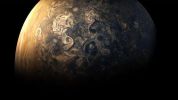
Jupiter-Juno-2024-Fra-5.jpgTurbulence Atmosphérique92 visiteQuelques informations de base : après un voyage de plus de cinq ans, la sonde Juno s'est mise en orbite autour de Jupiter le 4 juillet 2016. Distance de la Terre : 2,8 milliards de kilomètres. Le 24 octobre, elle a effectué son huitième survol rapproché, traversant la couche nuageuse de la planète et s'approchant à seulement 3 400 kilomètres de sa surface. Sa mission ? Collecter des données et des images de la plus grande planète de notre système solaire afin de les transmettre à la Terre.
Après un retard (phase initiale) dans la transmission des données, dû à une conjonction solaire durant laquelle les communications entre Jupiter et la Terre ont été interrompues par la proximité excessive de la planète avec le Soleil, les informations, stockées à bord de la sonde Juno, sont parvenues à la NASA, et les résultats sont stupéfiants. Les images révèlent les mystérieux pôles Nord et Sud de la planète, ainsi que d'immenses tempêtes de gaz.
En attendant de nouvelles images, nous vous présentons quelques magnifiques clichés transmis par la sonde, concernant cette géante gazeuse, la cinquième planète du système solaire.MareKromium
|
|

Jupiter-Impact-2010-005.jpgAnother Impact on Jupiter?91 visiteUN ALTRO BOLIDE ("FIREBALL") su Giove?
il giorno 20 Agosto 2010, alle ore 18:22 UT, un Astrofilo Giapponese, Masayuki Tachikawa, della città di Kumamoto, ha video-registrato quello che SEMBRA ESSERE l'aftermath di un impatto occorso sul Pianeta Giove.
Se l'ipotesi dell'impatto venisse confermata, questa sarebbe la terza volta in soli 13 mesi che gli Astrofili del Mondo intero rilevano segni di impatti su Giove. Gli eventi precedenti si sono verificati il 19 luglio 2009 ed il 3 Giugno 2010.
La maggiore speculazione che infiamma le più recenti discussioni riguardanti questo fenomeno ritiene che Giove possa essere colpito da bolidi (ed asteroidi?) assai più spesso di quanto si fosse finora ritenuto.
E' (anche) per questo motivo che svariati Ricercatori insistono a chiedere la creazione di una rete mondiale di telescopi destinati a monitorare costantemente il Gigante Gassoso e quindi (laddove possobile) a misurare le velocità d'impatto.
"Come l'evento del 3 giugno u.s., questo bolide non ha prodotto alcun residuo visibile", osserva comunque il Dr John Rogers, Direttore della sezione Giove della British Astronomical Association.MareKromium
|
|

Europa-Ridges-PIA17737-PCF-LXTT-IPF-1.jpgFeatures of Europa (Absolute Natural Colors; credits for the additional process. and color.: Dr Paolo C. Fienga/Lunar Explorer Italia/Italian Planetary Foundation)91 visiteThis image, taken by the NASA - Galileo Spacecraft on February, 2, 1999, shows us huge Cracks and Ridges on the Surface of the Jovian moon Europa. These (absolutely fascinating) Features reveal a complex Geologic History of Europa. Some Ridges, such as the prominent one, at the top right of the frame, develop into several long, arc-shaped "Cycloids" (---> a Cycloid is the curve traced by a point on the rim of a circular wheel as the wheel rolls along a straight line), that could reasonably be related to the changing Tidal Forces as Europa orbits the Gas-Giant Planet Jupiter. The Wall of this Ridge stands perhaps a third of a mile (approx. 0,5 Km) above the surrounding Ridged Plains, although their Edges are - likely - NOT as steep as they appear in this view.
The view was captured by the NASA - Galileo Spacecraft on February 2, 1999, during its E19 orbit, when the spacecraft was about 2500 miles (such as approx. 4023 km) from the Surface of Europa. The Resolution in the scene is roughly 295 feet (such as approx. 89.91 meters) per pixel. North is toward bottom left side of the picture.
This frame (which is a crop taken from an Original NASA - Galileo Spacecraft enhanced color image published on the NASA - Planetary Photojournal with the ID n. PIA 17737) has been additionally processed, contrast enhanced, magnified to aid visibility of the Surface details and then re-colorized, according to an educated guess carried out by Dr Paolo C. Fienga/LXTT/IPF, in what they should be its Absolute Natural Colors (such as the colors that a human eye would actually perceive if someone were onboard the NASA - Galileo Spacecraft and then looked outside, towards the Surface of the Jovian moon Europa), by using an original technique created - and, in time, dramatically improved - by the Lunar Explorer Italia Team. Different colors, as well as different shades of the same color, mean, among others, the existence of different Elements present on the Surface of Europa, each having a different Albedo (---> Reflectivity) and Chemical Composition.
Note: it is possible (but we, as IPF, have no way to be one-hundred-percent sure of such a circumstance), that the actual luminosity of Europa- as it is in this frame - would appear, to an average human eye, a little bit lower than it has been shown (or, better yet: interpreted) here.MareKromium
|
|

Jupiter_JUNO.gifUp, Down, like a Yo-Yo!91 visitenessun commentoMareKromium
|
|

Callisto-full disk-PIA03456_modest.jpgCallisto from Galileo90 visiteCaption NASA originale:"Bright scars on a darker surface testify to a long history of impacts on Jupiter's moon Callisto in this image of Callisto from NASA's Galileo spacecraft.
The picture, taken in May 2001, is the only complete global color image of Callisto obtained by Galileo, which has been orbiting Jupiter since December 1995. Of Jupiter's four largest moons, Callisto orbits farthest from the giant planet.
Callisto's surface is uniformly cratered but is not uniform in color or brightness. Scientists believe the brighter areas are mainly ice and the darker areas are highly eroded, ice-poor material".
|
|

Ganymede-V1-PIA02233-PCF-LXTT-IPF.jpgFeatures of Ganymede (Absolute Natural Colors; credits for the additional process. and color.: Dr Paolo C. Fienga/Lunar Explorer Italia/Italian Planetary Foundation)89 visiteThis frame was acquired by the NASA - Voyager 1 Spacecraft during its approach to Ganymede, from a distance of about 272.000 Km; the center of the picture lies at approx. 13° North Latitude and and 359° East Longitude. Ganymede (also known as Jupiter III) is the largest moon in the Solar System and the seventh moon (and third Galilean Satellite) outward from the Gas-Giant Planet Jupiter. Completing an orbit in roughly 7 (seven) Earth days, Ganymede participates in a 1:2:4 Orbital Resonance with the other Jovian moons Europa and Io, respectively. Ganymede has a diameter of about 5268 km (such as approx. 3273 miles), and, even though Ganymede is something like 8% larger than the planet Mercury, it only has about 45% of Mercury's mass; furthermore, its diameter is about 2% larger than the one of the Saturnian moon Titan, which is the second largest moon in the Solar System. Ganymede also has the highest mass of all Planetary Satellites, with approx. 2,02 times the mass of the Earth's Moon. This image shows detail on the Surface of Ganymede with a resolution of approx. 4,5 Km per pixel. What we see here, is a portion of a Region of Ganymede located in its Northern Hemisphere, near the Terminator. It shows a variety of Impact Structures, including both Rayed and Unrayed Impact Craters, as well as some odd-looking, Groove-like Surface Features (already discovered by the NASA - Voyager 1 Spacecraft in the lighter Regions of this Jovian moon). The most striking Surface Features, however, are the Bright Rayed Impact Craters which show a distinct light blueish color that, to some Observer, may also also appear white, with pink nuances, against the darker background. Ganymede's Surface is known to contain large amounts of Surface Water Ice and it appears that these (relatively) young Craters might have spread bright and (always relatively speaking) fresh Ice Materials all over the place. Likewise, the lighter color and Albedo (---> reflectivity) of the Grooved Areas suggests that over there, too, some cleaner and fresh Water Ice Material can be found. In fact, and as far as we know at the present day, Ganymede is composed of approximately equal amounts of Silicate Rock and Water Ice. It is a fully differentiated Celestial Body with an Iron-rich and still liquid core. Very recent studies suggest that, just like it has been speculated about the other Jovian moon Europa, even Ganymede may host a Subterranean Ocean, nearly 200 Km below its frozen Surface, somehow "sandwiched" between several different Layers of Rock and Ice. In addition to the above, the Surface of Ganymede is composed of two main types of Terrain: the Dark Terrain, saturated with Impact Craters and dated up to 4 (four) Billion Years ago (a Terrain that covers about a third of the moon), and the Lighter Terrain, which is crosscut by extensive Grooves and Ridges and that could be, likely, much less ancient. The cause of the Light Terrain's so-called "Disrupted Geology" is not yet fully known, but it could reasonably be the result of some powerful Tectonic Activity brought about by Tidal Heating (and let us not forget that Tidal Heating - due to Tidal Friction - may also be the primary reason why a Liquid Ocean can exist, deep down and inside the otherwise Frozen Crust of Ganymede). The NASA - Voyager 1 Spacecraft Original b/w frame has been additionally processed and then colorized, according to an informed speculation carried out by Dr Paolo C. Fienga (LXTT-IPF), in Absolute Natural Colors (such as the colors that a human eye would actually perceive if someone were onboard the NASA - Voyager 1 Spacecraft and then looked outside, towards the Jovian moon Ganymede), by using an original technique created - and, in time, dramatically improved - by the Lunar Explorer Italia Team. Different colors, as well as different shades of the same color, mean, among others, the existence of different Elements present on the Surface of Ganymede, each having a different Albedo (---> Reflectivity) and Chemical Composition.MareKromium
|
|

IO - TRUE COLOR FROM GALILEO.jpgIo in true colors88 visiteNASA's Galileo spacecraft acquired its highest resolution images of Jupiter's moon Io on 3 July 1999 during its closest pass to Io since orbit insertion in late 1995. This color mosaic uses the near-infrared, green and violet filters (slightly more than the visible range) of the spacecraft's camera and approximates what the human eye would see. Most of Io's surface has pastel colors, punctuated by black, brown, green, orange, and red units near the active volcanic centers. A false color version of the mosaic has been created to enhance the contrast of the color variations.
The improved resolution reveals small-scale color units which had not been recognized previously and which suggest that the lavas and sulfurous deposits are composed of complex mixtures (Cutout A of false color image). Some of the bright (whitish), high-latitude (near the top and bottom) deposits have an ethereal quality like a transparent covering of frost (Cutout B of false color image). Bright red areas were seen previously only as diffuse deposits. However, they are now seen to exist as both diffuse deposits and sharp linear features like fissures (Cutout C of false color image). Some volcanic centers have bright and colorful flows, perhaps due to flows of sulfur rather than silicate lava (Cutout D of false color image). In this region bright, white material can also be seen to emanate from linear rifts and cliffs.
Comparison of this image to previous Galileo images reveals many changes due to the ongoing volcanic activity.
Galileo will make two close passes of Io beginning in October of this year. Most of the high-resolution targets for these flybys are seen on the hemisphere shown here.
North is to the top of the picture and the sun illuminates the surface from almost directly behind the spacecraft. This illumination geometry is good for imaging color variations, but poor for imaging topographic shading. However, some topographic shading can be seen here due to the combination of relatively high resolution (1.3 kilometers or 0.8 miles per picture element) and the rugged topography over parts of Io. The image is centered at 0.3 degrees north latitude and 137.5 degrees west longitude. The resolution is 1.3 kilometers (0.8 miles) per picture element. The images were taken on 3 July 1999 at a range of about 130,000 kilometers (81,000 miles) by the Solid State Imaging (SSI) system on NASA's Galileo spacecraft during its twenty-first orbit.
|
|

Io_Europa-lor_0035136944_0x630_sci_1.jpgEuropa and Io in conjunction (2)87 visitenessun commentoMareKromium
|
|
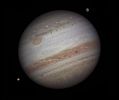
Jupiter-PIA14410.jpgJupiter and "Sons": Io and Ganymede87 visitenessun commentoMareKromium
|
|

Jupiter-WST.pngBeautiful Jupiter! - Credits JWST87 visitenessun commentoMareKromium
|
|

Europa-Lineae-Minos_Linea-PIA00275.jpgEuropa: Minos Linea (detail mgnf) - false colors86 visiteFalse color has been used here to enhance the visibility of certain features in this composite of 3 images of the Minos Linea region on Jupiter's moon Europa taken on 28 June 1996 Universal Time by the Solid State Imaging Camera on NASA's Galileo spacecraft. Triple bands, lineae and mottled terrains appear in brown and reddish hues, indicating the presence of contaminants in the ice. The icy plains, shown here in bluish hues, subdivide into units with different albedos at infrared wavelengths probably because of differences in the grain size of the ice.
The composite was produced using images with effective wavelengths at 989, 757 and 559 nnmts. The spatial resolution in the individual images ranges from 1,6 to 3,3 Km (about 1 to 2 miles) per pixel.
The area covered, centered at 45° North and 221° West, is about 1.260 Km (approx. 780 miles) across.
|
|
| 325 immagini su 28 pagina(e) |
|
|
|
|
6 | |
|
|
|
|
|
|
|





