| Piú viste - Jupiter: the "King" and His Moons |
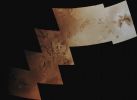
Io-Zamama_Patera-PIA03531-PCF-LXTT-IPF.jpgZamama (Absolute Natural Colors; credits for the additional process. and color.: Dr Paolo C. Fienga/Lunar Explorer Italia/Italian Planetary Foundation)102 visiteThe source area of what had been a towering Volcanic Plume in the middle of August of the AD 2001, lies in the far-right frame of this Image-Mosaic (of pictures taken by the NASA - Galileo Spacecraft on October, 16th, 2001) which shows us a portion of the Northern Latitudes of the Jovian "Volcanic" moon, Io. The Region showed in this Image-Mosaic includes the Zamama Lava Flow-Field, which emanates from the Northernmost of 2 (two) small Volcanoes visible in the far left frame. These Lava Flows were not present in any of the NASA - Voyager 1 Probe's images of Io, so it is logic to assume that they must have formed sometime between the NASA - Voyager 1 Fly-By (that occurred in the AD 1979) and the early observations of Io made by the NASA - Galileo Spacecraft and which took place in the AD 1996 (in addition to that, it has to be said that the NASA - Galileo Spacecraft also observed the Zamama Lava Flow-Field during the Io encounters that occurred in the AD 1999: a time when some NASA scientists identified narrow, long, dark Lava Flows which they thought to be relatively similar to other Lava Flows found on Planet Earth and, to be precise, in the Hawaii Islands).
Moving North/East, the second and third frames of this mosaic show a number of Lava Flow-Fields and several Unnamed Volcanic Depressions, known as "Paterae". It is still unclear whether the broad, shield-like features (or "Plateaux") on which the Paterae rest were created by Eruptions from the Paterae themselves, or if they were just preexisting Volcanic Features. Furthermore, some Fractures and Dark Lines suggest that the Crust of Io, in a few places of this Region, is breaking up, thus creating Cracks that Magma can use to rise up to the Surface. Finally, the far-right frame of this mosaic shows dark Lava Flows and bright "Spots". The bright "Spots" are probably Sulphur-bearing Plume Deposits, which are thought to be associated with the source of a Plume Eruption approx. 500 Km (such as about 310 miles) high, that was observed by the Galileo Spacecraft in August, 2001 (a Plume Eruption that actually was the largest one ever observed on Io).
This Image-Mosaic (which is an NASA - Original Galileo Spacecraft b/w Image-Mosaic published on May, 28th, 2002, on the NASA - Planetary Photojournal and identified by the serial n. PIA 03531) has been additionally processed and then colorized in Absolute Natural Colors (such as the colors that a human eye would actually perceive if someone were onboard the NASA - Galileo Spacecraft and then looked ahead, towards the Jovian moon Io), by using an original technique created - and, in time, dramatically improved - by the Lunar Explorer Italia Team.MareKromium
|
|

Europa,_Io_and_Jupiter.jpgOver the "Eye"102 visiteNice frame.MareKromium
|
|

Ganymede_-_Juno.jpgGanymede from Juno102 visitenessun commentoMareKromium
|
|
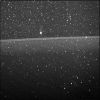
Jupiter-Juno-Rings.jpgFrom inside the Rings102 visitenessun commentoMareKromium
|
|

Io-flares and eruptions-PIA02254.jpgFlares and Eruptions on the limb of crescent Io98 visiteUn frame da ricordare, per bellezza ed importanza: ecco come appaiono le "flares" sul bordo di un pianeta in ombra. Sappiamo, in questo caso, che si tratta di eruzioni ed outgassing in corso e nessuno ne dubita. Tuttavia, quando fenomeni similari (o identici) vengono osservati sulla Luna, tutti (o quasi) gli Scienziati ed i Ricercatori si affrettano a dire che non è possibile e che deve trattarsi di sviste o bagliori da impatto. Ma perchè fa così paura l'idea che la Luna possa essere ancora in parte "viva"?
Voyager 2 took this picture of Io July 10, 1979, from a range of 1.2 million kilometers (750,000 miles). It was one of the last of an extensive sequence of "volcano watch" pictures planned as a time lapse study of the nearest of Jupiter's Galilean satellites. The sunlit crescent of Io is seen at the left, and the night side illuminated by light reflected from Jupiter can also be seen. Three volcanic eruption plumes are visible on the limb. All three were previously seen by Voyager 1. On the bright limb Plume 5 (upper) and Plume 6 (lower) are about 100 kilometers high, while Plume 2 on the dark limb is about 185 kilometers high and 325 kilometers wide. The dimensions of Plume 2 are about 1 1/2 times greater than during the Voyager 1 encounter, indicating that the intensity of the eruptions has increased during the four-month time interval between the Voyager encounters. The three volcanic eruptions and at least three others have apparently been active at roughly the same intensity or greater for a period of at least four months.
|
|

Callisto-Chain of craters-PIA00514_modest.jpgA chain of craters on Callisto98 visiteCaption NASA originale:"A portion of a chain of impact craters on Jupiter's moon Callisto is seen in this image taken by the Galileo spacecraft on November 4, 1996. This crater chain on Callisto is believed to result from the impact of a split object, similar to the fragments of Comet Shoemaker-Levy 9 which smashed into Jupiter's atmosphere in July of 1994".
|
|

Ganymede-P-51236218280_1b20779992_o.pngGanymede95 visitenessun commentoMareKromium
|
|

JUPITER_S_RINGS-01-PIA25038_width-640.jpg95 visiteCaption NASA Originale:"This high-resolution image of Jupiter's main dust ring was collected by the Stellar Reference Unit (SRU) navigation camera aboard NASA's Juno spacecraft. The image was taken from inside the ring looking out as Juno flew between Jupiter and the radiation belts during the spacecraft's 36th close flyby on Sept. 2, 2021. The brightest thin dust bands are associated with the orbits of Jupiter's small moons, Metis and Adrastea. The image is at a resolution of nearly 20 miles (32 kilometers) per pixel".MareKromium
|
|

JUPITER-Lightnings.jpgJupiter's Lightnings95 visiteIn the data from Juno’s first eight passes by the planet, the spacecraft’s Microwave Radiometer Instrument (MWR) detected 377 Jovian lightning discharges. Scientists saw that lightning on Jupiter can be as frequent as it is on Earth.MareKromium
|
|

Io-lor_0034685519_0x630_sci_1.jpgIo: the "Sulphur World" from New Horizons94 visitenessun commentoMareKromium
|
|

Io-Loki_Patera-PIA00320-PCF-LXTT-IPF.jpgVolcanic Plains and Paterae on Io: Loki Patera (Absolute Natural Colors; credits for the additional process. and color.: Dr Paolo C. Fienga/Lunar Explorer Italia/Italian Planetary Foundation)94 visiteA huge area of Io's Volcanic Plains is well shown in this mosaic of pictures taken by the NASA - Voyager 1 Space Probe. Numerous Volcanic Calderas and Lava Flows are visible here, including the Loki Patera (an active Lava Lake), which is the large shield-shaped and dark red Surface Feature visible in the lower right portion of the mosaic. As a matter of fact, the (sometime) intense light emitted from the Lava that boils inside Loki Patera can even be seen through telescopes, all the way from Earth, and these observations tell us that Loki has been active continuously (or at least every time an astronomer took a good look at it...) since the Voyager 1 Fly-By, which occurred in the month of March of the AD 1979.
The composition of Io's Volcanic Plains and Lava Flows has not been completely determined yet but, in the light of the information that we already possess (and, in particular, once we duly consider the orange-yellow color that can be seen over most of the Surface of Io), it is reasonable to say that they could dominantly consist of Sulphur, with Surface Frosts made of Sulphur Dioxide, Silicates (such as Basalts) encrusted with Sulphur and Sulphur Dioxide Condensates. The bright whitish patches, on the other hand, could probably consist of freshly deposited Sulphur Dioxide Frost. The dark red (and, sometime, almost black) spots, including Loki, are hot Sulphur Lava Lakes, which may remain molten even for a long time, thanks to the intrusions of molten Silicate Magma that (probably in an almost continuous way) comes up from deep inside Io. However, the very ultimate source of heat that keeps Io active, must be the Tidal (Frictional) Heating, due to the perpetual flexure of Io that is caused by the powerful Gravitational Influence of both Jupiter and Europa.
This picture (which is an Original NASA - Voyager 1 Space Proble color image mosaic published on the NASA - Planetary Photojournal with the n. PIA 00320) has been additionally processed and then re-colorized in Absolute Natural Colors (such as the colors that a human eye would actually perceive if someone were onboard the NASA - Voyager 1 Space Probe and then looked outside, towards the limb of the Jovian moon Io), by using an original technique created - and, in time, dramatically improved - by the Lunar Explorer Italia Team. Different colors, as well as different shades of the same color, mean, among others, the existence of different Elements present on the Surface of Io, each having a different Albedo (---> Reflectivity) and Chemical Composition.MareKromium
|
|

Io-lor_0035116949_0x630_sci_1.jpgMoments of Tvashtar (2)93 visitenessun commentoMareKromium
|
|
| 325 immagini su 28 pagina(e) |
 |
|
|
5 | |
|
|
|
|
|
|





