| |

| Piú viste - Jupiter: the "King" and His Moons |

Io-Natural_Colors-PCF-LXTT.jpgIo (Absolute Natural Colors; credits: Dr Paolo C. Fienga - Lunexit Team)120 visitenessun commentoMareKromium
|
|

Europa-PIA00874-PCF-LXTT.jpgEuropa's Leading Hemisphere (Absolute Natural Colors; credits for the additional process. and color.: Dr Paolo C. Fienga - Lunexit Team)118 visitenessun commentoMareKromium
|
|

Callisto-HR-01.jpgCallisto: North Pole and Northern Hemisphere (HR) - detail mgnf116 visitenessun commento
|
|

IO 6.jpgIo (On top of the erupting volcano)114 visiteForse l'immagine più famosa di un vulcano attivo su "Io". Essa è stata usata non solo in tanti documentari, ma anche - come fondale - per l'effettuazione del film "2010 - Odissea 2", in una sequenza in cui due Astronauti (un Russo ed un Americano) si spostano dall'Astronave Leonov alla Discovery, sospesa in quello che tecnicamente si chiama "Punto Lagrangiano" - o di equilibrio gravitazionale - fra Giove ed Io.
This color picture of Io, Jupiter's innermost Galilean satellite, was taken by Voyager 1 on the morning of March 5, 1979 at a range of 128,500 kilometers (77,100 miles). It is centered at 8 south latitude and 317 longitude. The width of the picture is about 1000 kilometers (600 miles). The diffuse reddish and orangish colorations are probably surface deposits of sulfur compounds, salts and possibly other volcanic sublimates. The dark spot with the irregular radiating pattern near the bottom of the picture may be a volcanic crater with radiating lava flows.
|
|

Io-PIA10249.jpgTvashtar Eruption from New Horizons109 visiteCaption NASA:"This New Horizons image of Jupiter's volcanic moon Io was taken at 13:05 Universal Time during the Spacecraft's Jupiter flyby on February 28, 2007. It shows the reddish color of the deposits from the giant volcanic eruption at the volcano Tvashtar, near the top of the sunlit crescent, as well as the bluish plume itself and the orange glow of the hot lava at its source. The relatively unprocessed image on the left provides the best view of the volcanic glow and the plume deposits, while the version on the right has been brightened to show the much fainter plume, and the Jupiter-lit night side of Io.
New Horizons' color imaging of Io's sunlit side was generally overexposed because the Spacecraft's color camera, the super-sensitive Multispectral Visible Imaging Camera (MVIC), was designed for the much dimmer illumination at Pluto. However, two of MVIC's four color filters, the blue and "Methane" filter (a special filter designed to map Methane frost on the Surface of Pluto at an infrared wavelength of 0.89 microns), are less sensitive than the others, and thus obtained some well-exposed views of the surface when illumination conditions were favorable. Because only two color filters are used, rather than the usual three, and because one filter uses infrared light, the color is only a rough approximation to what the human eye would see.
The red color of the Tvashtar plume fallout is typical of Io's largest volcanic plumes, including the previous eruption of Tvashtar seen by the Galileo and Cassini Spacecrafts in 2000, and the long-lived Pele plume on the opposite side of Io. The color likely results from the creation of reddish three-atom and four-atom Sulfur molecules (S3 and S4) from plume gases rich in two-atom Sulfur molecules (S2 After a few months or years, the S3 and S4 molecules recombine into the more stable and familiar yellowish form of Sulfur consisting of eight-atom molecules (S8), so these red deposits are only seen around recently-active Io volcanos.
Though the plume deposits are red, the plume itself is blue, because it is composed of very tiny particles that preferentially scatter blue light, like smoke. Also faintly visible in the left image is the pale-colored Prometheus plume, almost on the edge of the disk on the Equator at the 9 o'clock position.
Io was 2,4 MKM from the Spacecraft when the picture was taken, and the center of Io's disk is at 77° West Longitude, 5° South Latitude. The Solar Phase Angle (such as the angle formed by the Sun, Io and New Horizons) was 107°".MareKromium
|
|

Jupiter-Red_Spot-BJ.jpgJupiter's Great Red Spot from Voyager 1 (Credit: NASA, JPL; Digital processing: Dr Björn Jónsson - IAAA)109 visiteCaption NASA:"It is a hurricane twice the size of the Earth. It has been raging at least as long as telescopes could see it, and shows no signs of slowing. It is Jupiter's Great Red Spot, the largest swirling storm system in the Solar System.
Like most astronomical phenomena, the Great Red Spot was neither predicted nor immediately understood after its discovery. Still today, details of how and why the Great Red Spot changes its shape, size, and color remain mysterious. A better understanding of the weather on Jupiter may help contribute to the better understanding of weather here on Earth.
The above image is a recently completed digital enhancement of an image of Jupiter taken in 1979 by the Voyager 1 Spacecraft as it zoomed by the Solar System's largest planet.
At about 117 AU from Earth, Voyager 1 is currently the most distant human made object in the Universe and expected to leave the entire Solar Heliosheath any time now".MareKromium
|
|
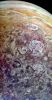
Jupiter-Juno-2024-Arabic-3.jpgتلاطم جوی109 visiteپس از سفری بیش از پنج سال، فضاپیمای جونو در ۴ ژوئیه ۲۰۱۶ به مدار مشتری رسید. فاصله از زمین: ۱.۷۴ میلیارد مایل. در ۲۴ اکتبر، هشتمین پرواز نزدیک خود را انجام داد و از میان پوشش ابری سیاره عبور کرد و به فاصله تنها ۳۴۰۰ کیلومتری سطح مشتری رسید. ماموریت آن؟ جمعآوری دادهها و تصاویر از بزرگترین سیاره منظومه شمسی برای ارسال به زمین.
پس از تأخیر (مرحله اولیه) در انتقال دادهها، به دلیل یک مقارنه خورشیدی که در آن ارتباطات بین مشتری و زمین به دلیل نزدیکی بیش از حد آن به خورشید قطع شد، اطلاعات ذخیره شده در کاوشگر جونو به ناسا رسید و نتایج شگفتانگیز است. تصاویر، قطبهای شمالی و جنوبی مرموز سیاره و همچنین طوفانهای گازی غولپیکر را نشان میدهند.
در حالی که منتظر عبورهای نزدیک جدید هستیم، تصاویر زیبایی را که توسط کاوشگر در رابطه با غول گازی، پنجمین سیاره منظومه شمسی، ارسال شده است، به شما نشان میدهیم.MareKromium
|
|

Jupiter.jpgA "Hole" in the King!107 visiteNaturalmente non è un "buco": solo l'ambra di Ganymede, che oscura una piccola Regione del Gigante Gassoso. Un raffronto fra questa immagine e quella che propone l'ombra di Io (PIA23437) potrebbe risultare interessante...MareKromium
|
|
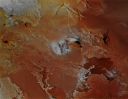
Io-Galai_Patera-PIA00324-PCF-LXTT-IPF.jpgVolcanic Plains and Paterae on Io: Galai Patera (Absolute Natural Colors; credits for the additional process. and color.: Dr Paolo C. Fienga/Lunar Explorer Italia/Italian Planetary Foundation)106 visiteIo's Volcanic Plains and at least 9 (nine) Paterae are shown, once again, in this really beautiful and highly suggestive NASA - Voyager 1 Space Probe image, which spans an area of about 1030 Km (such as approx. 640 miles) from left to right. North is at about the 01:30 o'clock position on the frame. A number of active Volcanic Calderae and huge Lava Flows are visible here: the most important (both for size and activity) is the dark red "teardrop-shaped" Surface Feature visible near the center of the frame, slightly to the right, which is Galai Patera, an approx. 100-Km-long (such as about 62 miles) Lava-flooded Caldera (---> Collapsed Vent). As we have already mentioned in yesterday's APOD, the exact composition of Io's Volcanic Plains and Lava Flows has not been determined yet; however, the prevalent yellow, brown, and orange materials may consist, dominantly, of Sulphur, with Surface Frosts made of Sulphur Dioxide and Silicates (such as Basalt), encrusted with Sulphur and Sulphur Dioxide Condensates. The dark red (and, sometime, almost black) spots visible all around the frame, of course including Galai Patera, are hot Sulphur Lava Lakes, which may remain molten for a long time, thanks to the intrusions of molten Silicate Magma that (probably in an almost continuous way) comes up from deep inside Io. Finally, the whitish patches visible at the upper left corner, in the center and on the lower left side of the picture are, most likely, Fresh Deposits of Sulphur Dioxide Frost.
This picture (which is an Original NASA - Voyager 1 Space Proble color image mosaic published on the NASA - Planetary Photojournal with the n. PIA 00324) has been additionally processed and then re-colorized in Absolute Natural Colors (such as the colors that a human eye would actually perceive if someone were onboard the NASA - Voyager 1 Space Probe and then looked outside, towards the limb of the Jovian moon Io), by using an original technique created - and, in time, dramatically improved - by the Lunar Explorer Italia Team. Different colors, as well as different shades of the same color, mean, among others, the existence of different Elements present on the Surface of Io, each having a different Albedo (---> Reflectivity) and Chemical Composition.MareKromium
|
|

Europa-PIA01212.jpgEuropa's terminator104 visiteThis image of Europa was obtained by the Solid State Imaging (CCD) System on board NASA's Galileo spacecraft during its 4th orbit of Jupiter. Linear features with bright central stripes referred to as "Triple Bands" (TB) are seen to transect the surface of Europa. Several of these TBs are over 700 Km in length. In the left side of the image the surface of Europa is seen to be locally pitted and irregular. Ridges less than 100 Km in length are also visible in this Region.
The area seen in this image, centered near 27° South and 300° West, is 760 (456 miles) by 850 Km (510 miles) across, which is approximately the size of the state of Texas or the country of France. North is to the top of the image, with the sun illuminating the surface from the left. The image which has a resolution of 1,3 Km per picture element (e cioè "per pixel") was obtained on December, 19th, 1996.
|
|

IO 4.jpgIo (Flying over a volcanic eruption and a sea of sulphur - Tvashtar Catena)103 visiteAn active volcanic eruption on Jupiter's moon Io was captured in this image taken on February 22, 2000 by NASA's Galileo spacecraft. Tvashtar Catena, a chain of giant volcanic calderas centered at 60 degrees north, 120 degrees west, was the location of an energetic eruption caught in action in November 1999. A dark, "L"-shaped lava flow to the left of the center in this more recent image marks the location of the November eruption. White and orange areas on the left side of the picture show newly erupted hot lava, seen in this false color image because of infrared emission. The two small bright spots are sites where molten rock is exposed to the surface at the toes of lava flows. The larger orange and yellow ribbon is a cooling lava flow that is more than more than 60 kilometers (37 miles) long. Dark, diffuse deposits surrounding the active lava flows were not there during the November 1999 flyby of Io.
This color mosaic was created by combining images taken in the near-infrared, clear, and violet filters from Galileo's camera. The range of wavelengths is slightly more than that of the human eye. The mosaic has been processed to enhance subtle color variations. The bright orange, yellow, and white areas at the left of the mosaic use images in two more infrared filters to show temperature variations, orange being the coolest and white the hottest material. This picture is about 250 kilometers (about 155 miles) across. North is toward the top and illumination from the Sun is from the west (left).
|
|
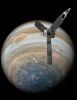
Jupiter-Juno-2024-1-Ita.jpgJ & J103 visiteAlcune informazioni di base: dopo un viaggio durato più di cinque anni, la sonda Juno è entrata in orbita attorno a Giove il 4 luglio 2016. Distanza dalla Terra: 1,74 miliardi di miglia. Il 24 ottobre ha effettuato il suo ottavo sorvolo ravvicinato, attraversando la coltre nuvolosa del pianeta e avvicinandosi a soli 3.400 chilometri dalla superficie di Giove. La sua missione? Raccogliere dati e immagini del pianeta più grande del nostro Sistema Solare da trasmettere sulla Terra.
Dopo un ritardo (Fase Iniziale) nella trasmissione dei dati, dovuto a una congiunzione solare che ha interrotto le comunicazioni tra Giove e la Terra a causa dell'eccessiva vicinanza al Sole, le informazioni, memorizzate nella sonda Juno, sono arrivate alla NASA e i risultati sono sorprendenti. Le immagini mostrano i misteriosi Poli Nord e Sud del pianeta, così come gigantesche tempeste di gas.
In attesa di nuovi sorvoli, vi mostriamo alcune splendide immagini trasmesse dalla sonda relative al gigante gassoso, il quinto pianeta del Sistema Solare.MareKromium
|
|
| 325 immagini su 28 pagina(e) |
|
|
4 | |
|
|
|
|
|
|
|
|
|





