| Piú viste - Jupiter: the "King" and His Moons |

Europa-PIA01405.jpgDark Region on Europa54 visiteThis view taken by NASA's Galileo spacecraft of Jupiter's icy moon Europa focuses on a dark, smooth Region whose center is the lowest area in this image. To the West (left), it is bounded by a cliff and terraces, which might have been formed by normal faulting. The slopes toward the East (right) leading into the dark spot are gentle. Near the center of the dark area, it appears the dark materials have covered some of the bright terrain and ridges. This suggests that when the dark material was deposited, it may have been a fluid or an icy slush. Only a few impact craters are visible, with some of them covered or flooded by dark material. Some appear in groups, which may indicate that they are secondary craters formed by debris excavated during a larger impact event. A potential source for these is the nearby crater Mannann`an.
North is to the top of the picture which is centered at 1° South Latitude and 225° West Longitude. The images in this mosaic have been re-projected to 50 mt/pixel.
|
|

Europa-PIA01144.jpgCold, cold world...54 visiteThis infrared image of Europa, showing heat radiation from its surface at a wavelength of 27 microns (millionths of a meter), provides the best view yet of Europa's daytime temperatures. Temperatures, derived from the brightness of the infrared radiation, can be determined from the colors by reference to the scale at the bottom of the image. The image, taken by Galileo spacecraft, shows the full disk of Europa, highly distorted by the relative motion of Europa and the spacecraft, centered on longitude 190°, with North at the top. The data show that midday temperatures at Europa's Equator reach about 130° Kelvin (-225 F). The surface is even colder toward the Poles and before or after midday.
Small patches of different colors on Europa's disk show regions that are warmer or cooler than their immediate surroundings: the warm patches are generally relatively dark and thus absorb more sunlight, than neighboring Regions, while the cool patches are relatively bright. In the lower left corner, heat radiation from Jupiter itself, appearing orange-red in this representation, can be seen peeking out from behind Europa's disk.
The image was taken with Galileo's PPR (Photopolarimeter-Radiometer) instrument on the spacecraft's seventh orbit around Jupiter, from a range of about 65,000 kilometers (40,389 miles). Surface temperatures derived from the strength of infrared radiation, as was done here, are called "brightness temperatures", and may be slightly in error.
The PPR instrument builds up an image by slowly scanning across the target over a period of up to one hour. The motion of Galileo relative to Europa during this time causes distortions in the satellite shape on the image, which therefore does not appear circular. The small overlapping circles that make up the image show the size of the area, about 160 kilometers (99 miles) across, covered by each individual PPR measurement. Blue spots in the dark sky in the right-hand portion of the image are due to noise.
|
|
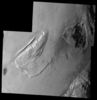
Io-PIA02555.jpgShamshu Mons and Patera from 34.500 Km54 visiteThis mosaic of images taken by NASA's Galileo spacecraft on February 22, 2000 shows 3 mountains and two lava-filled depressions in the Shamshu Region of Io. The dark oval feature on the left side is a depression that has been resurfaced by lava flows. The rough terrain North-East of the depression is Shamshu Mons. A 10-Km (6-mile) wide canyon oriented in North-East to South-West direction cuts this mountain. The northwestern edge of the mountain has been scalloped by erosion and it appears that the material has flowed along the canyon floor. Portions of 2 more mountains can be seen on the right side. The depression between these mountains is Shamshu Patera, a volcanic hotspot. The dark patches within it are recent and active lava flows. The northernmost edge of Shamshu Patera appears to be cutting into the mountain to its northeast. North is to the top of the picture and the Sun illuminates the surface from the West. This mosaic has a resolution of about 345 mt/pixel and covers an area of about 390x380 Km.
|
|
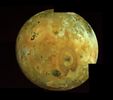
Io-PIA02294.jpgIo: full disk, from about 400.000 Km54 visitePerhaps the most spectacular of all the Voyager photos of Io is this mosaic obtained by Voyager 1 on March 5, 1979, at a range of 400.000 Km (approx.). A great variety of color and albedo is seen on the surface, now thought to be the result of surface deposits of various forms of Sulfur and Sulfur Dioxide. The two great volcanoes Pele and Loki (upper left) are prominent.
|
|

Europa-PIA01970.jpgApproaching Europa54 visiteCaption NASA originale:"View of Europa taken from a range of 2.869.252 Km (such as about 1,6 MMs). The color composite is made from three black and white images taken through the orange, green and violet filters. The 170° Longitude is at the center of the picture; this is the face away from Jupiter. Irregular dark and bright patches on the surface are different from the patterns on the other satellites of Jupiter and those on the Moon, Mars and Mercury. Dark intersecting lines may be faults that break the crust".
|
|
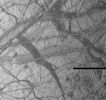
Europa-Ridges-PIA00518.jpgRidges on Europa54 visiteThis view of Jupiter's moon Europa shows a portion of the surface that has been highly disrupted by fractures and ridges. This picture covers an area about 238 Km (approx. 150 miles) wide by 225 Km (about 140 miles); in other words, the distance between Los Angeles and San Diego. Symmetric ridges in the dark bands suggest that the surface crust was separated and filled with darker material, somewhat analogous to spreading centers in the ocean basins of Earth. Although some impact craters are visible, their general absence indicates a youthful surface. The youngest ridges, such as the two features that cross the center of the picture, have central fractures, aligned knobs, and irregular dark patches. These and other features could indicate cryovolcanism, or processes related to eruption of ice and gases.
This picture, centered at 16° South Lat. and 196° West Long., was taken at a distance of 40.973 Km (about 25.290 mi) on November 6, 1996, by the Galileo spacecraft Solid State Imaging Television Camera.
|
|

Callisto-HR-00.jpgCallisto: the full disk (HR)54 visitenessun commento
|
|

Callisto-HR-02.jpgCallisto: South Pole and Southern Hemisphere (HR) - detail mgnf54 visitenessun commento
|
|

Jupiter_s_Aurorae.jpgJovian Aurorae54 visiteNASA's HST has recently taken images of Jupiter in support of the New Horizons Mission. The images were taken with Hubble's Wide Field Planetary Camera 2 and the Advanced Camera for Surveys. Hubble will continue to photograph Jupiter, as well as its volcanically active moon, Io, over the next month as the New Horizons spacecraft flies past Jupiter. New Horizons is en route to Pluto, and made its closest approach to Jupiter on February 28, 2007. Through combined remote imaging by Hubble and in situ measurements by New Horizons, the two missions will enhance each other scientifically, allowing scientists to learn more about the Jovian atmosphere, the Aurorae, and the charged-particle environment of Jupiter and its interaction with the Solar Wind.
For this photo, the combined ultraviolet- and visible-light images of Jupiter were taken with Hubble from February 17-21. The image segments in the boxes, obtained using the Advanced Camera for Surveys's ultraviolet camera, show auroral emissions that are always present in Jupiter's polar regions. The equatorial regions of Jupiter were imaged in blue light by the Wide Field Planetary Camera 2. Cloud features in Jupiter's main atmosphere are revealed. In the ultraviolet views, the atmosphere looks more hazy because sunlight is reflected from higher in the atmosphere.MareKromium
|
|

Europa-PIA10149.jpgThe Inner Ocean of Europa54 visiteCaption NASA:"Like Earth, Europa is thought to have an iron core, a rocky mantle and a surface ocean of salty water. Unlike on Earth, however, this ocean is deep enough to cover the whole moon, and being far from the Sun, the ocean surface is globally frozen over.
Europa's orbit is eccentric, which means as it travels around Jupiter, large tides, raised by Jupiter, rise and fall. Jupiter's position relative to Europa is also seen to librate, or wobble, with the same period. This tidal kneading causes frictional heating within Europa, much in the same way a paper clip bent back and forth can get hot to the touch, as illustrated by the red glow in the interior of Europa's rocky mantle and in the lower, warmer part of its ice shell. This tidal heating is what keeps Europa's ocean liquid and could prove critical to the survival of simple organisms within the ocean, if they exist".MareKromium
|
|

Io-TelegonusMensa-PIA03528_modest.jpgCollapsing Cliff at Telegonus Mensa (MULTISPECTRUM; credits: Lunexit)54 visiteCaption NASA:"This mosaic, showing an area called Telegonus Mensa, on Jupiter's moon Io and obtained by using frames taken by the NASA's Galileo Spacecraft on Oct. 16, 2001, reveal a complex interplay of geologic processes.
Four small, HR frames (9,6 mt, or 32 feet, per picture element) have been set into the larger context mosaic, which has a resolution of 42 mt (140 feet) per picture element. The illumination is from the upper right and North is to the top of the mosaic. A fracture runs North-West from the lower right corner of the mosaic into the amphitheater in the center of the frame. A HR image along this fracture reveals that lava has erupted from it.
The amphitheater itself is the site of extensive erosion, as the cliff has slumped South-Eastward under the influence of Io's gravity. HR frames directly south of the amphitheater show another slumping cliff in detail. Flat tops of massive slump blocks — up to 6 Km (3,7 miles) long and 0,5 Km (0,3 miles) across — are illuminated by the the Sun and cast shadows down the face of the cliff.
Based on these shadows, Galileo scientists estimate that the cliff is 1 to 2 Km high.
Just to the left of center a series of landslides can be seen, the longest of which extends for about 4 Km (such as approx. 2,5 miles)".MareKromium
|
|

Jupiter-V2-PIA01527_modest.jpgThe "Red Spot" of Jupiter53 visiteCaption NASA originale:"The region of white clouds now extends from east of the Red Spot and around its northern boundary, preventing small cloud vortices from circling the feature. The disturbed region west of the Red Spot has also changed since the equivalent Voyager 1 image. It shows more small scale structure and cloud vortices being formed out of the wave structures. The picture was taken on July 3, 1979, from about 6 MKM".
|
|
| 325 immagini su 28 pagina(e) |
 |
|
|
|
|
|
|
|
|
27 |
|





