| Piú viste - Jupiter: the "King" and His Moons |

Io-PIA00491.jpgIo: five views of the one and the same55 visiteFive color views of Jupiter's moon Io, as seen by NASA's Galileo spacecraft camera, were taken between the 25th and the 29th of June, 1996 Universal Time. The color is a composite of the red, green, and violet filters of the on board imaging system with the brightness of the violet bandpass increased to provide better color discrimination. The full disk images were intended for color mapping of Io's surface and for comparison to Voyager images. Where images overlap several features can be seen to change in relative brightness, perhaps due to unusual light scattering behavior or active phenomena. The crescent images were intended primarily for color imaging of active volcanic plumes on the bright limb and these images showed that the Voyager-era Loki plumes were no longer active and revealed a new plume at Ra Patera. The smallest features which can be discerned in the 5 views range from 9 to 23 kilometers and provide our best look at Io since the 1979 Voyager flybys. Sub-spacecraft longitudes on Io (from upper left to lower right) are 69, 338, 264, 211, and 221 W. North is to the top.
Launched in October 1989, Galileo entered orbit around Jupiter on December 7, 1995. The spacecraft's mission is to conduct detailed studies of the giant planet, its largest moons and the Jovian magnetic environment.
|
|

Io-PIA00715.jpgIo: three views of the one and the same55 visiteThree views of the full disk of Jupiter's volcanic moon, Io, each shown in natural and enhanced color. These three views, taken by Galileo in late June 1996, show about 75 percent of Io's surface. North is up. The top disks are intended to show the satellite in natural color (but colors will vary with display devices) while the bottom disks show enhanced color (near-infrared-, green-, and violet-filtered images) to highlight details of the surface. These images reveal that some areas on Io are truly red, whereas much of the surface is yellow or light greenish. (Accurate natural color renditions were not possible from the Voyager images taken during the 1979 flybys because there was no coverage in the red.) The reddish materials may be associated with very recent fragmental volcanic deposits (pyroclastics) erupted in the form of volcanic plumes. Dark materials appear in flows and on caldera floors. Bright white materials correspond to sulfur dioxide frost, and bright yellow materials appear to be in new flows such as those surrounding Ra Patera. The red material may be unstable since the color appears to fade over time. This fading appears to occur most rapidly in the equatorial region and more slowly over the polar regions; surface temperature may control the rate of transformation. Comparisons of these images to those taken by the Voyager spacecraft 17 years ago have revealed that many changes have occurred on Io. Since that time, about a dozen areas at least as large as the state of Connecticut have been resurfaced. Io's diameter is 3632 km.
|
|

Ganymede-PIA00707.jpgFine details of Ganymede icy-surface55 visiteDramatic view of fine details in ice hills and valleys in an unnamed region on Jupiter's moon Ganymede. North is to the top of the picture and the sun illuminates the surface from the left. The finest details that can be discerned in this picture are only 11 mt across (similar to the size of an average house) some 2000 times better than previous images of this region. The bright areas in the left hand version are the sides of hills facing the sun; the dark areas are shadows. In the right hand version the processing has been changed to bring out details in the shadowed regions that are illuminated by the bright hillsides. The brightness of some of the hillsides is so high that the picture elements "spill over" down the columns of the picture. The image was taken on June 28, 1996 from a distance of about 1000 Km.
|
|
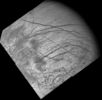
Europa-Craters-Unnamed_Crater-PIA00294.jpgFresh features on Europa55 visiteA newly discovered impact crater can be seen just right of the center of this image of Jupiter's moon Europa returned by NASA's Galileo spacecraft camera. The crater is about 30 kilometers (18.5 miles) in diameter. The impact excavated into Europa's icy crust, throwing debris (seen as whitish material) across the surrounding terrain. Also visible is a dark band, named Belus Linea, extending east-west across the image. This type of feature, which scientists call a 'triple band,' is characterized by a bright stripe down the middle. The outer margins of this and other triple bands are diffuse, suggesting that the dark material was put there as a result of possible geyser-like activity which shot gas and rocky debris from Europa's interior. The curving 'X' pattern seen in the lower left corner of the image appears to represent fracturing of the icy crust and infilling by slush which froze in place. The crater is centered at about 2 degrees north latitude by 239 degrees west longitude. The image was taken from a distance of 156,000 kilometers (about 96,300 miles) on June 27, 1996, during Galileo's first orbit around Jupiter. The area shown is 860 by 700 kilometers (530 by 430 miles), or about the size of Oregon and Washington combined.
|
|
Europa-PIA00295.jpgEuropa: a splendid frame (in Super HD)55 visiteDark crisscrossing bands on Jupiter's moon Europa represent widespread disruption from fracturing and the possible eruption of gases and rocky material from the moon's interior in this four-frame mosaic of images from NASA's Galileo spacecraft. These and other features suggest that soft ice or liquid water was present below the ice crust at the time of disruption. The data do not rule out the possibility that such conditions exist on Europa today. The pictures were taken from a distance of 156,000 kilometers (about 96,300 miles) on June 27, 1996. Many of the dark bands are more than 1,600 kilometers (1,000 miles) long, exceeding the length of the San Andreas fault of California. Some of the features seen on the mosaic resulted from meteoritic impact, including a 30- kilometer (18.5 mile) diameter crater visible as a bright scar in the lower third of the picture. In addition, dozens of shallow craters seen in some terrains along the sunset terminator zone (upper right shadowed area of the image) are probably impact craters. Other areas along the terminator lack craters, indicating relatively youthful surfaces, suggestive of recent eruptions of icy slush from the interior. The lower quarter of the mosaic includes highly fractured terrain where the icy crust has been broken into slabs as large as 30 kilometers (18.5 miles) across. The mosaic covers a large part of the northern hemisphere and includes the north pole at the top of the image. The sun illuminates the surface from the left. The area shown is centered on 20 degrees north latitude and 220 degrees west longitude and is about as wide as the United States west of the Mississippi River.
|
|

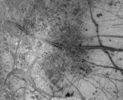
Europa-PIA01405.jpgDark Region on Europa55 visiteThis view taken by NASA's Galileo spacecraft of Jupiter's icy moon Europa focuses on a dark, smooth Region whose center is the lowest area in this image. To the West (left), it is bounded by a cliff and terraces, which might have been formed by normal faulting. The slopes toward the East (right) leading into the dark spot are gentle. Near the center of the dark area, it appears the dark materials have covered some of the bright terrain and ridges. This suggests that when the dark material was deposited, it may have been a fluid or an icy slush. Only a few impact craters are visible, with some of them covered or flooded by dark material. Some appear in groups, which may indicate that they are secondary craters formed by debris excavated during a larger impact event. A potential source for these is the nearby crater Mannann`an.
North is to the top of the picture which is centered at 1° South Latitude and 225° West Longitude. The images in this mosaic have been re-projected to 50 mt/pixel.
|
|

Europa-PIA01144.jpgCold, cold world...55 visiteThis infrared image of Europa, showing heat radiation from its surface at a wavelength of 27 microns (millionths of a meter), provides the best view yet of Europa's daytime temperatures. Temperatures, derived from the brightness of the infrared radiation, can be determined from the colors by reference to the scale at the bottom of the image. The image, taken by Galileo spacecraft, shows the full disk of Europa, highly distorted by the relative motion of Europa and the spacecraft, centered on longitude 190°, with North at the top. The data show that midday temperatures at Europa's Equator reach about 130° Kelvin (-225 F). The surface is even colder toward the Poles and before or after midday.
Small patches of different colors on Europa's disk show regions that are warmer or cooler than their immediate surroundings: the warm patches are generally relatively dark and thus absorb more sunlight, than neighboring Regions, while the cool patches are relatively bright. In the lower left corner, heat radiation from Jupiter itself, appearing orange-red in this representation, can be seen peeking out from behind Europa's disk.
The image was taken with Galileo's PPR (Photopolarimeter-Radiometer) instrument on the spacecraft's seventh orbit around Jupiter, from a range of about 65,000 kilometers (40,389 miles). Surface temperatures derived from the strength of infrared radiation, as was done here, are called "brightness temperatures", and may be slightly in error.
The PPR instrument builds up an image by slowly scanning across the target over a period of up to one hour. The motion of Galileo relative to Europa during this time causes distortions in the satellite shape on the image, which therefore does not appear circular. The small overlapping circles that make up the image show the size of the area, about 160 kilometers (99 miles) across, covered by each individual PPR measurement. Blue spots in the dark sky in the right-hand portion of the image are due to noise.
|
|
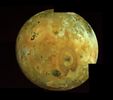
Io-PIA02294.jpgIo: full disk, from about 400.000 Km55 visitePerhaps the most spectacular of all the Voyager photos of Io is this mosaic obtained by Voyager 1 on March 5, 1979, at a range of 400.000 Km (approx.). A great variety of color and albedo is seen on the surface, now thought to be the result of surface deposits of various forms of Sulfur and Sulfur Dioxide. The two great volcanoes Pele and Loki (upper left) are prominent.
|
|
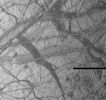
Europa-Ridges-PIA00518.jpgRidges on Europa55 visiteThis view of Jupiter's moon Europa shows a portion of the surface that has been highly disrupted by fractures and ridges. This picture covers an area about 238 Km (approx. 150 miles) wide by 225 Km (about 140 miles); in other words, the distance between Los Angeles and San Diego. Symmetric ridges in the dark bands suggest that the surface crust was separated and filled with darker material, somewhat analogous to spreading centers in the ocean basins of Earth. Although some impact craters are visible, their general absence indicates a youthful surface. The youngest ridges, such as the two features that cross the center of the picture, have central fractures, aligned knobs, and irregular dark patches. These and other features could indicate cryovolcanism, or processes related to eruption of ice and gases.
This picture, centered at 16° South Lat. and 196° West Long., was taken at a distance of 40.973 Km (about 25.290 mi) on November 6, 1996, by the Galileo spacecraft Solid State Imaging Television Camera.
|
|

Jupiter~1.jpgThe "Eyes" of Jupiter: a change of colors could mean a climate change?55 visiteJupiter's Great Red Spot is a swirling storm seen for over 300 years, since the beginning of telescopic observations. But in February 2006, planetary imager Christopher Go noticed it had been joined by Red Spot Jr - formed as smaller whitish oval-shaped storms merged and then developed the remarkable reddish hue. This sharp HST image showing the two salmon-colored Jovian storms was recorded in April 2006. About half the size of the original Red Spot, Red Spot Jr. is similar in diameter to planet Earth. Seen here below and left of the ancient storm system, it trails the Great Red Spot by about an hour as the planet rotates from left to right. While astronomers still don't exactly understand why Jupiter's red spots are red, they do think the appearance of Red Spot Jr. provides evidence for climate change on the Solar System's ruling Gas Giant.
|
|

Callisto-HR-00.jpgCallisto: the full disk (HR)55 visitenessun commento
|
|

Callisto-HR-02.jpgCallisto: South Pole and Southern Hemisphere (HR) - detail mgnf55 visitenessun commento
|
|
| 325 immagini su 28 pagina(e) |
 |
|
|
|
|
|
|
|
26 | |
|





