| |

| Piú viste - Jupiter: the "King" and His Moons |

Jupiter-033007.jpgStorm Spectra55 visiteThese images, taken with the LEISA infrared camera on the New Horizons Ralph instrument, show fine details in Jupiter's turbulent atmosphere using light that can only be seen using infrared sensors. These are "false color" pictures made by assigning infrared wavelengths to the colors red, green and blue. LEISA (Linear Etalon Imaging Spectral Array) takes images across 250 IR wavelengths in the range from 1.25 to 2.5 microns, allowing scientists to obtain an infrared spectrum at every location on Jupiter. A micron is one millionth of a meter.
These pictures were taken at 05:58 UT on February 27, 2007, from a distance of 2.9 million kilometers (1.6 million miles). They are centered at 8 degrees south, 32 degrees east in Jupiter "System III" coordinates. The large oval-shaped feature is the well-known Great Red Spot. The resolution of each pixel in these images is about 175 kilometers (110 miles); Jupiter's diameter is approximately 145,000 kilometers (97,000 miles).
The image on the left is an altitude map made by assigning the color red to 1.60 microns, green to 1.89 microns and blue to 2.04 microns. Because Jupiter's atmosphere absorbs light strongly at 2.04 microns, only clouds at very high altitude will reflect light at this wavelength. Light at 1.89 microns can go deeper in the atmosphere and light at 1.6 microns can go deeper still. In this map, bluish colors indicate high clouds and reddish colors indicate lower clouds. This picture shows, for example, that the Great Red Spot extends far up into the atmosphere.
In the image at right, red equals 1.28 microns, green equals 1.30 microns and blue equals 1.36 microns, a range of wavelengths that similarly probes different altitudes in the atmosphere. This choice of wavelengths highlights Jupiter's high-altitude south polar hood of haze. The edge of Jupiter's disk at the bottom of the panel appears slightly non-circular because the left-hand portion is the true edge of the disk, while the right portion is defined by the day/night boundary (known as the terminator).
These two images illustrate only a small fraction of the information contained in a single LEISA scan, highlighting just one aspect of the power of infrared spectra for atmospheric studies.
|
|

Io-New_Horizons.jpgIo (HR)55 visiteCaption NASA:"Spewed from a volcano, a complex plume rises over 300 Km above the horizon of Jupiter's moon Io in this image from cameras onboard the New Horizons spacecraft. The volcano, Tvashtar, is marked by the bright glow (about 1 o'clock) at the moon's edge, beyond the terminator or night/day shadow line. The shadow of Io cuts across the plume itself. Also capturing stunning details on the dayside surface, the high resolution image was recorded when the spacecraft was 2,3 MKM from Io. Later it was combined with lower resolution color data by astro-imager Sean Walker to produce this sharp portrait of the solar system's most active moon. Outward bound at almost 23 Km-per-second, the New Horizons spacecraft should cross the orbit of Saturn in June next year, and is ultimately destined to encounter Pluto in 2015".
|
|

Callisto-040507.jpgCallistus, from New Horizons55 visiteThe New Horizons Long Range Reconnaissance Imager (LORRI) captured these two images of Jupiter's outermost large moon, Callisto, as the spacecraft flew past Jupiter in late February.
New Horizons' closest approach distance to Jupiter was 2,3 MKM (about 1,4 MMs), not far outside Callisto's orbit, which has a radius of 1,9 MKM (about 1,2 MMs). However, Callisto happened to be on the opposite side of Jupiter during the spacecraft's pass through the Jupiter System, so these images, taken from 4,7 MKM (about 3 MMs) and 4,2 MKM (about 2,6 MMs) away, are the closest of Callisto that New Horizons obtained.
Callisto's ancient, crater-scarred surface makes it very different from its three more active sibling satellites, Io, Europa and Ganymede. Callisto, 4800 Km (about 3000 miles) in diameter, displays no large-scale geological features other than impact craters and every bright spot in these images is a crater. The largest impact feature on Callisto, the huge basin Valhalla, is visible as a bright patch at the 10 o'clock position. The craters are bright because they have excavated material relatively rich in water ice from beneath the dark, dusty material that coats most of the surface.
The two images show essentially the same side of Callisto - the side that faces Jupiter - under different illumination conditions. The images accompanied scans of Callisto's infrared spectrum with New Horizons' Linear Etalon Imaging Spectral Array (LEISA).
The New Horizons Science Team designed these scans to study how the infrared spectrum of Callisto's water ice changes as lighting and viewing conditions change, and as the ice cools through Callisto's late afternoon.
The infrared spectrum of water ice depends slightly on its temperature, and a goal of New Horizons when it reaches the Pluto system (in 2015) is to use the water ice features in the spectrum of Pluto's moon Charon, and perhaps on Pluto itself, to measure surface temperature.
Callisto provided an ideal opportunity to test this technique on a much better-known body.
The left image, taken at 05:03 Universal Time on February 27, 2007, is centered at 5° South, 5° West, and has a Solar Phase Angle of 46°. The right image was taken at 03:25 Universal Time on February 28, 2007. It is centered at 4° South, 356° West, and has a Solar Phase Angle of 76°.MareKromium
|
|

Ganymede-lor_0035286134_0x630_sci_1.jpgThe "obscure outline" of Ganymede (2)55 visiteDescription: Ganymede crossing crescent Jupiter
Time: 2007-03-04 03:50:16 UTC
Exposure: 80 msec
Target: GANYMEDE
Range: 5,9 MKM MareKromium
|
|

Europa-PIA10131.jpgThe Inner Ocean of Europa55 visiteCaption NASA:"Scientists are all but certain that Europa has an ocean underneath its icy surface, but they do not know how thick this ice might be. This artist concept illustrates 2 possible cut-away views through Europa's ice shell. In both, heat escapes, possibly volcanically, from Europa's rocky mantle and is carried upward by buoyant oceanic currents. If the heat from below is intense and the ice shell is thin enough (left), the ice shell can directly melt, causing what are called "chaos" on Europa, regions of what appear to be broken, rotated and tilted ice blocks. On the other hand, if the ice shell is sufficiently thick (right), the less intense interior heat will be transferred to the warmer ice at the bottom of the shell, and additional heat is generated by tidal squeezing of the warmer ice. This warmer ice will slowly rise, flowing as glaciers do on Earth, and the slow but steady motion may also disrupt the extremely cold, brittle ice at the surface.
Europa is no larger than Earth's moon, and its internal heating stems from its eccentric orbit about Jupiter, seen in the distance. As tides raised by Jupiter in Europa's ocean rise and fall, they may cause cracking, additional heating and even venting of water vapor into the airless sky above Europa's icy surface".MareKromium
|
|

Jupiter-00.jpgInternal Heat Drives Jupiter's Giant Storm Eruption (VL)55 visiteAn image of Jupiter in Visible-Light (VL) from NASA's Hubble Space Telescope (HST) on May 11, 2007 showing the turbulent pattern generated by the two plumes at the upper left part of Jupiter.
MareKromium
|
|
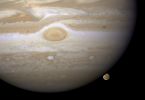
Jupiter-HST-2008-42-a-ful-001_jpg.jpgHiding... (natural colors; credits: NASA)55 visiteNASA's Hubble Space Telescope has caught Jupiter's moon Ganymede playing a game of "peek-a-boo", In this crisp Hubble image, Ganymede is shown just before it ducks behind the giant planet.
Ganymede completes an orbit around Jupiter every 7 days. Because Ganymede's orbit is tilted nearly edge-on to Earth, it routinely can be seen passing in front of and disappearing behind its giant host, only to reemerge later.
Composed of rock and ice, Ganymede is the largest moon in our Solar System. It is even larger than the planet Mercury.
But Ganymede looks like a dirty snowball next to Jupiter, the largest planet in our solar system. Jupiter is so big that only part of its Southern Hemisphere can be seen in this image.
Hubble's view is so sharp that astronomers can see features on Ganymede's surface, most notably the white impact crater, Tros, and its system of rays, bright streaks of material blasted from the crater. Tros and its ray system are roughly the width of Arizona.
The image also shows Jupiter's Great Red Spot, the large eye-shaped feature at upper left. A storm the size of two Earths, the Great Red Spot has been raging for more than 300 years. Hubble's sharp view of the gas giant planet also reveals the texture of the clouds in the Jovian Atmosphere as well as various other storms and vortices.
Astronomers use these images to study Jupiter's Upper Atmosphere. As Ganymede passes behind the giant planet, it reflects sunlight, which then passes through Jupiter's Atmosphere. Imprinted on that light is information about the gas giant's atmosphere, which yields clues about the properties of Jupiter's high-altitude haze above the cloud tops.
This color image was made from three images taken on April 9, 2007, with the Wide Field Planetary Camera 2 in red, green, and blue filters. The image shows Jupiter and Ganymede in close to natural colors.MareKromium
|
|
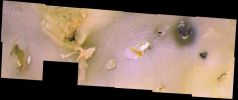
Io-Chain of Craters-PIA02566.jpgA chain of craters and "paterae" on Io54 visiteThis mosaic illustrates the range of "patera" morphology on Io.
But what is a "patera"? It is an irregular depression, or a complex one with scalloped edges, but which does not have the characteristics of an impact crater. The "paterae" on Io often correspond to active volcanic centers and are in some ways similar to calderas. What's a "caldera"? "Calderas" are large, usually roughly circular depressions that form by collapse over shallow magma chambers that have been partially emptied by volcanic eruptions. However, the "paterae" on Io are different from "calderas" seen elsewhere in the Solar System. They have many straight edges and sharp angles, suggesting that they are related to fractures in Io's crust. In many cases the lava can be seen to erupt from these straight edges. Planetary geologists aren't sure whether the paterae form over magma chambers or if they result from fractures and movements in the crust, and the lava subsequently follows the fractures.
|
|

Io-Zal Region-PIA02554.jpgZal Region on Io54 visiteThis image shows one of many intriguing mountains on Jupiter's moon Io. The image was made by combining a recent high-resolution, black and white image with earlier low-resolution color data to provide a high-resolution, color view. NASA's Galileo spacecraft took both images.
The 240-kilometer (150-mile) long mountain in the image is south of the volcanic hot spot named Zal. The black and white version of this image was useful for showing the shape of the mountain and the small fans of debris piled against the base of its tall, steep cliffs. However, when colorized the relationship between different types of materials becomes apparent. For example, the bright, red material is believed to contain a compound of sulfur that forms when sulfur is boiled at a high temperature. Active eruptions of molten rock (lava) are the most likely source for the heat. Thus we see red sulfur where lava reaches the surface. Other sulfur compounds cover the yellow areas, and the black areas are fresh silicate lava that has not yet been coated by the yellow sulfurous materials. The green patches are still somewhat mysterious; they appear to form when red sulfur lands on warm lava and the two react in a manner that is still unknown.
In this image, it is clear that the red material has blown out of a long crack along the western side of the mountain. Lava has flowed from this crack and filled a depression (caldera). Some of the red sulfur close to the dark caldera appears to have been converted into green material. The fact that lava comes up along the faults that define the sides of the mountains provides important clues to how the mountains form and the state of the interior of Io. Scientists at the University of Arizona speculate that the formation of the mountains on Io may be related to plumes of hot material rising inside the fiery body of Io.
North is to the top and the setting sun is shining from the west. The image is centered at about 33 degrees north, 72 degrees west. The high-resolution image was taken on February 22, 2000 by NASA's Galileo spacecraft. The image was taken by the Galileo's onboard camera from a range of 33,500 kilometers (20,800 miles) and has a resolution of 335 meters (1,100 feet) per picture element. The color images were taken on July 3, 1999. They have resolutions of 1.3 kilometers (0.81 miles) per picture element and are illuminated from almost directly behind the spacecraft. They were taken at a distance of about 130,000 kilometers(81,000 miles) from Io.
|
|

Io-Volcanic Plumes and Flares-PIA00703.jpgVolcanic activity on Io ("Plumes" and "Flares")54 visitenessun commento
|
|

Io-PIA00740.jpgThe "face" of Io54 visitenessun commento
|
|

Io-Plumes-PIA01081.jpgMore "Plumes" on Io54 visitenessun commento
|
|
| 325 immagini su 28 pagina(e) |
|
|
|
|
|
|
|
25 | |
|
|
|
|





