| Piú viste - Jupiter: the "King" and His Moons |

Ganymede-PIA00707.jpgFine details of Ganymede icy-surface55 visiteDramatic view of fine details in ice hills and valleys in an unnamed region on Jupiter's moon Ganymede. North is to the top of the picture and the sun illuminates the surface from the left. The finest details that can be discerned in this picture are only 11 mt across (similar to the size of an average house) some 2000 times better than previous images of this region. The bright areas in the left hand version are the sides of hills facing the sun; the dark areas are shadows. In the right hand version the processing has been changed to bring out details in the shadowed regions that are illuminated by the bright hillsides. The brightness of some of the hillsides is so high that the picture elements "spill over" down the columns of the picture. The image was taken on June 28, 1996 from a distance of about 1000 Km.
|
|

Ganymede-PIA00496.jpgFrost on crater-tops of Ganymede55 visiteScientists believe that water-ice frosts are the likely cause for the brightening seen around the circular rims of these craters located at a high northern latitude (57°) on Jupiter's moon Ganymede in this image taken by NASA's Galileo spacecraft on September 6, 1996. The image shows the same kind of bright, high-latitude surface areas as those first seen by the Voyager 1 spacecraft in 1979, but at higher resolution (this image spans about 18 Km - or 11 miles on a side). Even though the Sun is shining from the south, the north-facing walls of the ridges and craters are brighter than the walls facing the Sun. This is interpreted to mean that the very bright north-facing slopes are covered with surface water-ice frosts, and that these frosts preferentially accumulate in such high-latitude locations.
Galileo scientists say that at the HR seen in Galileo images, the high-latitude brightness seen by Voyager 1 might be partly attributable to frosts forming on cooler, north-facing slopes. The right-hand side of the image is dominated by a north-south line of impact craters; the smallest ones at the top are about 2 kilometers (1.2 miles) in diameter and the large one at the bottom is about 5 kilometers (about 3 miles) in diameter. Ganymede is the largest moon in the solar system, larger than the planet Mercury and nearly the size of Mars.
|
|

Europa-PIA00366.jpgEuropa: computer mosaic from Voyager 255 visiteEuropa looks like a cracked egg in this computer mosaic of the best Voyager 2 images. In this presentation, the variation of surface brightness due to the angle of the sun has been removed by computer processing, so that surface features can be seen equally well at all places. The many broad dark streaks show up well, but this presentation does not bring out the much fainter and more enigmatic light streaks. These pictures were taken from a distance of about 250.000 Km and show features as small as 5 Km across.
|
|

Europa-PIA01101.jpgWhen the Sun sets...On Europa55 visiteThis image of Europa was taken by the Galileo spacecraft under "low-Sun" illumination - the equivalent of taking a picture from a high altitude at Sunrise or Sunset. Note that in this image the topography of the terrain is emphasized. Planetary geologists use information from images acquired under a variety of lighting conditions to identify different types of structures and interpret how they formed. For example, the length of the shadow cast by a feature (e.g. a ridge or knob) is indicative of that feature's height. In this recent image, ridges and irregularly shaped knobs ranging in size from 5 Km across down to the limit of resolution (0,44 Km/pixel) can be seen. Measurements from shadow lengths indicate that features in this image range from tens of meters up to approx. 100 mt in height. The Galileo spacecraft acquired this image of Europa's surface during its 3rd orbit around Jupiter. The image covers an area of approx. 40 by 75 Km, centered near 10° South and 190° West.
|
|

Europa-PIA01401.jpgThe frozen Ocean of Europa55 visiteThis complex area on the side of Europa which faces away from Jupiter shows several types of features that are formed by disruptions of Europa's icy crust. North is to the top of the image, taken by NASA's Galileo spacecraft, and the Sun illuminates the surface from the left. The prominent wide, dark bands are up to 20 Km (about 12 miles) wide and over 50 Km (appx. 30 miles) long. They are believed to have formed when Europa's icy crust fractured, separated and filled in with darker, "dirtier" ice or slush from below. A relatively rare type of feature on Europa is the 15-Km-diameter (about 9,3-mile) impact crater in the lower left corner. The small number of impact craters on Europa's surface is an indication of its relatively young age. A region of chaotic terrain south of this impact crater contains crustal plates which have broken apart and rafted into new positions. Some of these "ice rafts" are nearly 1 Km (about 1/2 a mile) across.
Other regions of chaotic terrain are visible and indicate heating and disruption of Europa's icy crust from below. The youngest features in this scene are the long, narrow cracks in the ice which cut across all other features. One of these cracks is about 30 kilometers (18 miles) to the right of the impact crater and extends for hundreds of miles from the top to the bottom of the image.
|
|

Jupiter~1.jpgThe "Eyes" of Jupiter: a change of colors could mean a climate change?55 visiteJupiter's Great Red Spot is a swirling storm seen for over 300 years, since the beginning of telescopic observations. But in February 2006, planetary imager Christopher Go noticed it had been joined by Red Spot Jr - formed as smaller whitish oval-shaped storms merged and then developed the remarkable reddish hue. This sharp HST image showing the two salmon-colored Jovian storms was recorded in April 2006. About half the size of the original Red Spot, Red Spot Jr. is similar in diameter to planet Earth. Seen here below and left of the ancient storm system, it trails the Great Red Spot by about an hour as the planet rotates from left to right. While astronomers still don't exactly understand why Jupiter's red spots are red, they do think the appearance of Red Spot Jr. provides evidence for climate change on the Solar System's ruling Gas Giant.
|
|

Io-Tohill-Scarp-01.jpgThe mysterious Tohill Mons and Patera (2) - natural colors55 visitenessun commento
|
|

Io-Tohill-Scarp-00.jpgThe mysterious Tohill Mons and Patera (1) - natural colors55 visitenessun commento
|
|
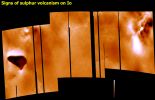
Io-Sulphur_Volcanism-Original_NASA_Galileo.jpgRecent Sulphur Volcanism on Io (natural colors)55 visitenessun commento
|
|

Io-022707_Erupt_on_Io.jpgRestless Tvashtar55 visiteThe first images returned to Earth by New Horizons during its close encounter with Jupiter feature the Galilean moon Io, snapped with the Long Range Reconnaissance Imager (LORRI) at 0840 UTC on February 26, while the moon was 2,5 MMs (about 4 MKM) from the spacecraft.
Io is intensely heated by its tidal interaction with Jupiter and is thus extremely volcanically active. That activity is evident in these images, which reveal an enormous dust plume, more than 150 miles high, erupting from the volcano Tvashtar. The plume appears as an umbrella-shaped feature of the edge of Io's disk in the 11 o'clock position in the right image, which is a long-exposure (20-millisecond) frame designed specifically to look for plumes like this. The bright spots at 2 o'clock are high mountains catching the setting sun; beyond them the night side of Io can be seen, faintly illuminated by light reflected from Jupiter itself.
The left image is a shorter exposure — 3 milliseconds — designed to look at surface features. In this frame, the Tvashtar volcano shows as a dark spot, also at 11 o'clock, surrounded by a large dark ring, where an area larger than Texas has been covered by fallout from the giant eruption.
This is the clearest view yet of a plume from Tvashtar, one of Io's most active volcanoes. Ground-based telescopes and the Galileo Jupiter orbiter first spotted volcanic heat radiation from Tvashtar in November 1999, and the Cassini spacecraft saw a large plume when it flew past Jupiter in December 2000. The Keck telescope in Hawaii picked up renewed heat radiation from Tvashtar in spring 2006, and just two weeks ago the Hubble Space Telescope saw the Tvashtar plume in ultraviolet images designed to support the New Horizons flyby.
The New Horizons images of the plume — which show features as small as 20 Km (12 miles), are 12 times sharper than the HST images and about three times sharper than the Cassini images. "This is the best image of a large volcanic plume on Io since the Voyager flybys in 1979" says John Spencer, deputy leader of the New Horizons Jupiter Encounter Science Team from Southwest Research Institute.
"If the Tvashtar plume remains active, the images we take later in the encounter should be even better".
|
|

Io-032807.jpgBurning Io!55 visiteNew Horizons captured this unique view of Jupiter's moon Io with its color camera - the Multispectral Visible Imaging Camera (MVIC) - at 00:25 UT on March 1, 2007, from a range of 2,3 MKM (about 1,4 MMs). The image is centered at Io coordinates 4°South lat. and 162° West Long., and was taken shortly before the complementary Long Range Reconnaissance Imager (LORRI) photo of Io released on March 13, which had higher resolution but was not in color.
Like that LORRI picture, this processed image shows the nighttime glow of the Tvashtar volcano and its plume rising 330 kilometers (200 miles) into sunlight above Io's north pole. However, the MVIC picture reveals the intense red of the glowing lava at the plume source and the contrasting blue of the fine dust particles in the plume (similar to the bluish color of smoke), as well as more subtle colors on Io's sunlit crescent. The lower parts of the plume in Io's shadow, lit only by the much fainter light from Jupiter, are almost invisible in this rendition. Contrast has been reduced to show the large range of brightness between the plume and Io's disk.
A component of the Ralph imaging instrument, MVIC has three broadband color filters: blue (480 nanometers), red (620 nm) and infrared (850 nm); as well as a narrow methane filter (890 nm). Because the camera was designed for the dim illumination at Pluto, not the much brighter sunlight at Jupiter, the red and infrared filters are overexposed on Io's dayside. This image is therefore composed from the blue and methane filters only, and the colors shown are only approximations to those that the eye would see. Nevertheless, the human eye would easily see the red color of the volcano and the blue color of the plume.
|
|

Jupiter-033007.jpgStorm Spectra55 visiteThese images, taken with the LEISA infrared camera on the New Horizons Ralph instrument, show fine details in Jupiter's turbulent atmosphere using light that can only be seen using infrared sensors. These are "false color" pictures made by assigning infrared wavelengths to the colors red, green and blue. LEISA (Linear Etalon Imaging Spectral Array) takes images across 250 IR wavelengths in the range from 1.25 to 2.5 microns, allowing scientists to obtain an infrared spectrum at every location on Jupiter. A micron is one millionth of a meter.
These pictures were taken at 05:58 UT on February 27, 2007, from a distance of 2.9 million kilometers (1.6 million miles). They are centered at 8 degrees south, 32 degrees east in Jupiter "System III" coordinates. The large oval-shaped feature is the well-known Great Red Spot. The resolution of each pixel in these images is about 175 kilometers (110 miles); Jupiter's diameter is approximately 145,000 kilometers (97,000 miles).
The image on the left is an altitude map made by assigning the color red to 1.60 microns, green to 1.89 microns and blue to 2.04 microns. Because Jupiter's atmosphere absorbs light strongly at 2.04 microns, only clouds at very high altitude will reflect light at this wavelength. Light at 1.89 microns can go deeper in the atmosphere and light at 1.6 microns can go deeper still. In this map, bluish colors indicate high clouds and reddish colors indicate lower clouds. This picture shows, for example, that the Great Red Spot extends far up into the atmosphere.
In the image at right, red equals 1.28 microns, green equals 1.30 microns and blue equals 1.36 microns, a range of wavelengths that similarly probes different altitudes in the atmosphere. This choice of wavelengths highlights Jupiter's high-altitude south polar hood of haze. The edge of Jupiter's disk at the bottom of the panel appears slightly non-circular because the left-hand portion is the true edge of the disk, while the right portion is defined by the day/night boundary (known as the terminator).
These two images illustrate only a small fraction of the information contained in a single LEISA scan, highlighting just one aspect of the power of infrared spectra for atmospheric studies.
|
|
| 325 immagini su 28 pagina(e) |
 |
|
|
|
|
|
24 | |
|
|
|





