| Piú viste - Jupiter: the "King" and His Moons |

Jupiter-V1-PIA01518_modest.jpgThe "Plume"56 visiteCaption NASA originale:"Reconstruction of a plume on Jupiter, photographed on March 1st, 1979".
Nota: in questo frangente per "plume" si intende uno 'sbuffo' di nuvole bianche e vaporose le quali si distinguono nettamente dal resto del paesaggio circostante.
L'espressione "plume", di regola, viene invece impiegata per indicare il 'pennacchio' di fumo che caratterizza i vulcani in fase eruttiva (innumerevoli sono, infatti, le "plumes" che vediamo sul piccolo - ma attivissimo! - Io).
|
|

Jupiter-WO-PIA01513_modest.jpgWhite Ovals on Jupiter56 visiteCaption NASA originale:"This photo of Jupiter was taken by Voyager 1 on March 1st, 1979, from a distance of 4.300.000 Km. The region shown is just to the southeast of the Great Red Spot. A small section of the spot can be seen at upper left. One of the 40-year-old white ovals in Jupiter's atmosphere can also be seen at middle left, as well as a wealth of other atmospheric features, including the flow lines in and around the ovals.
The smallest details that can be seen in this photo are about 80 Km across".
|
|

Jupiter-V1-PIA01324_modest.jpgCrescent Jupiter (from Voyager 1)56 visiteCaption NASA originale:"This crescent view of Jupiter was taken by Voyager 1 on March 24, 1979. This image was taken through three color filters and recombined to produce the color image. This photo was assembled from three black and white negatives by the Image Processing Lab at Jet Propulsion Laboratory".
|
|
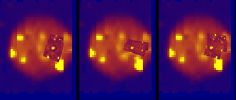
Io-active volcanoes-PIA02558_modest.jpgActive volcanoes on Io in 3 different months56 visiteCaption NASA originale:Changes in the volcanoes on Io can be seen in these 3 views, taken by NASA's Galileo spacecraft during its 3 flybys of Io in October and November 1999 and February 2000. All the images show the active volcanoes as bright yellow, corresponding to hot lava flows that appear glowing in infrared wavelengths. The 3 views were taken by the spacecraft's near-infrared mapping spectrometer and show the comparison of a typical low-resolution observation to the high-resolution views. The Prometheus volcano is seen near the middle of all three images. Before the recent flybys, only Prometheus and three other volcanoes were known to be active in this region. After these and other high-resolution observations, scientists were able to detect 14 volcanoes in the same area. The fainter volcanoes (hot spots) show some significant changes over intervals of 1 to 3 months. The area shown by all three observations put together is about 2 million square kilometers (about 770,000 square miles)".
|
|

Ganymede-PIA02582.jpgScarps on Ganymede56 visiteOriginal caption:"NASA's Galileo spacecraft took this image of dark terrain within Nicholson Regio, near the border with Harpagia Sulcus on Jupiter's moon Ganymede. The ancient, heavily cratered dark terrain is faulted by a series of scarps. The faulted blocks form a series of "stair-steps" like a tilted stack of books. On Earth, similar types of features form when tectonic faulting breaks the crust and the intervening blocks are pulled apart and rotate. This image supports the notion that the boundary between bright and dark terrain is created by that type of extensional faulting.
North is to the right of the picture and the Sun illuminates the surface from the west (top). The image is centered at -14° latitude and 320° longitude and covers an area approx. 16 by 15 Km (about 10 by 9 miles). The resolution is 20 mt (66 feet) per picture element. The image was taken on May 20, 2000, at a range of 2.090 Km (about 1.299 miles)".
|
|
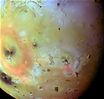
Io-Pele-PIA01112.jpgPele's deposits on Io56 visiteThe varied effects of Ionian volcanism can be seen in this false color infrared composite image of Io's Trailing Hemisphere. LR color data from Galileo's first orbit (June, 1996) have been combined with a HR clear filter picture taken on the third orbit (November, 1996) of the spacecraft around Jupiter. A diffuse ring of bright red material encircles Pele, the site of an ongoing, high velocity volcanic eruption. Pele's plume is nearly invisible, except in back-lit photographs, but its deposits indicate energetic ejection of sulfurous materials out to distances more than 600 Km from the central vent. Another bright red deposit lies adjacent to Marduk, also a currently active ediface. High temperature hot spots have been detected at both these locations, due to the eruption of molten material in lava flows or lava lakes. Bright red deposits on Io darken and disappear within years or decades of deposition, so the presence of bright red materials marks the sites of recent volcanism.
|
|

Europa-PIA02500.jpgFrozen H2SO4 (Sulphuric Acid) on Europa?56 visiteFrozen Sulfuric Acid on Jupiter's moon Europa is depicted in this image produced from data gathered by NASA's Galileo spacecraft. The brightest areas, where the yellow is most intense, represent Regions of high frozen Sulfuric Acid concentration. Sulfuric Acid is found in "exhaust battery acid" and in Earth's acid rain.
This image is based on data gathered by Galileo's NIMS (Near Infrared Mapping Spectrometer).
Europa's Leading Hemisphere is toward the bottom right and there are enhanced concentrations of Sulfuric Acid in the Trailing Side of Europa (the upper left side of the image). This is the face of Europa that is struck by sulfur ions coming from Jupiter's innermost moon, Io. The long, narrow features that criss-cross Europa also show Sulfuric Acid that may be from sulfurous material extruded in cracks.
Galileo, launched in 1989, has been orbiting Jupiter and its moons since December 1995.
|
|

Europa-Craters-Tyre_Crater-PIA00702.jpgTyre Crater (False Colors; credits for the additional process. and color.: NASA/JPL)56 visiteThis feature on Europa was seen as a dark, diffuse circular patch on a previous Galileo global image of Europa's Leading Hemisphere on April 3, 1997. The "bulls-eye" pattern appears to be a 140- Km-wide impact scar (about the size of the island of Hawaii) which formed as the surface fractured minutes after a mountain-sized asteroid or comet slammed into the satellite. This approx. 214-Km-wide picture is the product of 3 images which have been processed in false color to enhance shapes and compositions. North is toward the top of this picture, which is illuminated from sunlight coming from the West. This color composite reveals a sequence of events which have modified the surface of Europa. The earliest event was the impact which formed the Tyre structure at 34° North Latitude and 146,5° West Longitude. The impact was followed by the formation of the reddish lines superposed on Tyre. The red color designates areas that are probably a dirty water ice mixture. The fine blue-green lines crossing the region from west to east appear to be ridges which formed after the crater.
|
|

Europa-PIA00366.jpgEuropa: computer mosaic from Voyager 256 visiteEuropa looks like a cracked egg in this computer mosaic of the best Voyager 2 images. In this presentation, the variation of surface brightness due to the angle of the sun has been removed by computer processing, so that surface features can be seen equally well at all places. The many broad dark streaks show up well, but this presentation does not bring out the much fainter and more enigmatic light streaks. These pictures were taken from a distance of about 250.000 Km and show features as small as 5 Km across.
|
|

Europa-PIA01101.jpgWhen the Sun sets...On Europa56 visiteThis image of Europa was taken by the Galileo spacecraft under "low-Sun" illumination - the equivalent of taking a picture from a high altitude at Sunrise or Sunset. Note that in this image the topography of the terrain is emphasized. Planetary geologists use information from images acquired under a variety of lighting conditions to identify different types of structures and interpret how they formed. For example, the length of the shadow cast by a feature (e.g. a ridge or knob) is indicative of that feature's height. In this recent image, ridges and irregularly shaped knobs ranging in size from 5 Km across down to the limit of resolution (0,44 Km/pixel) can be seen. Measurements from shadow lengths indicate that features in this image range from tens of meters up to approx. 100 mt in height. The Galileo spacecraft acquired this image of Europa's surface during its 3rd orbit around Jupiter. The image covers an area of approx. 40 by 75 Km, centered near 10° South and 190° West.
|
|

Europa-mosaic-PIA01407.jpgDifferent surface features of Europa56 visite1. Triple bands and dark spots were the focus of some images from Galileo's eleventh orbit of Jupiter. Triple bands are multiple ridges with dark deposits along the outer margins. Some extend for thousands of kilometers across Europa's icy surface. They are cracks in the ice sheet and indicate the great stresses imposed on Europa by tides raised by Jupiter, as well as Europa's neighboring moons, Ganymede and Io. The dark spots or "lenticulae" are spots of localized disruption.
2. The Conamara Chaos region reveals icy plates which have broken up, moved, and rafted into new positions. This terrain suggests that liquid water or ductile ice was present near the surface. On Galileo's twelfth orbit of Jupiter, sections of this region with resolutions as high as 10 meters per picture element will be obtained.
3. Mannann'an Crater is a feature newly discovered by Galileo in June 1996. Color and high resolution images (to 40 meters per picture element) from Galileo's fourteenth orbit of Jupiter will offer a close look at the crater and help characterize how impacts affect the icy surface of this moon.
4. Cilix, a large mound about 1.5 kilometers high, is the center of Europa's coordinate system. Its concave top and what may be flow like features to the southwest of the mound are especially intriguing. The origin of this feature is unknown at present. Color, stereo, and high resolution images (to 65 meters per picture element) from Galileo's fifteenth orbit of Jupiter will offer new insights and resolve questions about its origin.
5. Images of Agenor Linea (white arrow) and Thrace Macula (black arrow) with resolutions as high as 30 meters per picture element will be obtained during Galileo's sixteenth orbit of Jupiter. Agenor is an unusually bright lineament on Europa. Is the brightness due to new ice, and if so, does it represent recent activity? Could the dark region of Thrace Macula be a flow from ice volcanism?
6. Images of Europa's south polar terrain obtained during Galileo's seventeenth orbit of Jupiter will offer insights into the processes which are active in this region. Is the ice crust thicker near Europa's poles than near the equator? The prominent dark line running from upper left to lower right through the center of this image is Astypalaea Linea. It is a fault about the length of the San Andreas fault in California and is the largest such fault known on Europa. Images with resolutions of 48 meters per picture element will be obtained to examine its geologic structure.
7. This long lineament, Rhadamanthys Linea. is spotted with dark "freckles". Are these freckle features formed by icy volcanism? Is this an early form of a triple band? Stereo and high resolution (to 46 meters per picture element) obtained during Galileo's eighteenth orbit of Jupiter may indicate whether the lineament is the result of volcanic processes or is formed by other surface processes.
8. During Galileo's nineteenth orbit of Jupiter, images of Europa will be taken with very low sun illuminations, similar to taking a picture at sunset or sunrise. The object will be to search for backlit plumes issuing from icy volcanic vents. Such plumes would be direct evidence of a liquid ocean beneath the ice. Resolutions will be as high as 40 meters per picture element. This picture was simulated image from Galileo data obtained during the spacecraft's second orbit of Jupiter in September 1996.
North is to the top of the pictures. During orbit 13, the Galileo spacecraft was behind the sun from our vantage point on Earth so it did not obtain or transmit data from that orbit. The left two images in the bottom row were obtained by NASA's Voyager 2 spacecraft in 1979; the remaining images were obtained by the Solid State Imaging (SSI) system on NASA's Galileo spacecraft in 1996.
|
|

Europa-PIA01404.jpgConamara Chaos Region (HR)56 visiteThis HR view of the Conamara Chaos Region on Jupiter's moon Europa, reveals craters which range in size from about 30 to over 450 mt (slightly over 1/4 of a mile) in diameter. The large number of craters seen here is unusual for Europa. This section of Conamara Chaos lies inside a bright ray of material which was ejected by the large impact crater, Pwyll, about 1000 Km (620 miles) to the South. The presence of craters within the bright ray suggests that many are secondaries which formed from chunks of material that were thrown out by the enormous energy of the impact which formed Pwyll. North is to the upper right of the picture and the Sun illuminates the surface from the East. The image, centered at 9° Latitude and 274° Longitude, covers an area of approx. 8 by 4 Km (such as about 5 by 2,5 miles). The finest details that can be discerned in this picture are about 20 mt (66 feet) across. The images were taken on December 16, 1997 from a distance of 960 Km from Europa.
|
|
| 325 immagini su 28 pagina(e) |
 |
|
|
|
|
23 | |
|
|
|
|





