| Piú viste - Jupiter: the "King" and His Moons |
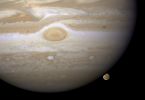
Jupiter-HST-2008-42-a-ful-001_jpg.jpgHiding... (natural colors; credits: NASA)57 visiteNASA's Hubble Space Telescope has caught Jupiter's moon Ganymede playing a game of "peek-a-boo", In this crisp Hubble image, Ganymede is shown just before it ducks behind the giant planet.
Ganymede completes an orbit around Jupiter every 7 days. Because Ganymede's orbit is tilted nearly edge-on to Earth, it routinely can be seen passing in front of and disappearing behind its giant host, only to reemerge later.
Composed of rock and ice, Ganymede is the largest moon in our Solar System. It is even larger than the planet Mercury.
But Ganymede looks like a dirty snowball next to Jupiter, the largest planet in our solar system. Jupiter is so big that only part of its Southern Hemisphere can be seen in this image.
Hubble's view is so sharp that astronomers can see features on Ganymede's surface, most notably the white impact crater, Tros, and its system of rays, bright streaks of material blasted from the crater. Tros and its ray system are roughly the width of Arizona.
The image also shows Jupiter's Great Red Spot, the large eye-shaped feature at upper left. A storm the size of two Earths, the Great Red Spot has been raging for more than 300 years. Hubble's sharp view of the gas giant planet also reveals the texture of the clouds in the Jovian Atmosphere as well as various other storms and vortices.
Astronomers use these images to study Jupiter's Upper Atmosphere. As Ganymede passes behind the giant planet, it reflects sunlight, which then passes through Jupiter's Atmosphere. Imprinted on that light is information about the gas giant's atmosphere, which yields clues about the properties of Jupiter's high-altitude haze above the cloud tops.
This color image was made from three images taken on April 9, 2007, with the Wide Field Planetary Camera 2 in red, green, and blue filters. The image shows Jupiter and Ganymede in close to natural colors.MareKromium
|
|

Jupiter-Impact04-PIA12147.jpgImpact on Jupiter!57 visitenessun commentoMareKromium
|
|

Orbital_Resonance.gifThe "Orbital Resonance" (GIF-Movie; credits: http://fisicaondemusica.unimore.it.)57 visitePremessa: il moto di un Corpo Celeste in orbita attorno ad un altro Corpo Celeste di massa molto maggiore (ex.: un pianeta attorno ad una stella, o un satellite attorno ad un pianeta) è un "Moto Periodico Semplice" ("Moto Circolare Uniforme").
Ora, può accadere che due (o più) pianeti si trovino ad orbitare attorno alla medesima stella (o che due - o più - satelliti si trovino ad orbitare attorno al medesimo "Parent Planet") con tempi di rivoluzione (---> i "Periodi del loro Moto") i quali stanno tra loro in rapporto di due piccoli interi (come 2:1, 2:3, ecc. - si legge "due a uno", "due a tre" etc.).
In questo caso, anche la loro reciproca attrazione gravitazionale verrà ad assumere un carattere di periodicità: essa cioè aumenterà quando i due pianeti si avvicinano, e diminuirà quando essi si allontanano.
Se queste variazioni della forza attrattiva gravitazionale sentita da ciascun pianeta saranno significative per la sua orbita, questa potrà modificarsi. Ed a tal punto sarà possibile identficare due scenari:
1) il moto dei pianeti diviene instabile: le orbite cambiano lentamente finché i due corpi non si influenzano più sensibilmente. (nota: nel caso di un Corpo Celeste Maggiore ed uno minore, questo effetto si risolverà nello "scacciare" il corpo minore da certe zone dello spazio, "liberando" la strada al Corpo Maggiore)
2) i due pianeti non si avvicinano mai abbastanza da influenzarsi violentemente, e quindi entrano in risonanza stabile.
(nota: le loro orbite, in questo caso, subiranno delle modificazioni le quali verranno poi compensate - rectius: annullate - dal verificarsi di modificazioni contrarie nell'arco di ogni rivoluzione)
per maggiori info: http://fisicaondemusica.unimore.it.MareKromium
|
|
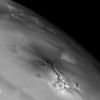
Io-PIA02232-1.jpgIo's Limb (RAW b/w NASA-Galileo Spacecraft Original Frame)56 visiteCaption NASA:"This picture of Io was taken on the morning of March 5 at a range of 75.445 Km. The area shown is at approx. 15° South Latitude and 244° East Longitude. Many depressions and elevations are shown. The light is coming from the left, so a depression has a bright right wall and shadow on the left wall. The depressions are complex in shape and do not resemble impact craters. Two of the depressions are joined by a shallow trough. The elevations are irregular and comical. They are cut by linear and irregular troughs. The surface is smooth and plain-like, that is, the surface is not pockmarked by abundant impact craters so are probably geologically young.
|
|

Io-The eruption of Pele-PIA00323.jpgThe eruption of "Pele" on Io56 visitenessun commento
|
|

Io-Southern Polar Region-PIA00327.jpgThe Southern Polar Region of Io56 visitenessun commento
|
|

Europa-V1-PIA00016-0.jpgEuropa56 visite"TUTTI QUESTI MONDI VI APPARTENGONO, TRANNE EUROPA: NON TENTATE DI ATTERRARVI.
VIVETECI INSIEME.
VICETECI IN PACE".
Ricordate questa "famosissima" trasmissione (diretta alla Terra ed all'equipaggio dell'astronave Sovietica "Leonov") proveniente dall'astronave Americana "Discovery", in quel momento guidata dall'Elaboratore HAL 9000?
Naturalmente stiamo parlando di "2010 - Odissea 2", il prosieguo cinematografico dell'immortale capolavoro di Sir Stanley Kubrick "2001 - A Space Odyssey".
Europa: la culla di una Nuova Civiltà, da studiare "restando lontani", così da non contaminarla con la nostra arroganza e supponenza.
Due film da rivedere e, dopo aver visto queste immagini, su cui provare a meditare...
|
|

Europa-Thera and Thrace Macula-PIA00875.jpg"Thera" and "Thrace" Macula on Europa56 visiteThis image of Europa's southern hemisphere was obtained by the solid state imaging (CCD) system on board NASA's Galileo spacecraft during its sixth orbit of Jupiter. The upper left portion of the image shows the southern extent of the "wedges" region, an area that has undergone extensive disruption. South of the wedges, the eastern extent of Agenor Linea (nearly 1000 kilometers in length) is also visible. Thera and Thrace Macula are the dark irregular features southeast of Agenor Linea. This image can be used by scientists to build a global map of Europa by tying such Galileo images together with images from 1979 during NASA's Voyager mission. Such lower resolution images also provide the context needed to interpret the higher resolution images taken by the Galileo during both its nominal mission and the upcoming Europa mission. North is to the top of the picture and the sun illuminates the surface from the right. The image, centered at -40 latitude and 180 longitude, covers an area approximately 675 by 675 kilometers. The finest details that can be discerned in this picture are about 3.3 kilometers across. The images were taken on Feb 20, 1997 at 12 hours, 55 minutes, 34 seconds Universal Time when the spacecraft was at a range of 81,707 kilometers.
|
|
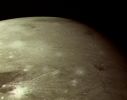
Ganymede-PIA01515.jpgThe North Pole of Ganymede (in real colors)56 visiteThis color picture as acquired by Voyager 1 during its approach to Ganymede on Monday afternoon (the 5th of March). At ranges between about 230 to 250 thousand km. The images show detail on the surface with a resolution of four and a half km. This picture is of a region in the northern hemisphere near the terminator. It shows a variety of impact structures, including both razed and unrazed craters, and the odd, groove-like structures discovered by Voyager in the lighter regions. The most striking features are the bright ray craters which have a distinctly 'bluer' color appearing white against the redder background. Ganymede's surface is known to contain large amounts of surface ice and it appears that these relatively young craters have spread bright fresh ice materials over the surface. Likewise, the lighter color and reflectivity of the grooved areas suggests that here, too, there is cleaner ice. We see ray craters with all sizes of ray patterns, ranging from extensive systems of the crater in the southern part of this picture, which has rays at least 300-500 kilometers long, down to craters which have only faint remnants of bright ejects patterns (such as several of the craters in the southern half of PIA01516; P21262). This variation suggests that, as on the Moon, there are processes which act to darken ray material, probably 'gardening' by micrometeoroid impact.
|
|

Ganymede-PIA00706.jpgCrescent Ganymede from Galileo56 visiteView of Ganymede from the Galileo spacecraft during its first encounter with the Jovian Satellite. North is to the top of the picture and the Sun illuminates the surface from the right. The finest details that can be discerned in this picture are about 6,7 Km across. It is 8:45:09 UT on June 26, 1996.
|
|

Callisto-Asgard emisph.-Gal-PIA01100_modest.jpgThe "Asgard" hemisphere of Callisto56 visiteCaption NASA originale:"False color view of a portion of the leading hemisphere of Jupiter's moon Callisto as seen through the infrared filters of the Solid State Imaging (CCD) system aboard NASA's Galileo spacecraft. North is to the top of the picture and the sun illuminates the surface from the east. More recent impacts have excavated bright, relatively clean ice from beneath Callisto's battered surface. Callisto's dark mottled appearance may be due to contamination by non-ice components contributed by impactors or concentrated in a residue as ice is removed".
|
|
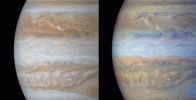
Jupiter-CH-PIA02877_modest.jpgReal Colors and False Colors of Jupiter56 visiteCaption NASA originale:"These color composite frames of the mid-section of Jupiter were of narrow angle images acquired on December 31, 2000, a day after Cassini's closest approach to the planet. The smallest features in these frames are roughly ~ 60 kilometers. The left is natural color, composited to yield the color that Jupiter would have if seen by the naked eye. The right frame is composed of 3 images: two were taken through narrow band filters centered on regions of the spectrum where the gaseous methane in Jupiter's atmosphere absorbs light, and the third was taken in a red continuum region of the spectrum, where Jupiter has no absorptions".
|
|
| 325 immagini su 28 pagina(e) |
 |
|
|
|
|
22 | |
|
|
|
|





