| |

| Piú viste - Jupiter: the "King" and His Moons |

Jupiter-20070323.gifWatch Jupiter and some of His Moons rotate! (GIF-Movie)56 visiteCaption NASA:"South is toward the top in this frame from a stunning movie featuring Jupiter and moons recorded last Thursday from the Central Coast of New South Wales, Australia. In fact, three Jovian Moons and two red spots are ultimately seen in the full video as they glide around the Solar System's ruling gas giant. In the early frame above, Ganymede, the largest moon in the Solar System, is off the lower right limb of the Planet, while intriguing Europa is visible against Jupiter's cloud tops, also near the lower right. Jupiter's new Red Spot junior is just above the broad white band in the Planet's Southern (upper) Hemisphere. In later frames, as Planet and moons rotate (right to left), red spot junior moves behind Jupiter's left edge while the Great Red Spot itself comes into view from the right. Also finally erupting into view at the right, is Jupiter's volcanic moon, Io (...)".
Note: click on the frame to see the movie
|
|

Io-050107_08.jpgVolcanic Lights In the Night of Io56 visiteThis unusual image shows Io glowing in the darkness of Jupiter's shadow. It is a combination of eight images taken by the New Horizons Long Range Reconnaissance Imager (LORRI) between 14:25 and 14:55 Universal Time on February 27, 2007, about 15 hours before the spacecraft's closest approach to Jupiter. North is at the top of the image.
Io's surface is invisible in the darkness, but the image reveals glowing hot lava, auroral displays in Io's tenuous atmosphere and volcanic plumes across the moon. The three bright points of light on the right side of Io are incandescent lava at active volcanoes - Pele and Reiden (south of the equator), and a previously unknown volcano near 22 degrees north, 233 degrees west near the edge of the disk at the 2 o'clock position.
An auroral glow, produced as intense radiation from Jupiter's magnetosphere bombards Io’s atmosphere, outlines the edge of the moon’s disk. The glow is patchy because the atmosphere itself is patchy, being denser over active volcanoes. In addition to the near-surface glow, there is a remarkable auroral glow suspended 330 kilometers (200 miles) above the edge of the disk at the 2 o'clock position; perhaps this glowing gas was ejected from the new volcano below it. Another glowing gas plume, above a fainter point of light, is visible just inside Io's disk near the 6 o'clock position; this plume is above another new volcanic eruption discovered by New Horizons.
On the left side of the disk, near Io's equator, a cluster of faint dots of light is centered near the point on Io that always faces Jupiter. This is the region where electrical currents connect Io to Jupiter's magnetosphere. It is likely that electrical connections to individual volcanoes are causing the glows seen here, though the details are mysterious.
Total exposure time for this image was 16 seconds. The range to Io was 2.8 million kilometers (1.7 million miles), and the image is centered at Io coordinates 7 degrees south, 306 degrees west. The image has been heavily processed to remove scattered light from Jupiter, but some artifacts remain, such as dark patches in the background.
MareKromium
|
|

Io-050107_07.jpgAs Time goes by...On Io!56 visiteThis montage compares similar sides of Io photographed by the Galileo spacecraft in October 1999 and the New Horizons spacecraft on February 27, 2007.
The New Horizons image was taken with its Long Range Reconnaissance Imager (LORRI) from a range of 2,7 MKM (about 1,7 MMs).
Most features on Io have changed little in the 7-plus years between these images, despite continued intense volcanic activity. The largest visible feature is the dark oval composed of deposits from the Pele Volcano, nearly 1200 Km (about 750 miles) across its longest dimension. At high Northern Latitudes, the volcano Dazhbog is prominent as a dark spot in the New Horizons image, near the edge of the disk at the 11 o'clock position. This volcano is much less conspicuous in the Galileo image. This darkening happened after this 1999 Galileo image but before Galileo took its last images of Io in 2001.
A more recent change, discovered by New Horizons, can be seen in the Southern Hemisphere (circled).
A new volcanic eruption - near 55° South and 290° West - has created a roughly circular deposit nearly 500 Km (about 300 miles) in diameter that was not seen by Galileo. Other New Horizons images show that the plume that created this deposit is still active.
The New Horizons image is centered at Io coordinates 8° South and 269° West.
MareKromium
|
|

Io-050107_03.jpgTvashtar's Rainbow...56 visiteVariations in the appearance of the giant plume from the Tvashtar volcano on Jupiter's moon Io are seen in this composite of the best photos taken by the New Horizons Long Range Reconnaissance Imager (LORRI) during its Jupiter flyby in late February-early March 2007.
New Horizons was fortunate to witness this unusually large plume during its brief Jupiter flyby; the Galileo Jupiter orbiter spent more than five years imaging the volcanic moon (between 1996 and 2001) without ever capturing such detailed pictures of a large Io plume. The plume is roughly 330 Km (about 200 miles) high. The cause of the fine wispy structure in the plume, which varies strikingly from image to image, is unknown, but these pictures may help scientists to understand the phenomenon.
The pictures were taken at distances ranging from 3,1 to 2,3 MKM (such as from 1,9 to 1,4 MMs), but they have been scaled to show the plume at the same relative size in every frame. Illumination conditions also vary: in the final image, Io's shadow cuts across the plume and hides all but its topmost regions, and the glow of hot lava can be seen on the nightside at the source of the plume.
The times of the images, from top to bottom, are: February 26, 18:38 (Universal Time); February 26, 21:01; February 28, 03:50; February 28, 04:40; February 28, 11:04 and March 1, 00:35.MareKromium
|
|

Europa-050107_01.jpgRising Europa56 visiteNew Horizons took this image of the icy moon Europa rising above Jupiter’s cloud tops with its Long Range Reconnaissance Imager (LORRI) at 11:48 Universal Time on February 28, 2007, six hours after the spacecraft’s closest approach to Jupiter.
The picture was one of a handful of the Jupiter System that New Horizons took primarily for artistic, rather than scientific, value. This particular scene was suggested by space enthusiast Richard Hendricks of Austin, Texas, in response to an Internet request by New Horizons scientists for evocative, artistic imaging opportunities at Jupiter.
The spacecraft was 2,3 MKM (about 1,4 MMs) from Jupiter and 3 MKM (such as about 1,8 MMs) from Europa when the picture was taken.
Europa's diameter is 3.120 kilometers (1.939 miles).
The image is centered on Europa coordinates 5° South and 6° West.
In keeping with its artistic intent - and to provide a more dramatic perspective - the image has been rotated so South is at the top.
Nota: in data 9 Maggio 2007, la NASA pubblica nel suo "Planetary Photojournal" questa medesima immagine con il medesimo titolo.
Se non altro, dato che sappiamo che la NASA legge Lunexit, ci farebbe piacere ricevere, di quando in quando, un "grazie per la collaborazione!"...MareKromium
|
|

Europa-1.jpgRising Europa56 visitenessun commentoMareKromium
|
|

Jupiter-02.jpgInternal Heat Drives Jupiter's Giant Storm Eruption (IR + VL)56 visiteDetailed analysis of two continent-sized storms that erupted in Jupiter's Atmosphere in March 2007 shows that Jupiter's internal heat plays a significant role in generating atmospheric disturbances. Understanding this outbreak could be the key to unlock the mysteries buried in the deep Jovian Atmosphere, say astronomers.
Understanding these phenomena is important for Earth's meteorology where storms are present everywhere and jet streams dominate the atmospheric circulation. Jupiter is a natural laboratory where atmospheric scientists study the nature and interplay of the intense jets and severe atmospheric phenomena.
An international team coordinated by Agustin Sánchez-Lavega from the Universidad del País Vasco in Spain presents its findings about this event in the January 24 issue of the journal Nature.
The team monitored the new eruption of cloud activity and its evolution with an unprecedented resolution using NASA's HST, the NASA Infrared Telescope Facility in Hawaii, and telescopes in the Canary Islands (Spain).
A network of smaller telescopes around the world also supported these observations.
According to the analysis, the bright plumes were storm systems triggered in Jupiter's deep water clouds that moved upward in the atmosphere vigorously and injected a fresh mixture of ammonia ice and water about 20 miles (30 Km) above the visible clouds. The storms moved in the peak of a jet stream in Jupiter's Atmosphere at 375 mph (600 Km/hour). Models of the disturbance indicate that the jet stream extends deep in the buried atmosphere of Jupiter, more than 60 miles (approx. 100 Km) below the cloud tops where most sunlight is absorbed.MareKromium
|
|
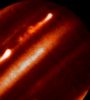
Jupiter-01.jpgInternal Heat Drives Jupiter's Giant Storm Eruption (IR)56 visiteAn image of Jupiter in infrared-light from NASA's Infrared Telescope Facility (IRTF) on April 5, 2007.
MareKromium
|
|

Io-100907_8.jpgIo: Global Map (false colors)56 visiteA: A global map of Jupiter’s moon Io derived from 8 images taken by the Long Range Reconnaissance Imager (LORRI) on the New Horizons Spacecraft, as it passed Jupiter on its way to Pluto in late February 2007. Details as small as 12 Km (7 miles) are visible. The map shows the comprehensive picture of Io’s volcanism obtained by New Horizons. Yellow ovals denote areas with new, faded or shifted plume deposits since the last images taken by the Galileo spacecraft in 2001. Green circles denote areas where probable new lava flows have occurred. Cyan diamonds indicate locations of active volcanic plumes, and orange hexagons are volcanic hot spots detected by the Linear Etalon Imaging Spectral Array (LEISA) instrument. For plumes and hot spots, symbol size indicates the approximate relative size and brightness of the features.
B-F: Comparison of New Horizons (NH) and earlier images of major surface changes discovered by New Horizons at Io’s volcanoes Masubi (45° South, 57° West) and North Lerna (55° South, 290° West). The scale bars are 200 Km long, and a is the solar phase angle. At Masubi, old lava flows seen by Voyager and Galileo (B) have been obscured at low phase angles (C) by deposits from two active plumes associated with a new 240-Km (150-mile) long dark lava flow, which is the longest lava flow known to have been erupted in the solar system since the discovery of Io volcanism in 1979. At North Lerna, a recent eruption has generated a 130-Km long lava flow (F), as well as an active plume that has produced a concentric pattern of deposits.
This image appears in the Oct. 12, 2007, issue of Science magazine, in a paper by John Spencer, et al.MareKromium
|
|

Io-PIA02520.jpgMountains on Io (MULTISPECTRUM; credits: Lunexit)56 visiteCaption NASA:"This image taken by NASA's Galileo Spacecraft during its close flyby of Jupiter's moon Io on November 25, 1999 shows some of the curious mountains found there. The Sun is illuminating the scene from the left, and because it is setting, the Sun exaggerates the shadows cast by the mountains. By measuring the lengths of these shadows, Galileo scientists can estimate the height of the mountains. The mountain just left of the middle of the picture is 4 Km (13.000 feet) high and the small peak to the lower left is 1,6 Km (5000 feet) high.
These mountains, like others imaged during a previous Galileo flyby of Io in October '99, seem to be in the process of collapsing. Huge landslides have left piles of debris at the bases of the mountains. The ridges that parallel their margins are also indicative of material moving down the mountainsides due to gravity.
North is to the upper left of the picture. The image, centered at 8,1° South Latitude and 78,7° East Longitude, covers an area approx. 210-by-110 Km (such as about 130-by-70 miles). The resolution is 267 meters (880 feet) per picture element.
The image was taken at a range of approx. 25.000 Km (about 16.000 miles) by Galileo's onboard camera".
MareKromium
|
|

Jupiter-HST~0.jpgThree "Red Spots" Mix it Up on Jupiter56 visiteThis sequence of Hubble Space Telescope images offers an unprecedented view of a planetary game of Pac-Man among 3 "Red Spots" clustered together in Jupiter's Atmosphere. The time series shows the passage of the "Red Spot Jr." in a band of clouds below (South) of the Great Red Spot (GRS). "Red Spot Jr." first appeared on Jupiter in early 2006 when a previously white storm turned red. This is the second time, since turning red, it has skirted past its big brother apparently unscathed. But this is not the fate of "Baby Red Spot", which is in the same latitudinal band as the GRS. This new red spot first appeared earlier this year. The Baby Red Spot gets ever closer to the GRS in this picture sequence until it is caught up in the anticyclonic spin of the GRS. In the final image the Baby Spot is deformed and pale in color and has been spun to the right (East) of the GRS.
These three natural-color Jupiter images were made from data acquired on May 15, June 28, and July 8, 2008, by the Wide Field Planetary Camera 2 (WFPC2).MareKromium
|
|
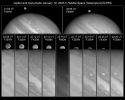
Jupiter-HST-2008-42-a-ful-004_jpg.jpgHiding: the whole sequence56 visiteThis series of images taken with NASA's Hubble Space Telescope shows Jupiter's largest moon, Ganymede, disappearing behind the Planet.
The top images show Ganymede next to Jupiter. The images were taken in blue and red light on Jan. 19, 2005 with Hubble's Advanced Camera for Surveys. The close-up images at bottom follow Ganymede as it ducks behind Jupiter a few minutes later.MareKromium
|
|
| 325 immagini su 28 pagina(e) |
|
|
|
|
|
21 | |
|
|
|
|
|
|





