| Piú viste - Jupiter: the "King" and His Moons |

Jupiter-PIA02873.jpgJupiter, from Cassini56 visiteOriginal caption:"This true-color simulated view of Jupiter is composed of 4 images taken by NASA's Cassini spacecraft on December 7, 2000. To illustrate what Jupiter would have looked like if the cameras had a field-of-view large enough to capture the entire Planet, the cylindrical map was projected onto a globe. The resolution is about 144 Km (about 89 miles) per pixel. Jupiter's moon Europa is casting the shadow on the Giant Gas Planet".
|
|

Jupiter-PIA02880.jpgThe "Heat" of Jupiter56 visiteOriginal caption:"These images taken through the wide angle camera near closest approach in the deep near-infrared methane band, combined with filters which sense electromagnetic radiation of orthogonal polarization, show that the light from the Poles of Jupiter is "polarized".
That is, the Poles appear bright in one image, and dark in the other. Polarized light is most readily scattered by aerosols. These images indicate that the aerosol particles at Jupiter's Poles are small and likely consist of aggregates of even smaller particles, whereas the particles at the Equator and covering the Great Red Spot are larger.
Images like these will allow scientists to ascertain the distribution, size and shape of aerosols, and consequently, the distribution of heat, in Jupiter's atmosphere".
|
|
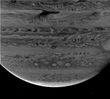
Jupiter-PIA02865-1.JPGJupiter's clouds - 619 nnmts filter56 visiteThe images shown here demonstrate the power of these filters in studies of cloud stratigraphy. The images cover latitudes from about 15° North at the top down to the Southern Polar Region at the bottom. (...)
The most prominent feature seen in all 3 filters is the Polar Stratospheric Haze that makes Jupiter bright near the Pole. The equatorial band is also very bright in the strong 890-nnmts image and to a lesser extent in the 727 band, but is subdued in the weak 619-nnmts image. These are high, thin, haze layers that are nearly transparent at wavelengths outside the methane absorption bands.
Another prominent feature is the Great Red Spot: about a third of it appears at the right-hand edge of the frame.
It is a bright feature in methane absorption because it has extensive cloud cover reaching to high altitude.
A wisp of high thin cloud can be seen trailing off its western rim in the 2nd and 3rd image.
|
|

Jupiter_s SouthPole-PIA07784.jpgThe South Pole of Jupiter56 visiteThe South Polar Regions shown here are less clearly visible because Cassini viewed them at an angle and through thicker atmospheric haze.
The round maps are polar stereographic projections that show the North or South Pole in the center of the map and the Equator at the edge.
|
|

The Galileans~0.jpgThe "Galileans"56 visiteIo, the large volcanic satellite of Jupiter, was first shown to the World in images transmitted from the Voyager 1 Spacecraft.
Unfortunately their cameras had no red filters and color pictures often had to be extrapolated substituting orange for red and violet for blue.
In the case of Io, this led to a garish 'pizza' appearance with many reproductions of the released images further wandering toward the red until Io looked like tomato soup!
Io is very bright, and largely a pale yellow with gray green to orange regions. Galileo has greatly refined the color information from Io. The albedo of Io (il primo a Sx) is a bright 0,6, while Europa (the brightest) is 0,64. Ganymede's albedo is just 0,42 and then - last - the dark Callisto is only 0,2.
|
|

Europa-PIA01126.jpgEuropa's Lanscape (HR)56 visiteThis mosaic shows some of the highest resolution images obtained by the Solid State Imaging (SSI) System on NASA's Galileo spacecraft during its 11th orbit around Jupiter. North is to the top of the image. The Sun illuminates the scene from the left, showing hundreds of ridges that cut across each other, indicating multiple episodes of ridge formation either by volcanic or tectonic activity within the ice. Also visible in the image are numerous isolated mountains or "massifs". The highest of these, located in the upper right corner and lower center of the mosaic, are approx. 500 mt (about 1.640 feet) high. Irregularly shaped areas where the ice surface appears to be lower than the surrounding plains (e.g., in the left-center and lower left corner of the mosaic) may be related to the "chaos" areas of iceberg-like features seen in earlier SSI images of Europa.
The mosaic, centered at 35,4° North Lat. and 86,8° West Long., covers an area of 108 by 90 Km (about 66 x 55 miles).
The smallest distinguishable features in the image are about 68 meters (223 feet) across. These images were obtained on November 6, 1997, when the Galileo spacecraft was approximately 3,250 kilometers (1,983 miles) from Europa.
|
|

Jupiter-2006-19-b-full_jpg.jpgJupiter's Red Spot Jr. and the surrounding "swirls"56 visitenessun commento
|
|

PSP_002162_9030_RED_browse.jpgJupiter from Mars56 visiteCaption NASA:"The HiRISE camera is the most powerful telescope to have left Earth orbit. As such, it is capable of some interesting astronomical observations.
This image of Jupiter and its major satellites was acquired to calibrate the pointing and color response of the camera. An oversight in planning this unusual observation put the focus mechanism in the wrong location, blurring the image. This does not detract from the calibration objectives, but makes the raw image less esthetic.
To compensate, the image has been "sharpened" on the ground by Dennis Gallagher, the HiRISE chief optical designer. With this sharpening, and because Mars is closer to Jupiter than Earth is, this image has comparable resolution as the HST's pictures of Jupiter.
The colors are not what is seen by the human eye because HiRISE is able to detect light with a slightly longer wavelength than we can (that is, the infrared)".MareKromium
|
|

Jupiter-NO-00-022807_3.jpgJupiter! (after New Horizons' Fly-By)56 visitenessun commentoMareKromium
|
|

Jupiter-20070323.gifWatch Jupiter and some of His Moons rotate! (GIF-Movie)56 visiteCaption NASA:"South is toward the top in this frame from a stunning movie featuring Jupiter and moons recorded last Thursday from the Central Coast of New South Wales, Australia. In fact, three Jovian Moons and two red spots are ultimately seen in the full video as they glide around the Solar System's ruling gas giant. In the early frame above, Ganymede, the largest moon in the Solar System, is off the lower right limb of the Planet, while intriguing Europa is visible against Jupiter's cloud tops, also near the lower right. Jupiter's new Red Spot junior is just above the broad white band in the Planet's Southern (upper) Hemisphere. In later frames, as Planet and moons rotate (right to left), red spot junior moves behind Jupiter's left edge while the Great Red Spot itself comes into view from the right. Also finally erupting into view at the right, is Jupiter's volcanic moon, Io (...)".
Note: click on the frame to see the movie
|
|

Io-050107_08.jpgVolcanic Lights In the Night of Io56 visiteThis unusual image shows Io glowing in the darkness of Jupiter's shadow. It is a combination of eight images taken by the New Horizons Long Range Reconnaissance Imager (LORRI) between 14:25 and 14:55 Universal Time on February 27, 2007, about 15 hours before the spacecraft's closest approach to Jupiter. North is at the top of the image.
Io's surface is invisible in the darkness, but the image reveals glowing hot lava, auroral displays in Io's tenuous atmosphere and volcanic plumes across the moon. The three bright points of light on the right side of Io are incandescent lava at active volcanoes - Pele and Reiden (south of the equator), and a previously unknown volcano near 22 degrees north, 233 degrees west near the edge of the disk at the 2 o'clock position.
An auroral glow, produced as intense radiation from Jupiter's magnetosphere bombards Io’s atmosphere, outlines the edge of the moon’s disk. The glow is patchy because the atmosphere itself is patchy, being denser over active volcanoes. In addition to the near-surface glow, there is a remarkable auroral glow suspended 330 kilometers (200 miles) above the edge of the disk at the 2 o'clock position; perhaps this glowing gas was ejected from the new volcano below it. Another glowing gas plume, above a fainter point of light, is visible just inside Io's disk near the 6 o'clock position; this plume is above another new volcanic eruption discovered by New Horizons.
On the left side of the disk, near Io's equator, a cluster of faint dots of light is centered near the point on Io that always faces Jupiter. This is the region where electrical currents connect Io to Jupiter's magnetosphere. It is likely that electrical connections to individual volcanoes are causing the glows seen here, though the details are mysterious.
Total exposure time for this image was 16 seconds. The range to Io was 2.8 million kilometers (1.7 million miles), and the image is centered at Io coordinates 7 degrees south, 306 degrees west. The image has been heavily processed to remove scattered light from Jupiter, but some artifacts remain, such as dark patches in the background.
MareKromium
|
|

Io-050107_07.jpgAs Time goes by...On Io!56 visiteThis montage compares similar sides of Io photographed by the Galileo spacecraft in October 1999 and the New Horizons spacecraft on February 27, 2007.
The New Horizons image was taken with its Long Range Reconnaissance Imager (LORRI) from a range of 2,7 MKM (about 1,7 MMs).
Most features on Io have changed little in the 7-plus years between these images, despite continued intense volcanic activity. The largest visible feature is the dark oval composed of deposits from the Pele Volcano, nearly 1200 Km (about 750 miles) across its longest dimension. At high Northern Latitudes, the volcano Dazhbog is prominent as a dark spot in the New Horizons image, near the edge of the disk at the 11 o'clock position. This volcano is much less conspicuous in the Galileo image. This darkening happened after this 1999 Galileo image but before Galileo took its last images of Io in 2001.
A more recent change, discovered by New Horizons, can be seen in the Southern Hemisphere (circled).
A new volcanic eruption - near 55° South and 290° West - has created a roughly circular deposit nearly 500 Km (about 300 miles) in diameter that was not seen by Galileo. Other New Horizons images show that the plume that created this deposit is still active.
The New Horizons image is centered at Io coordinates 8° South and 269° West.
MareKromium
|
|
| 325 immagini su 28 pagina(e) |
 |
|
|
|
|
20 | |
|
|
|
|





