| |

| Piú viste - Jupiter: the "King" and His Moons |

Europa_and_Jupiter.jpgI am speechless...166 visiteC'è un luogo del Sistema Solare dove pensiamo di trovare forme di vita extraterrestri. Ha un nome molto familiare ed è uno dei satelliti di Giove: si chiama Europa. Questo mondo ha delle caratteristiche geologiche che lo rendono estremamente interessante da decenni. Fuori è coperto da una spessa crosta ghiacciata, ma dentro contiene un enorme oceano, proprio come quelli che abbiamo qui sulla Terra (vedi Nota 1).
La sua caratteristica unica suggerisce che l'acqua oceanica può "in qualche modo muoversi attraverso il guscio e raggiungere la superficie", ha affermato Alyssa Rhoden, scienziato del Southwest Research Institute in Colorado. Se l'affermazione è, in effetti, vera, "i nutrienti e l'energia possono circolare tra l'oceano, il guscio di ghiaccio e la superficie, e questo può essere benefico per la vita".
L'imminente Europa Clipper della NASA è una missione rivoluzionaria per capire di più sul corpo planetario e sul suo potenziale di abitabilità. Verrà lanciato nel 2024 e arriverà nel 2030.
NASA's upcoming Europa Clipper is a groundbreaking mission to learn more about the planetary body and its potential for habitability. It will launch in 2024 and arrive in 2030.
Rhoden said, "I started researching Europa 22 years ago and have always had the same images to work with. So, I'd say I'm EXTREMELY excited about the new datasets that Clipper will provide. As for habitability, there are probably many ways it will inform us about it, but what I'm most interested in seeing is evidence of liquid water within the ice shell."
When asked what life might be found on Europa, Rhoden quipped, "Space whales, obviously." (See Note 2.)
Note 1: This information is over 28 years old;
Note 2: If this lady is a "scientist," then it's really over...MareKromium
|
|

Jupiter-PIA23437.jpgIo's Shadow164 visiteCaption NASA Originale:"Jupiter's volcanically active moon Io casts its shadow on the planet in this dramatic image from NASA's Juno Spacecraft. As with solar eclipses on the Earth, within the dark circle racing across Jupiter's cloud tops one would witness a full solar eclipse as Io passes in front of the Sun.
Such events occur frequently on Jupiter because it is a large planet with many moons. In addition, unlike most other planets in our solar system, Jupiter's axis is not highly tilted relative to its orbit, so the Sun never strays far from Jupiter's equatorial plane (+/- 3°). This means Jupiter's moons regularly cast their shadows on the planet throughout its year.
Juno's close proximity to Jupiter provides an exceptional fish-eye view, showing a small fraction near the planet's Equator. The shadow is about 2.200 miles (such as approx. 3.540,55 Km) wide, approximately the same width as Io, but appears much larger relative to Jupiter.
A little larger than Earth's Moon, Io is perhaps most famous for its many active volcanoes, often caught lofting fountains of ejecta well above its thin (?) Atmosphere.
Citizen scientist Kevin M. Gill created this enhanced-color image using data from the spacecraft's JunoCam imager. The raw image was taken on Sept. 11, 2019 at 8:41 p.m. PDT (11:41 p.m. EDT) as the Juno spacecraft performed its 22nd close fly-by of Jupiter. At the time the image was taken, the spacecraft was about 4.885 miles (approx. 7.861,64 Km) from the cloud tops at a Latitude of 21° North".
Nota: e per chi ha visto il famoso "2010 Odissea Due: l'Anno del Contatto", questa immagine dovrà "ricordare" qualcosa...MareKromium
|
|

Jupiter-PIA23606.jpgThe "Eye" of Jupiter160 visiteCaption NASA Originale:"Swirling in Jupiter's Atmosphere for hundreds of years, the Great Red Spot is captured in this pair of close-up images from Juno's JunoCam Camera. The giant storm churns through Jupiter's Atmosphere, creating the turbulent flows to its West. On the West-side of the Great Red Spot itself, a sliver of red material is being pulled off the periphery. This is a recent, frequent, phenomenon first observed in ground-based data in 2017.
Two images have been mosaicked together by citizen scientist Kevin M. Gill to create this enhanced color composite. When they were taken on Feb. 12, 2019 at 10:24 a.m. PDT (1:24 p.m. EDT) and 10:29 a.m. PDT (1:29 p.m. EDT), Juno was about 43.500 miles (such as about 70.006,464 Km) above Jupiter's cloud tops. Features as small as 31 miles (approx. 49,889 Km) can be resolved in the images, allowing us to see structure in the interior of the Great Red Spot, as well as the fine texture of the white clouds in the South Tropical Zone below".MareKromium
|
|

Europa-2-PCF-LXTT.jpgRising Europa (Absolute Natural Colors; credits for the additional process. and color.: Dr Paolo C. Fienga - Lunexit Team)159 visitenessun commentoMareKromium
|
|

Europa-Ridges-PIA00518-PCF-LXTT.jpgRidges on Europa (Absolute Natural Colors; credits for the additional process. and color.: Dr Paolo C. Fienga - Lunexit Team)156 visitenessun commentoMareKromium
|
|

Europa-HR-PCF-LXTT.jpgEuropa (Absolute Natural Colors; credits for the additional process. and color.: Dr Paolo C. Fienga - Lunexit Team)154 visitenessun commentoMareKromium
|
|

Europa-Craters-Mannann_an_Crater-PIA01402-PCF-LXTT-IPF.jpgFeatures of Mannann'an Crater (Absolute Natural Colors; credits for the additional process. and color.: Dr Paolo C. Fienga/Lunar Explorer Italia/Italian Planetary Foundation)153 visiteThis composite view taken by the NASA - Galileo Spacecraft, shows a portion of the Rim and the Interior of the Impact Crater known as Mannann'an, which is located on Jupiter's moon, Europa. A high resolution image (20 meters per picture element) was combined with a lower resolution one (80 meters per picture element), to produce this composite picture. The color data here can be used to distinguish between Regions where the Ice located on the Surface of Europa is purer (---> cleaner) from other areas where the Ice itself, instead, is more contaminated (---> dirty; mixed with other elements); the reddish/brown Surface Material visible to the West (Left side - Sx) of the frame is thought to be "dirty" Ice, while the white/bluish areas visible inside the Crater should be made of "cleaner" Ice. The Rim of Mannann'an is (barely visible) on the left of the composite, approx. at the boundary between the area with the higher concentration of reddish/brown Surface Material and the area where the white Surface Material is dominant. The high resolution data show several small Surface Features inside this Impact Crater, including Concentric Fractures and a Spider-like set of Fractures near the right (East) edge of the image.
North is to the top of the picture and the Sun illuminates the scene from the East (right - Dx). The image, which is centered at 3° North Latitude and 240° West Longitude, covers an area of approximately 18 by 4 Km (such as about 11,12 by 2,48 miles). The finest details that can be discerned in this picture are about 40 meters (44 yards) across. The images were taken by the Solid State Imaging Camera onboard Galileo, when the Spacecraft flew by Europa on March 29th, 1998, at a distance of 1934 Km (such aapprox. 1201 miles) from its Surface.
This frame (which is an Original NASA - Galileo Spacecraft false colors image composite published on the NASA - Planetary Photojournal with the ID n. PIA 01402) has been additionally processed and then re-colorized, according to an educated guess carried out by Dr Paolo C. Fienga (LXTT-IPF), in Absolute Natural Colors (such as the colors that a human eye would actually perceive if someone were onboard the NASA - Galileo Spacecraft and then looked outside, towards the Surface of the Jovian moon Europa), by using an original technique created - and, in time, dramatically improved - by the Lunar Explorer Italia Team. Different colors, as well as different shades of the same color, mean, among others, the existence of different Elements present on the Surface of Europa, each having a different Albedo (---> Reflectivity) and Chemical Composition.MareKromium
|
|

Jupiter-PIA23442.jpgOn the Limb...149 visiteCaption NASA Originale:"NASA's Juno spacecraft captured this impressive image revealing a band of swirling clouds in Jupiter's Northern Latitudes during Juno's close fly-by occurred on November, 3, 2019. Small pop-up storms can also be seen rising above the lighter areas of the clouds, most noticeably on the right side of the image.
This view provides scientists with high-resolution details — the spacecraft skimmed approximately 3.200 miles (such as about 5.149,9 Km) above Jupiter's cloud tops at the time it was taken.
Citizen scientist Björn Jónsson created this enhanced color image using data from the JunoCam camera. The picture, as we wrote above, was taken on November, 3, 2019 at 2:13 p.m. PST (5:13 p.m. EST) at a Latitude of about 38° North".MareKromium
|
|

Jupiter-PIA22936.jpgThe "Giant" from Earth149 visiteThis Earth-based observation of Jupiter and the South Tropical Disturbance approaching the Great Red Spot was captured on January, 26, 2018 by the Amateur Astronomer Christopher Go, who also processed the image.MareKromium
|
|
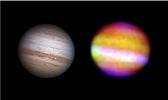
Jupiter_sofiawesley.jpgJupiter from the Stratosphere145 visiteDalla Rubruica "NASA - Picture of the Day", del giorno 3 Giugno 2010:"SOFIA, the Stratospheric Observatory for InfraRed Astronomy, captured its "first light" images on May 26, from an altitude of 35.000 feet.
While flying above most of planet Earth's InfraRed-absorbing water vapor, SOFIA's premier IR views of the cosmos included this remarkable false-color image (right panel) of Jupiter.
For comparison, on the left is a recent, ground-based visible light image. Both show our Solar System's ruling gas giant without its dark Southern Equatorial Belt (normally seen in the upper Hemisphere in this orientation). That familiar feature faded from view early in May. But the bright white stripe in SOFIA's image is a region of Jupiter's clouds transparent to IR Light, offering a glimpse below the cloud tops".MareKromium
|
|

Jupiter-White_Storm-PIA23445.jpgWhite Storm on Jupiter143 visiteCaption NASA Originale:"This view of Jupiter's Upper Atmosphere from NASA's Juno Spacecraft includes something remarkable: two storms caught in the act of merging.
The two white ovals seen within the orange-colored band left of center are Anticyclonic Storms — that is, storms that rotate counter-clockwise. The larger of the two ovals has been tracked for many years, as it grew in size through mergers with other Anticyclonic white ovals.
JunoCam was fortunate to capture this new merger, which typically takes place over the course of only a few days.
The event interests scientists because the ovals had approached each other months earlier, only to move apart again.
This merger may be the result of perturbations due to the proximity of Oval BA, which is the larger storm just to the North of the two merging, white ovals. Oval BA is the second largest Anticyclonic Vortex in Jupiter's Atmosphere (second only to the famous Great Red Spot). During this pass over Jupiter, Juno gave scientists their best views of Oval BA to date.
Citizen scientist Tanya Oleksuik created this color-enhanced image using data from the JunoCam camera. The original image was taken on December, 26, 2019, at 10:28 a.m. PST (1:28 p.m. EST) as the Juno Spacecraft performed its 24th close fly-by of the Planet. At the time, the Spacecraft was about 44.900 miles (such as approx. 72.259,54 Km) from the tops of Jupiter's clouds, at a latitude of about 60° South".MareKromium
|
|

Europa-Craters-Tyre_Crater-PIA00702-PCF-LXTT-IPF.jpgTyre Crater (Absolute Natural Colors; credits for the additional process. and color.: Dr Paolo C. Fienga/Lunexit Team/Italian Planetary Foundation)142 visiteThis unbelievably complex Surface Feature located on the Jovian moon Europa was originally seen as a dark, diffuse Circular Patch on a previous NASA - Galileo Spacecraft's global image of Europa's Leading Hemisphere taken on April 3, 1997. The "Bulls-Eye" pattern appears to be a 140- Km-wide Impact "Scar" (about the size of the island of Hawaii) which formed as the Surface of Europa fractured minutes after a (probably) mountain-sized Asteroid or Comet slammed into this fascinating Celestial Body.
This approx. 214-Km-wide picture is the product of the combination of 3 (three) images which have originally been processed in false colors, so to enhance shapes and compositions of the photographed Surface. North is toward the top of this picture, which is illuminated from Sunlight coming from the West. This composite reveals a sequence of events which have deeply modified the Surface of Europa. The earliest event was the impact which formed the Tyre Structure, located at 34° North Latitude and 146,5° West Longitude. The impact was then followed by the formation of the brown/reddish lines superposed on Tyre. The brown/reddish color, in fact, designates areas that are probably made of (or covered by) some kind of a "dirty" Water-Ice Mixture. On the other hand, the fine light blue-gray lines crossing the whole Region from West to East appear to be Ridges which (obviously) formed after the Crater.
The images forming this composite were taken on April 4, 1997, at a resolution of 595 meters (1950 feet) per picture element and a range of approx. 29.000 Km (such as about 18.000 miles) from Europa. The frames were taken by Galileo's Solid State Imaging (CCD) System.
This frame (which is the Original NASA - Galileo Spacecraft false-color image composite published on the NASA - Planetary Photojournal with the ID n. PIA 00702) has been additionally processed and then re-colorized, according to an educated guess carried out by Dr Paolo C. Fienga (LXTT-IPF), in Absolute Natural Colors (such as the colors that a human eye would actually perceive if someone were onboard the NASA - Galileo Spacecraft and then looked outside, towards the Surface of the Jovian moon Europa), by using an original technique created - and, in time, dramatically improved - by the Lunar Explorer Italia Team. Different colors, as well as different shades of the same color, mean, among others, the existence of different Elements present on the Surface of Europa, each having a different Albedo (---> Reflectivity) and Chemical Composition.MareKromium
|
|
| 325 immagini su 28 pagina(e) |
2 | |
|
|
|
|
|
|
|
|
|
|
|





