| Piú viste - Jupiter: the "King" and His Moons |

Europa-crescent-V2-PIA00325.jpgCrescent Europa from Voyager 256 visiteThis mosaic of Europa, the smallest Galilean satellite, was taken by Voyager 2. This face of Europa is centered at about the 300° meridian. The bright areas are probably ice deposits, whereas the darkened areas may be the rocky surface or areas with a more patchy distribution of ice. The most unusual features are the systems of long linear structures that cross the surface in various directions. Some of these linear structures are over 1000 Km long and about 2 or 3 Km wide. They may be fractures or faults which have disrupted the surface.
|
|
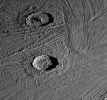
Ganymede-PIA01609.jpgRecent impact craters on Ganymede56 visiteOblique view of two fresh impact craters in bright grooved terrain near the north pole of Jupiter's moon, Ganymede. The craters postdate the grooved terrain since each is surrounded by swarms of smaller craters formed by material which was ejected out of the crater as it formed, and which subsequently reimpacted onto the surrounding surface. The crater to the north, Gula, which is 38 kilometers (km) in diameter, has a distinctive central peak, while the crater to the south, Achelous, (32 km in diameter) has an outer lobate ejecta deposit extending about a crater radius from the rim. Such images show the range of structural details of impact craters, and help in understanding the processes that form them.
North is to the top of the picture and the sun illuminates the surface from the right. The image, centered at 62 degrees latitude and 12 degrees longitude, covers an area approximately 142 by 132 kilometers. The resolution is 175 meters per picture element. The images were taken on April 5, 1997 at 6 hours, 33 minutes, 37 seconds Universal Time at a range of 17,531 kilometers by the Solid State Imaging (SSI) system on NASA's Galileo spacecraft.
|
|

Callisto-V1-PIA00362_modest.jpgCallisto from 1.200.000 Km (Voyager 1)56 visiteCaption NASA originale:"This color photo of Jupiter's satellite Callisto was made from three black-and-white images taken March 5 from a distance of 746.000 miles (1,2 MKMs).
It shows the entire hemisphere of Callisto that was photographed at HR by Voyager 1 during the close encounter with the satellite. Visible near the upper left limb is the large basin-like structure discovered by Voyager 1. The central region of the basin is much brighter than the average surface of the satellite. Near the south polar region are two bright areas associated with smaller basin-like structures. These bright areas are believed to contain more clean ice than the rest of Callisto's generally 'dirty-ice' surface".
|
|

Jupiter-HW-PIA00360_modest.jpgHigh Winds on Jupiter (from appx. 4.000.000 Km)56 visiteCaption NASA originale:"A high resolution image of the Jovian mid-latitudes taken by Voyager 1 on March 2, 1979, shows distinctly differing characteristics of the planet's meteorology. The well defined pale orange line running from southwest to northeast (North is at the top) marks the high speed north temperate current with wind speeds of about 120 meters p/s. These high winds produce a cleaner flow pattern in the surrounding clouds whose average lifetime is of about 2 years".
|
|

Jupiter-V2-PIA00343_modest.jpgJupiter in full detail, by Voyager 256 visiteCaption NASA originale:"The colors have been enhanced to bring out detail. Zones of light-colored, ascending clouds alternate with bands of dark, descending clouds. The clouds travel around the planet in alternating eastward and westward belts at speeds of up to 540 Km p/h. Tremendous storms as big as Earthly continents surge around the planet. The Great Red Spot is an enormous anticyclonic storm that drifts along its belt, eventually circling the entire planet".
|
|
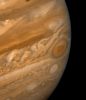
Jupiter-V2-LAFT-PIA01370_modest.jpgLate afternoon on Jupiter...56 visiteCaption NASA originale:"This color composite made from Voyager 2 narrow-angle camera frames shows the Great Red Spot during the late Jovian afternoon. North of the Red Spot lies a curious darker section of the South Equatorial Belt (SEB), the belt in which the Red Spot is located. A bright eruption of material passing from the SEB northward into the diffuse equatorial clouds has been observed on all occasions when this feature passes north of the Red Spot. The remnants of one such eruption are apparent in this photograph".
|
|

Io-Tohill Mons-PIA03600_modest.jpgTohill Mons56 visitenessun commento
|
|

Europa-Lineae-Agenor_Linea.jpgEuropa: the "Agenor Linea"56 visiteCaption NASA originale:"This bright white swath cutting across the surface of icy Jovian moon Europa is known as "Agenor Linea". In all about 1000 Km long and 5 Km wide, only a section is pictured here as part of a combined color and black and white Galileo's images. Most linear features on Europa are dark in color but Agenor Linea is uniquely bright for unknown reasons. Also unknown is the origin of the reddish material along the sides. While these and other details of Europa's surface formations remain mysterious, the general results of Galileo's exploration of Europa have supported the idea that an ocean of liquid water lies beneath the cracked and frozen crust. An extraterrestrial liquid ocean holds out the tantalizing possibility of life". Curioso: alla NASA sono davvero incapaci di fare commenti equilibrati alle immagini che loro stessi propongono. Parlano di "Tantalizing possibility of life" sotto il ghiaccio di Europa, ma sono incapaci di dire che su Marte, forse, esiste qualche forma di vita...
|
|
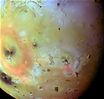
Io-Pele-PIA01112.jpgPele's deposits on Io56 visiteThe varied effects of Ionian volcanism can be seen in this false color infrared composite image of Io's Trailing Hemisphere. LR color data from Galileo's first orbit (June, 1996) have been combined with a HR clear filter picture taken on the third orbit (November, 1996) of the spacecraft around Jupiter. A diffuse ring of bright red material encircles Pele, the site of an ongoing, high velocity volcanic eruption. Pele's plume is nearly invisible, except in back-lit photographs, but its deposits indicate energetic ejection of sulfurous materials out to distances more than 600 Km from the central vent. Another bright red deposit lies adjacent to Marduk, also a currently active ediface. High temperature hot spots have been detected at both these locations, due to the eruption of molten material in lava flows or lava lakes. Bright red deposits on Io darken and disappear within years or decades of deposition, so the presence of bright red materials marks the sites of recent volcanism.
|
|
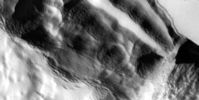
Io-PIA02597.jpgTelegonus Mensa in HR56 visiteA cliff slumps outward in these HR view that NASA's Galileo spacecraft captured of the edge of a mountain named Telegonus Mensa on Jupiter's moon Io. When Galileo flew near the South Pole of Io in October 2001, scientist's targeted this cliff to study the process of erosion. Water and wind cause most erosion on Earth, but Io has neither surface water nor atmosphere. The cliff is slumping due to gravity (?). The picture has a resolution of about 10 mt (33 feet) per picture element. Galileo's camera took it from a distance of about 1000 Km (about 620 miles). North is to the top and the Sun illuminates the surface from the upper right.
|
|

Europa-PIA00578.jpgIce "floes" on Europa56 visiteJupiter's moon Europa, as seen in this image taken June 27, 1996 by NASA's Galileo spacecraft, displays features in some areas resembling ice floes (--->banchise) seen in Earth's Polar Seas. Europa has an icy crust that has been severely fractured, as indicated by the dark linear, curved, and wedged-shaped bands seen here. These fractures have broken the crust into plates as large as 30 Km (approx. 18,5 miles) across. Areas between the plates are filled with material that was probably icy slush contaminated with rocky debris. Some individual plates were separated and rotated into new positions. Europa's density indicates that it has a shell of water ice thicker than 100 Km, parts of which could be liquid. Currently, water ice could extend from the surface down to the rocky interior, but the features seen in this image suggest that motion of the disrupted icy plates was lubricated by soft ice or liquid water below the surface at the time of disruption. This image covers part of the Equatorial Region of Europa.
|
|

Europa-mosaic-PIA01407.jpgDifferent surface features of Europa56 visite1. Triple bands and dark spots were the focus of some images from Galileo's eleventh orbit of Jupiter. Triple bands are multiple ridges with dark deposits along the outer margins. Some extend for thousands of kilometers across Europa's icy surface. They are cracks in the ice sheet and indicate the great stresses imposed on Europa by tides raised by Jupiter, as well as Europa's neighboring moons, Ganymede and Io. The dark spots or "lenticulae" are spots of localized disruption.
2. The Conamara Chaos region reveals icy plates which have broken up, moved, and rafted into new positions. This terrain suggests that liquid water or ductile ice was present near the surface. On Galileo's twelfth orbit of Jupiter, sections of this region with resolutions as high as 10 meters per picture element will be obtained.
3. Mannann'an Crater is a feature newly discovered by Galileo in June 1996. Color and high resolution images (to 40 meters per picture element) from Galileo's fourteenth orbit of Jupiter will offer a close look at the crater and help characterize how impacts affect the icy surface of this moon.
4. Cilix, a large mound about 1.5 kilometers high, is the center of Europa's coordinate system. Its concave top and what may be flow like features to the southwest of the mound are especially intriguing. The origin of this feature is unknown at present. Color, stereo, and high resolution images (to 65 meters per picture element) from Galileo's fifteenth orbit of Jupiter will offer new insights and resolve questions about its origin.
5. Images of Agenor Linea (white arrow) and Thrace Macula (black arrow) with resolutions as high as 30 meters per picture element will be obtained during Galileo's sixteenth orbit of Jupiter. Agenor is an unusually bright lineament on Europa. Is the brightness due to new ice, and if so, does it represent recent activity? Could the dark region of Thrace Macula be a flow from ice volcanism?
6. Images of Europa's south polar terrain obtained during Galileo's seventeenth orbit of Jupiter will offer insights into the processes which are active in this region. Is the ice crust thicker near Europa's poles than near the equator? The prominent dark line running from upper left to lower right through the center of this image is Astypalaea Linea. It is a fault about the length of the San Andreas fault in California and is the largest such fault known on Europa. Images with resolutions of 48 meters per picture element will be obtained to examine its geologic structure.
7. This long lineament, Rhadamanthys Linea. is spotted with dark "freckles". Are these freckle features formed by icy volcanism? Is this an early form of a triple band? Stereo and high resolution (to 46 meters per picture element) obtained during Galileo's eighteenth orbit of Jupiter may indicate whether the lineament is the result of volcanic processes or is formed by other surface processes.
8. During Galileo's nineteenth orbit of Jupiter, images of Europa will be taken with very low sun illuminations, similar to taking a picture at sunset or sunrise. The object will be to search for backlit plumes issuing from icy volcanic vents. Such plumes would be direct evidence of a liquid ocean beneath the ice. Resolutions will be as high as 40 meters per picture element. This picture was simulated image from Galileo data obtained during the spacecraft's second orbit of Jupiter in September 1996.
North is to the top of the pictures. During orbit 13, the Galileo spacecraft was behind the sun from our vantage point on Earth so it did not obtain or transmit data from that orbit. The left two images in the bottom row were obtained by NASA's Voyager 2 spacecraft in 1979; the remaining images were obtained by the Solid State Imaging (SSI) system on NASA's Galileo spacecraft in 1996.
|
|
| 325 immagini su 28 pagina(e) |
 |
|
|
|
|
19 | |
|
|
|
|





