| |

| Piú viste - Jupiter: the "King" and His Moons |

Jupiter-Clouds_NewHorizons_big.jpgJupiter's Clouds (from New Horizon) - HR58 visiteCaption NASA:"The New Horizons Spacecraft took some stunning images of Jupiter earlier this year while on the way out to Pluto. Famous for its Great Red Spot, Jupiter is also known for its regular, equatorial cloud bands, visible through even modest sized telescopes. The above image was taken near Jupiter's Terminator, and shows that the Jovian giant possibly has the widest diversity of cloud patterns in our Solar System. On the far left are clouds closest to Jupiter's South Pole.
Here turbulent whirlpools and swirls are seen in a dark region, dubbed a belt, that rings the Planet.
Even light colored regions, called zones, show tremendous structure, complete with complex wave patterns. The energy that drives these waves likely comes from below. New Horizons is the fastest space probe ever launched, and is zipping through the Solar System on track to reach Pluto in 2015".MareKromium
|
|
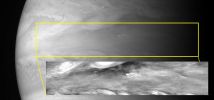
Jupiter-PIA10097.jpgAtmospheric Waves58 visiteWith its Multispectral Visible Imaging Camera (MVIC), half of the Ralph instrument, New Horizons captured several pictures of mesoscale gravity waves in Jupiter's Equatorial Atmosphere. Buoyancy waves of this type are seen frequently on Earth - for example, they can be caused when air flows over a mountain and a regular cloud pattern forms downstream. In Jupiter's case there are no mountains, but if conditions in the atmosphere are just right, it is possible to form long trains of these small waves.
The source of the wave excitation seems to lie deep in Jupiter's atmosphere, below the visible cloud layers at depths corresponding to pressures 10 times that at Earth's surface. The New Horizons measurements showed that the waves move about 100 mt-per-second faster than surrounding clouds; this is about 25% of the speed of sound on Earth and is much greater than current models of these waves predict.
Scientists can "read" the speed and patterns these waves to learn more about activity and stability in the atmospheric layers below".MareKromium
|
|

Jupiter-PIA10096.jpgPolar Lightning on Jupiter58 visiteCaption NASA:"Images taken by the New Horizons Long-Range Reconnaissance Imager (LORRI) of Jupiter's night side showed lightning strikes.
Each "strike" is probably the cumulative brightness of multiple strikes. This is the first lightning seen at High Latitudes on Jupiter; it demonstrates that convection is not confined to lower latitudes, implying an internal driving heat source.
Their power is consistent with previous lightning measurements at Jupiter's Lower Latitudes, equivalent to extremely bright terrestrial "super bolts".MareKromium
|
|

Jupiter-02.jpgInternal Heat Drives Jupiter's Giant Storm Eruption (IR + VL)58 visiteDetailed analysis of two continent-sized storms that erupted in Jupiter's Atmosphere in March 2007 shows that Jupiter's internal heat plays a significant role in generating atmospheric disturbances. Understanding this outbreak could be the key to unlock the mysteries buried in the deep Jovian Atmosphere, say astronomers.
Understanding these phenomena is important for Earth's meteorology where storms are present everywhere and jet streams dominate the atmospheric circulation. Jupiter is a natural laboratory where atmospheric scientists study the nature and interplay of the intense jets and severe atmospheric phenomena.
An international team coordinated by Agustin Sánchez-Lavega from the Universidad del País Vasco in Spain presents its findings about this event in the January 24 issue of the journal Nature.
The team monitored the new eruption of cloud activity and its evolution with an unprecedented resolution using NASA's HST, the NASA Infrared Telescope Facility in Hawaii, and telescopes in the Canary Islands (Spain).
A network of smaller telescopes around the world also supported these observations.
According to the analysis, the bright plumes were storm systems triggered in Jupiter's deep water clouds that moved upward in the atmosphere vigorously and injected a fresh mixture of ammonia ice and water about 20 miles (30 Km) above the visible clouds. The storms moved in the peak of a jet stream in Jupiter's Atmosphere at 375 mph (600 Km/hour). Models of the disturbance indicate that the jet stream extends deep in the buried atmosphere of Jupiter, more than 60 miles (approx. 100 Km) below the cloud tops where most sunlight is absorbed.MareKromium
|
|

Io-100907_8.jpgIo: Global Map (false colors)58 visiteA: A global map of Jupiter’s moon Io derived from 8 images taken by the Long Range Reconnaissance Imager (LORRI) on the New Horizons Spacecraft, as it passed Jupiter on its way to Pluto in late February 2007. Details as small as 12 Km (7 miles) are visible. The map shows the comprehensive picture of Io’s volcanism obtained by New Horizons. Yellow ovals denote areas with new, faded or shifted plume deposits since the last images taken by the Galileo spacecraft in 2001. Green circles denote areas where probable new lava flows have occurred. Cyan diamonds indicate locations of active volcanic plumes, and orange hexagons are volcanic hot spots detected by the Linear Etalon Imaging Spectral Array (LEISA) instrument. For plumes and hot spots, symbol size indicates the approximate relative size and brightness of the features.
B-F: Comparison of New Horizons (NH) and earlier images of major surface changes discovered by New Horizons at Io’s volcanoes Masubi (45° South, 57° West) and North Lerna (55° South, 290° West). The scale bars are 200 Km long, and a is the solar phase angle. At Masubi, old lava flows seen by Voyager and Galileo (B) have been obscured at low phase angles (C) by deposits from two active plumes associated with a new 240-Km (150-mile) long dark lava flow, which is the longest lava flow known to have been erupted in the solar system since the discovery of Io volcanism in 1979. At North Lerna, a recent eruption has generated a 130-Km long lava flow (F), as well as an active plume that has produced a concentric pattern of deposits.
This image appears in the Oct. 12, 2007, issue of Science magazine, in a paper by John Spencer, et al.MareKromium
|
|

Io-PIA02520.jpgMountains on Io (MULTISPECTRUM; credits: Lunexit)58 visiteCaption NASA:"This image taken by NASA's Galileo Spacecraft during its close flyby of Jupiter's moon Io on November 25, 1999 shows some of the curious mountains found there. The Sun is illuminating the scene from the left, and because it is setting, the Sun exaggerates the shadows cast by the mountains. By measuring the lengths of these shadows, Galileo scientists can estimate the height of the mountains. The mountain just left of the middle of the picture is 4 Km (13.000 feet) high and the small peak to the lower left is 1,6 Km (5000 feet) high.
These mountains, like others imaged during a previous Galileo flyby of Io in October '99, seem to be in the process of collapsing. Huge landslides have left piles of debris at the bases of the mountains. The ridges that parallel their margins are also indicative of material moving down the mountainsides due to gravity.
North is to the upper left of the picture. The image, centered at 8,1° South Latitude and 78,7° East Longitude, covers an area approx. 210-by-110 Km (such as about 130-by-70 miles). The resolution is 267 meters (880 feet) per picture element.
The image was taken at a range of approx. 25.000 Km (about 16.000 miles) by Galileo's onboard camera".
MareKromium
|
|
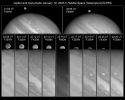
Jupiter-HST-2008-42-a-ful-004_jpg.jpgHiding: the whole sequence58 visiteThis series of images taken with NASA's Hubble Space Telescope shows Jupiter's largest moon, Ganymede, disappearing behind the Planet.
The top images show Ganymede next to Jupiter. The images were taken in blue and red light on Jan. 19, 2005 with Hubble's Advanced Camera for Surveys. The close-up images at bottom follow Ganymede as it ducks behind Jupiter a few minutes later.MareKromium
|
|

Jupiter-HST-2008-42-a-ful-002_jpg.jpgHiding... (natural colors; credits: NASA)58 visitenessun commentoMareKromium
|
|
Jupiter-Impact-2010-001.jpgImpact on Jupiter! (ctx frame)58 visitenessun commentoMareKromium
|
|

Jupiter-Impact05-PIA12148.jpgImpact on Jupiter!58 visitenessun commentoMareKromium
|
|

Jupiter-Impact-2010-003.jpgImpact on Jupiter! (from Hubble Space Telescope - ctx frame)58 visiteNASA scientists have interrupted the checkout and calibration of the Hubble Space Telescope to aim the recently refurbished observatory at a new expanding spot on the giant planet Jupiter. The spot, caused by the impact of a comet or an asteroid, is changing day to day in the Planet's cloud tops.
For the past several days the world's largest telescopes have been trained on Jupiter. Not to miss the potentially new science in the unfolding drama 360 MMs away, Space Telescope Science Institute director Matt Mountain allocated discretionary time to a team of astronomers led by Heidi Hammel of the Space Science Institute in Boulder, Colo.
The Hubble picture, taken on July 23, 2009, is the sharpest visible-light picture taken of the impact feature. The observations were made with Hubble's new camera, the Wide Field Camera 3 (WFC3).
"This image of the impact on Jupiter is fantastic" said U.S. Senator Barbara A. Mikulski, D-Md., chairwoman of the Commerce, Justice and Science Appropriations Subcommittee. "It tells us that our astronauts and ground crew at the Goddard Space Flight Center successfully repaired the Hubble telescope".
"This is just one example of what Hubble's new, state-of-the-art camera can do, thanks to the STS-125 astronauts and the entire Hubble team," said Ed Weiler, associate administrator of NASA's Science Mission Directorate. "However, the best is yet to come!".
"Hubble's truly exquisite imaging capability has revealed an astonishing wealth of detail in the 2009 impact site" said Hammel. "By combining these images with our ground-based data at other wavelengths, our Hubble data will allow a comprehensive understanding of exactly what is happening to the impact debris. My sincerest congratulations and thanks to the team who created Wide Field Camera 3 and to the astronauts who installed it!".
Co-investigator Imke de Pater of the University of California at Berkeley said: "The combination of the Hubble data with mid-infrared images from the Gemini telescope will give us an insight into changes of the vertical structure of the atmosphere due to the impact".MareKromium
|
|

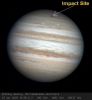
Jupiter-Impact-2010-004.jpgImpact on Jupiter! (from Hubble Space Telescope - edm)58 visiteDiscovered by Australian amateur astronomer Anthony Wesley on Sunday, July 19, 2009, the spot was created when a small object plunged into Jupiter's atmosphere and disintegrated. The only other time in history such a feature has been seen on Jupiter was 15 years ago.
"This is strikingly similar to the comet Shoemaker Levy 9 that impacted Jupiter in July 1994" said team member Keith Noll of the Space Telescope Science Institute in Baltimore, Md.
"Since we believe this magnitude of impact is rare, we are very fortunate to see it with Hubble" added Amy Simon-Miller of NASA's Goddard Space Flight Center in Greenbelt, Md. She explained that the details seen in the Hubble view shows a lumpiness to the debris plume caused by turbulence in Jupiter's atmosphere. The spot is presently twice the length of the United States.
Simon-Miller estimated that the diameter of the object that slammed into Jupiter was at least the size of several football fields. The force of the explosion on Jupiter was thousands of times more powerful than the suspected comet or asteroid that exploded over the Tunguska River Valley in Siberia in June 1908.
The WFC3, installed by the STS-125 astronauts in May, is not yet fully calibrated. So while it is possible to obtain celestial images, the camera's full power cannot yet be realized for most observations. The WFC3 can still return meaningful science images that will complement the Jupiter pictures being taken with ground-based telescopes.
This is a Natural Color image of Jupiter as seen in Visible Light.
Credit: NASA, ESA, and H. Hammel (Space Science Institute, Boulder, Colo.), and the Jupiter Impact Team
The members of the Jupiter Impact Team are:
Dr. Heidi B. Hammel (Space Science Institute, Boulder, Colo.)
Dr. Amy Simon-Miller (NASA's Goddard Space Flight Center, Greenbelt, Md.)
Dr. Keith S. Noll (Space Telescope Science Institute, Baltimore, Md.)
Dr. Michael H. Wong (Space Telescope Science Institute, Baltimore, Md.)
Prof. John T. Clarke (Boston University, Boston, Mass.)
Prof. Imke de Pater (University of California, Berkeley, Calif.)
Dr. Glenn S. Orton (Jet Propulsion Laboratory, Pasadena, Calif.)
Dr. Agustin Sanchez-Lavega (University of the Basque Country, Spain)
CONTACT
Dwayne Brown
HQ, Washington
202-358-1726
dwayne.c.brown@nasa.gov
Ray Villard
Space Telescope Science Institute, Baltimore, Md.
410-338-4514
villard@stsci.eduMareKromium
|
|
| 325 immagini su 28 pagina(e) |
|
|
|
|
|
18 | |
|
|
|
|
|
|





