| Piú viste - Jupiter: the "King" and His Moons |

Jupiter-PIA02865-4.jpgA "deep look" in the "deep clouds" of Jupiter59 visiteFinally, this is the combination of the 3 images taken from Cassini using the 3 different filters.
This picture reveals cloud structures and movements at different depths in the atmosphere around Jupiter's South Pole. Cassini's cameras come equipped with filters that sample 3 wavelengths where Methane gas absorbs light. These are in the RED (619 nnmts) and in the NEAR-INFRARED (at 727 and 890 nnmts). Absorption in the 619 nnmts filter is weak. It is stronger in the 727 nnmts band and very strong in the 890 nnmts band where 90% of the light is absorbed by Methane gas.
Light in the weakest band can penetrate the deepest into Jupiter's atmosphere. It is sensitive to the amount of cloud and haze down to the pressure of the water cloud (which lies at a depth where pressure is about 6 times the atmospheric pressure at sea level on the Earth).
Light in the strongest methane band is absorbed at high altitude and is sensitive only to Ammonia cloud level and higher (with pressures less than about one-half of Earth's atmospheric pressure) and the middle methane band is sensitive to the ammonia and ammonium hydrosulfide cloud layers as deep as two times Earth's atmospheric pressure.
|
|

The Galileans~0.jpgThe "Galileans"59 visiteIo, the large volcanic satellite of Jupiter, was first shown to the World in images transmitted from the Voyager 1 Spacecraft.
Unfortunately their cameras had no red filters and color pictures often had to be extrapolated substituting orange for red and violet for blue.
In the case of Io, this led to a garish 'pizza' appearance with many reproductions of the released images further wandering toward the red until Io looked like tomato soup!
Io is very bright, and largely a pale yellow with gray green to orange regions. Galileo has greatly refined the color information from Io. The albedo of Io (il primo a Sx) is a bright 0,6, while Europa (the brightest) is 0,64. Ganymede's albedo is just 0,42 and then - last - the dark Callisto is only 0,2.
|
|

Jupiter-2006-19-b-full_jpg.jpgJupiter's Red Spot Jr. and the surrounding "swirls"59 visitenessun commento
|
|

Jupiter-Storms.jpgColliding "Spots"59 visiteCaption NASA originale:"Two storms systems larger than Earth are nearly colliding right now on planet Jupiter. No one was sure what would happen, but so far both storms have survived. In the above false-color infrared image taken last week by the Gemini Observatory in Hawaii, the red spots appear white because their cloud tops tower above other clouds. Blue color represents lower clouds than white, while clouds colored red are the deepest. The smaller red spot, sometimes called Red Spot Jr. or just Oval BA, turned red earlier this year for reasons unknown. If both Jovian hurricanes continue to survive, they will surely pass near each other again in a few years since they revolve around Jupiter at different rates. Astronomers will continue to monitor Red Spot Jr. closely, however, to see if it will remain red when it rotates away from the larger Great Red Spot".
|
|

PSP_002162_9030_RED_browse.jpgJupiter from Mars59 visiteCaption NASA:"The HiRISE camera is the most powerful telescope to have left Earth orbit. As such, it is capable of some interesting astronomical observations.
This image of Jupiter and its major satellites was acquired to calibrate the pointing and color response of the camera. An oversight in planning this unusual observation put the focus mechanism in the wrong location, blurring the image. This does not detract from the calibration objectives, but makes the raw image less esthetic.
To compensate, the image has been "sharpened" on the ground by Dennis Gallagher, the HiRISE chief optical designer. With this sharpening, and because Mars is closer to Jupiter than Earth is, this image has comparable resolution as the HST's pictures of Jupiter.
The colors are not what is seen by the human eye because HiRISE is able to detect light with a slightly longer wavelength than we can (that is, the infrared)".MareKromium
|
|

Jupiter-021307_JKdk3.jpgJupiter, from New Horizons59 visiteCaption NASA:"This image of Jupiter is produced from a 2x2 mosaic of photos taken by the New Horizons Long Range Reconnaissance Imager (LORRI), and assembled by the LORRI Team at the Johns Hopkins University Applied Physics Laboratory.
The telescopic camera snapped the images during a 3', 35" span on February 10, 2007, when the spacecraft was about 29 MKM (approx. 18 MMs) from Jupiter.
At this distance, Jupiter's diameter was 1015 LORRI pixels - nearly filling the imager's entire (1,024-by-1,024 pixel) field of view.
Features as small as 290 Km (about 180 miles) are visible.
Both the Great Red Spot and Little Red Spot are visible in the image, on the left and lower right, respectively. The apparent "storm" on the Planet's right limb is a section of the South Tropical Zone that has been detached from the Region to its West (or left) by a "disturbance" that scientists and amateur astronomers are watching closely.
At the time LORRI took these images, New Horizons was 820 million kilometers (510 million miles) from home - nearly 5½ times the distance between the Sun and Earth. This is the last full-disk image of Jupiter LORRI will produce, since Jupiter is appearing larger as New Horizons draws closer, and the imager will start to focus on specific areas of the planet for higher-resolution studies".MareKromium
|
|

Jupiter-20070323.gifWatch Jupiter and some of His Moons rotate! (GIF-Movie)59 visiteCaption NASA:"South is toward the top in this frame from a stunning movie featuring Jupiter and moons recorded last Thursday from the Central Coast of New South Wales, Australia. In fact, three Jovian Moons and two red spots are ultimately seen in the full video as they glide around the Solar System's ruling gas giant. In the early frame above, Ganymede, the largest moon in the Solar System, is off the lower right limb of the Planet, while intriguing Europa is visible against Jupiter's cloud tops, also near the lower right. Jupiter's new Red Spot junior is just above the broad white band in the Planet's Southern (upper) Hemisphere. In later frames, as Planet and moons rotate (right to left), red spot junior moves behind Jupiter's left edge while the Great Red Spot itself comes into view from the right. Also finally erupting into view at the right, is Jupiter's volcanic moon, Io (...)".
Note: click on the frame to see the movie
|
|

Jupiter-lor_0035089864_0x630_sci_1.jpgJupiter's Ring59 visiteDescription: Jupiter's Ring - Main Ring vertical structure including ripples
Time: 2007-03-01 21:19:04 UTC
Exposure: 3000 msec
Target: Jupiter
Range: 3,6 MKM
|
|

Io-050107_07.jpgAs Time goes by...On Io!59 visiteThis montage compares similar sides of Io photographed by the Galileo spacecraft in October 1999 and the New Horizons spacecraft on February 27, 2007.
The New Horizons image was taken with its Long Range Reconnaissance Imager (LORRI) from a range of 2,7 MKM (about 1,7 MMs).
Most features on Io have changed little in the 7-plus years between these images, despite continued intense volcanic activity. The largest visible feature is the dark oval composed of deposits from the Pele Volcano, nearly 1200 Km (about 750 miles) across its longest dimension. At high Northern Latitudes, the volcano Dazhbog is prominent as a dark spot in the New Horizons image, near the edge of the disk at the 11 o'clock position. This volcano is much less conspicuous in the Galileo image. This darkening happened after this 1999 Galileo image but before Galileo took its last images of Io in 2001.
A more recent change, discovered by New Horizons, can be seen in the Southern Hemisphere (circled).
A new volcanic eruption - near 55° South and 290° West - has created a roughly circular deposit nearly 500 Km (about 300 miles) in diameter that was not seen by Galileo. Other New Horizons images show that the plume that created this deposit is still active.
The New Horizons image is centered at Io coordinates 8° South and 269° West.
MareKromium
|
|

Elara-lor_0035239919_0x630_sci_1-01.jpgElara, from New Horizons59 visiteData & Statistics for Elara:
Discovered by: C. Perrine
Date of discovery: 1905
Mass (in Kg): 7,77e+17
Mass (if Earth = 1): 1,3002e-07
Equatorial radius (in Km): 38
Equatorial radius (if Earth = 1): 5,9580e-03
Mean density (grm/cm^3): 3,3
Mean distance from Jupiter (in Km): 11.737.000
Rotational period (in days): 0,5
Orbital period (in days): 259,6528
Mean orbital velocity (Km/sec): 3,29
Orbital eccentricity: 0,2072
Orbital inclination: 24,77°
Escape velocity (Km/sec): 0,0522
Visual geometric albedo: 0,03
Magnitude (Vo): 16,77MareKromium
|
|

Europa-1.jpgRising Europa59 visitenessun commentoMareKromium
|
|
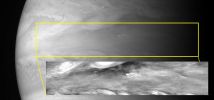
Jupiter-PIA10097.jpgAtmospheric Waves59 visiteWith its Multispectral Visible Imaging Camera (MVIC), half of the Ralph instrument, New Horizons captured several pictures of mesoscale gravity waves in Jupiter's Equatorial Atmosphere. Buoyancy waves of this type are seen frequently on Earth - for example, they can be caused when air flows over a mountain and a regular cloud pattern forms downstream. In Jupiter's case there are no mountains, but if conditions in the atmosphere are just right, it is possible to form long trains of these small waves.
The source of the wave excitation seems to lie deep in Jupiter's atmosphere, below the visible cloud layers at depths corresponding to pressures 10 times that at Earth's surface. The New Horizons measurements showed that the waves move about 100 mt-per-second faster than surrounding clouds; this is about 25% of the speed of sound on Earth and is much greater than current models of these waves predict.
Scientists can "read" the speed and patterns these waves to learn more about activity and stability in the atmospheric layers below".MareKromium
|
|
| 325 immagini su 28 pagina(e) |
 |
|
|
|
|
17 | |
|
|
|
|





