| Piú viste - Jupiter: the "King" and His Moons |

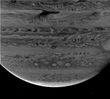
Jupiter-Clouds_NewHorizons_big.jpgJupiter's Clouds (from New Horizon) - HR60 visiteCaption NASA:"The New Horizons Spacecraft took some stunning images of Jupiter earlier this year while on the way out to Pluto. Famous for its Great Red Spot, Jupiter is also known for its regular, equatorial cloud bands, visible through even modest sized telescopes. The above image was taken near Jupiter's Terminator, and shows that the Jovian giant possibly has the widest diversity of cloud patterns in our Solar System. On the far left are clouds closest to Jupiter's South Pole.
Here turbulent whirlpools and swirls are seen in a dark region, dubbed a belt, that rings the Planet.
Even light colored regions, called zones, show tremendous structure, complete with complex wave patterns. The energy that drives these waves likely comes from below. New Horizons is the fastest space probe ever launched, and is zipping through the Solar System on track to reach Pluto in 2015".MareKromium
|
|
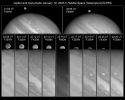
Jupiter-HST-2008-42-a-ful-004_jpg.jpgHiding: the whole sequence60 visiteThis series of images taken with NASA's Hubble Space Telescope shows Jupiter's largest moon, Ganymede, disappearing behind the Planet.
The top images show Ganymede next to Jupiter. The images were taken in blue and red light on Jan. 19, 2005 with Hubble's Advanced Camera for Surveys. The close-up images at bottom follow Ganymede as it ducks behind Jupiter a few minutes later.MareKromium
|
|
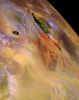
Io-Zal Patera-PIA02527.jpgZal Patera (False Colors; credits: NASA/JPL)59 visitenessun commento
|
|

Callisto-V1-PIA02277_modest.jpgCallisto's basin from Voyager 159 visiteCaption NASA originale:"This picture of a multi=ring basin on Callisto was taken the morning of March 6, 1979, from a distance of about 200.000 Km. The complicated circular structure seen at left center is similar to the large circular impact basins that dominate the surface of the Earth's moon and also the planet Mercury. The inner parts of these basins are generally surrounded by radially lineated ejecta and several concentric mountainous ring structures that are thought to form during the impact event. This multi-ring basin on Callisto consists of light floored central basin some 300 k m in diameter surrounded by at least eight to ten discontinuous rhythmically spaced ridges. No radially lineated ejecta can be seen. The ring structures on Moon and Mercury have been likened to ripples produced on a pond by a rock striking the water. The great number of rings observed around this basin on Callisto is consistent with its low planetary density and probable low internal strength".
|
|
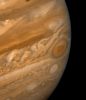
Jupiter-V2-LAFT-PIA01370_modest.jpgLate afternoon on Jupiter...59 visiteCaption NASA originale:"This color composite made from Voyager 2 narrow-angle camera frames shows the Great Red Spot during the late Jovian afternoon. North of the Red Spot lies a curious darker section of the South Equatorial Belt (SEB), the belt in which the Red Spot is located. A bright eruption of material passing from the SEB northward into the diffuse equatorial clouds has been observed on all occasions when this feature passes north of the Red Spot. The remnants of one such eruption are apparent in this photograph".
|
|

Jupiter&Comet Shoemaker.jpgComet Shoemaker impacting Jupiter59 visiteQuesta spettacolare ripresa - ottenuta dall'HST - ci mostra alcuni dettagli relativi ai momenti successivi alla sequenza di impatti che, nel Luglio 1994, interessarono gli strati superiori dell'atmosfera di Giove.
Per quelli che non ricordano tutta la storia diciamo che queste immagini ci raccontano della fine (spettacolare, comunque) incontrata dai residui della cometa Shoemaker-Levy la quale, durante la sua corsa verso l'interno del Sistema Solare - ivi, lo Spazio di Giove -, venne "fatta a pezzi" (letteralmente) dalle onde gravitazionali provenienti dal Re dei Giganti Gassosi.
|
|

Io-PIA01070.jpgAs Time Goes By...On Io! (1)59 visiteDetail of changes on Jupiter's moon Io in the Region around Volund as seen by the Voyager 1 spacecraft in April 1979 (left frame) and NASA's Galileo spacecraft in September 1996 (right frame). North is to the top of both frames which are approx. 600 by 600 Km. Note the new linear feature, which may be a volcanic fissure, trending east from the southern end of Volund. Dark diffuse material lies to the west and a ring of bright material which may be SO2- rich plume deposits appears to be centered near the middle of the new linear feature.
|
|
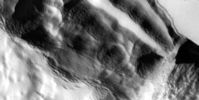
Io-PIA02597.jpgTelegonus Mensa in HR59 visiteA cliff slumps outward in these HR view that NASA's Galileo spacecraft captured of the edge of a mountain named Telegonus Mensa on Jupiter's moon Io. When Galileo flew near the South Pole of Io in October 2001, scientist's targeted this cliff to study the process of erosion. Water and wind cause most erosion on Earth, but Io has neither surface water nor atmosphere. The cliff is slumping due to gravity (?). The picture has a resolution of about 10 mt (33 feet) per picture element. Galileo's camera took it from a distance of about 1000 Km (about 620 miles). North is to the top and the Sun illuminates the surface from the upper right.
|
|

Europa-Ice_Floes-PIA00291.jpgThe typical "surface features" of Europa59 visiteJupiter's moon Europa, as seen in this image taken June 27, 1996 by NASA's Galileo spacecraft, displays features in some areas resembling ice floes seen in Earth's polar seas. Europa, about the size of Earth's moon, has an icy crust that has been severely fractured, as indicated by the dark linear, curved, and wedged-shaped bands seen here. These fractures have broken the crust into plates as large as 30 kilometers (18.5 miles) across. Areas between the plates are filled with material that was probably icy slush contaminated with rocky debris. Some individual plates were separated and rotated into new positions. Europa's density indicates that it has a shell of water ice as thick as 100 kilometers (about 60 miles), parts of which could be liquid. Currently, water ice could extend from the surface down to the rocky interior, but the features seen in this image suggest that motion of the disrupted icy plates was lubricated by soft ice or liquid water below the surface at the time of disruption. This image covers part of the equatorial zone of Europa and was taken from a distance of 156,000 kilometers (about 96,300 miles) by the solid-state imager camera on the Galileo spacecraft. North is to the right and the sun is nearly directly overhead. The area shown is about 360 by 770 kilometers (220-by-475 miles or about the size of Nebraska), and the smallest visible feature is about 1.6 kilometers (1 mile) across.
|
|

Europa-PIA00578.jpgIce "floes" on Europa59 visiteJupiter's moon Europa, as seen in this image taken June 27, 1996 by NASA's Galileo spacecraft, displays features in some areas resembling ice floes (--->banchise) seen in Earth's Polar Seas. Europa has an icy crust that has been severely fractured, as indicated by the dark linear, curved, and wedged-shaped bands seen here. These fractures have broken the crust into plates as large as 30 Km (approx. 18,5 miles) across. Areas between the plates are filled with material that was probably icy slush contaminated with rocky debris. Some individual plates were separated and rotated into new positions. Europa's density indicates that it has a shell of water ice thicker than 100 Km, parts of which could be liquid. Currently, water ice could extend from the surface down to the rocky interior, but the features seen in this image suggest that motion of the disrupted icy plates was lubricated by soft ice or liquid water below the surface at the time of disruption. This image covers part of the Equatorial Region of Europa.
|
|

Jupiter-1994-35-a-web_print.jpgJupiter in ultraviolet light, after being struck by Shoemaker-Levy 959 visiteUltraviolet image of Jupiter taken by the Wide Field Camera of the HST. The image shows Jupiter's atmosphere at a wavelength of 2550 Angstroms after many impacts by fragments of comet Shoemaker-Levy 9. The most recent impactor is fragment R which is below the center of Jupiter (third dark spot from the right). This photo was taken 3:55 EDT on July 21, 1994, about 2,5 hours after R's impact. A large dark patch from the impact of fragment H is visible rising on the morning (left) side. Proceeding to the right, other dark spots were caused by impacts of fragments Ql, R, D and G (now one large spot) and L, with L covering the largest area of any seen thus far.
The spots are all very dark in ultraviolet light because - we think - a large amount of dust, right after the impacts, was being deposited on the upper layers of Jupiter stratosphere - and dust absorbs Sunlight.
The dark, round spot just above the center of Jupiter is the moon "Io".
|
|
Jupiter-PIA02865-1.JPGJupiter's clouds - 619 nnmts filter59 visiteThe images shown here demonstrate the power of these filters in studies of cloud stratigraphy. The images cover latitudes from about 15° North at the top down to the Southern Polar Region at the bottom. (...)
The most prominent feature seen in all 3 filters is the Polar Stratospheric Haze that makes Jupiter bright near the Pole. The equatorial band is also very bright in the strong 890-nnmts image and to a lesser extent in the 727 band, but is subdued in the weak 619-nnmts image. These are high, thin, haze layers that are nearly transparent at wavelengths outside the methane absorption bands.
Another prominent feature is the Great Red Spot: about a third of it appears at the right-hand edge of the frame.
It is a bright feature in methane absorption because it has extensive cloud cover reaching to high altitude.
A wisp of high thin cloud can be seen trailing off its western rim in the 2nd and 3rd image.
|
|
| 325 immagini su 28 pagina(e) |
 |
|
|
|
|
16 | |
|
|
|
|





