| Piú viste - Jupiter: the "King" and His Moons |
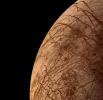
Europa-V2-PIA00459.jpgEuropa from Voyager 2 - the closest approach61 visiteCaption NASA originale:"This color image of the Jovian moon Europa was acquired by Voyager 2 during its close encounter on Monday morning, July 9, 1979. Europa, the size of our Moon, is thought to have a crust of ice perhaps 100 kilometers thick which overlies the silicate crust. The complex array of streaks indicate that the crust has been fractured and filled by materials from the interior. The lack of relief, any visible mountains or craters, on its bright limb is consistent with a thick ice crust hypothesis".
|
|

Callisto-Asgard emi.-Gal-PIA00562_modest.jpgThe "Asgard" hemisphere of Callisto (detail mgnf)61 visiteCaption NASA originale:"...Dominating the scene is the impact structure, Asgard, centered on the smooth, bright region near the middle of the picture and surrounded by concentric rings up to 1.700 kilometers in diameter. A second ringed structure with a diameter of about 500 kilometers can be seen to the north of Asgard, partially obscured by the more recent, bright-rayed crater, Burr. The icy materials excavated by the younger craters contrast sharply with the darker and redder coatings on older surfaces of this Moon..."
|
|

Io-Emakong patera-PIA02598_modest.jpgThe "Emakong" Patera (HR)61 visiteCaption NASA originale:"Clues about how lava spreads great distances on Jupiter's volcanic moon Io come from HR views taken by NASA's Galileo spacecraft of a lava channel flowing out of Emakong Patera near Io's equator.
The lava channel is dark and runs to the right from the dark patera, or large depression, at the left of this mosaic. The 1999 images showed a dark channel though which molten material once fed a broad, bright lava flow that extended for hundreds of Km".
|
|

Io-Pele plume-PIA02546_modest.jpgThe "sulphuric plume" of Pele61 visiteThis image depicts the discovery of sulfur gas in the plume of the Pele volcano on Jupiter's moon Io, as seen by the Hubble Space Telescope in October 1999, during a flyby of Io by NASA's Galileo spacecraft. The main image shows Io passing in front of Jupiter as seen by Hubble's Wide-Field Planetary Camera (WFPC2) in near-ultraviolet light. The small inset shows that when a WFPC2 image at shorter ultraviolet wavelengths is included in a color composite with the near-ultraviolet image, Io's Pele plume appears as a dark smudge off the edge of Io's disk, silhouetted against Jupiter. The larger inset shows data from Hubble's Space Telescope Imaging Spectrograph, which mapped the composition of Pele's plume by analyzing the ultraviolet light from Jupiter which had passed through the plume. The regions shown in yellow were rich in sulfur gas, which was precisely centered over the Pele volcano, whose position is shown along with the edge of Io's disk.
|
|

Europa-Lineae-Agenor_Linea-HR-PIA01646.jpgThe "Agenor Linea" on Europa (detail mgnf + HR)60 visiteAgenor Linea is an unusual feature on Jupiter's icy moon Europa since it is brighter than its surroundings while most of Europa's ridges and bands are relatively dark. During the Galileo spacecraft's 17th orbit of Jupiter, high resolution images were obtained of Agenor Linea near Europa's day/night boundary so as to emphasize fine surface details. This mosaic shows high resolution images embedded in slightly lower resolution images which were also acquired during the 17th orbit. The Galileo images show that Agenoris not a ridge, but is relatively flat. Its interior consists of several long bands, just one of which is the very bright feature known as Agenor. Each long band shows fine striations along its length. A few very small craters pockmark Agenor Linea and its surroundings. Agenor is cut by some narrow fractures, and by some small subcircular features called lenticulae. Rough chaotic terrain is visible at the top and bottom of this photo, and appears to be "eating away" at the edges of Agenor. Though previously it was suspected that Agenor Linea might be one of the youngest features on Europa, this new view shows that it is probably not.
North is to the upper right of the picture and the sun illuminates the surface from the east. The image, centered at 44 degrees south latitude and 219 degrees west longitude, covers an area approximately 130 by 95 kilometers (80 by 60 miles). The highest resolution images were obtained at a resolution of about 50 meters (165 feet) per picture element and are shown here in context at about 220 meters per picture element. The images were taken on September 26th, 1998 at ranges as close as 5000 kilometers (3100 miles) by the Solid State Imaging (SSI) system on NASA's Galileo spacecraft.
|
|

Amalthea-PIA07248_modest.jpgAmalthea: just an "Ice Cube"!60 visiteThese images of Jupiter's moon Amalthea were taken with NASA's Galileo and Voyager spacecraft. Recent findings show that Amalthea is almost pure water ice, hinting that it may not have formed where it now orbits! This information challenges long-held theories about how moons form around giant planets. The image on the left shows the Escape Velocities (EV) color-coded on a shape model of Amalthea with the same viewpoint as the Voyager spacecraft image in the middle panel. Blue represents the lowest EV, barely 1 mt/second (about 3 feet) near the anti-Jupiter end, while red (barely visible) shows the region of much higher EV, nearly 90 mt/second (295 feet). The low EV result from the low density of Amalthea and from its rapid rotation as it orbits Jupiter.
The middle image is a composite from both Galileo and NASA's Voyager spacecraft and shows Amalthea from the anti-Jupiter side. The visible area is about 150 Km (about 93 miles) across.
The Sun is behind the spacecraft, resulting in loss of visible shadows. The brighter markings on the ends of a ridge are prominent in this view.
On the right is a Galileo image of Amalthea, (see PIA02532), with the bright spots on the end of Amalthea seen from the leading side of the satellite. Here the Sun is to the left and topography, such as the impact crater at the right, is visible.
Amalthea is Jupiter's fifth largest moon. It orbits about 181,000 kilometers (112,468 miles) from Jupiter, considerably closer than the Moon orbits Earth. It measures about 168 miles in length and half that in width. Galileo passed within about 99 miles of the moon on Nov. 5, 2002. After more than 30 close encounters with Jupiter's four largest moons, the Amalthea flyby was the last moon flyby for Galileo. The mission began orbiting the planet in 1995.
|
|

Ganymede and Europa-PIA02574.jpgGanymede and Europa: so different and yet so similar!60 visiteThis frame compares a HR view of Arbela Sulcus on Ganymede (top) with the gray band Thynia Linea on another Jovian moon, Europa (bottom), shown to the same scale. Both images are from NASA's Galileo spacecraft.
Arbela Sulcus is one of the smoothest lanes of bright terrain identified on Ganymede, but subtle striations are apparent here along its length. This section of Arbela contrasts markedly from highly fractured terrain to its west and dark terrain to its east.
On Europa, gray bands such as Thynia Linea have formed by tectonic crustal spreading and renewal. Such bands have sliced through and completely separated pre-existing features in the surrounding bright, ridged plains. The younger prominent double ridge Delphi Flexus cuts across Thynia Linea. The scarcity of craters on Europa attests to the relative youth of its surface compared to Ganymede's.
Unusual for Ganymede, it is possible that Arbela Sulcus has formed by complete separation of Ganymede's icy crust, like bands on Europa. Tests of this idea come from detailed comparisons of their internal shapes and the relationships to the surrounding structures.
In the Ganymede image, north is to the top of the picture and the Sun illuminates the surface from the west. The image, centered at -15degrees latitude and 347 degrees longitude, covers an area approximately 34 by 26 kilometers (21 by 16 miles). The resolution is 34 meters (112 feet) per picture element. The image was taken on May 20, 2000, at a range of 3,370 kilometers (2,094 miles).
In the Europa image, north is to the upper-right of the picture and the Sun illuminates the surface from the northwest. The image, centered at-66 degrees latitude and 161 degrees longitude, covers an area approximately 44 by 46 kilometers (27 by 29 miles). The resolution is 45 meters (147 feet) per picture element. The image was taken on September 26, 1998, at a range of 3,817 kilometers (2,371 miles).
|
|
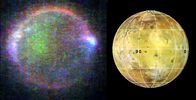
Io-PIA01637.jpgIo's "aurorae"60 visiteThis eerie view of Jupiter's moon Io in eclipse (left) was acquired by NASA's Galileo spacecraft while the moon was in Jupiter's shadow. Gases above the satellite's surface produced a ghostly glow that could be seen at visible wavelengths (red, green and violet). The vivid colors, caused by collisions between Io's atmospheric gases and energetic charged particles trapped in Jupiter's magnetic field, had not previously been observed. The green and red emissions are probably produced by mechanisms similar to those in Earth's polar regions that produce the aurora, or northern and southern lights. Bright blue glows mark the sites of dense plumes of volcanic vapor, and may be places where Io is electrically connected to Jupiter. The viewing geometry is shown in the image on the right. North is to the top of the picture and Jupiter is on the right. The resolution is 13,5 Km (about 8 miles) per picture element. The images were taken on May 31, 1998 at a range of 1,3 MKM (such as about 800.000 miles) by Galileo's onboard solid state imaging camera system during the spacecraft's 15th orbit of Jupiter.
|
|

Jupiter_sMap00-PIA07782-2.jpgSuper-detailed Jupiter's Map (2)60 visiteThe map shows a variety of colorful cloud features, including parallel reddish-brown and white bands, the Great Red Spot - frame 1), multi-lobed chaotic regions, white ovals and many small vortices. Many clouds appear in streaks and waves due to continual stretching and folding by Jupiter's winds and turbulence. The bluish-gray features along the north edge of the central bright band are equatorial "hot spots" meteorological systems such as the one entered by NASA's Galileo probe. Small bright spots within the orange band north of the Equator are lightning-bearing thunderstorms. The Polar Regions are less clearly visible because Cassini viewed them at an angle and through thicker atmospheric haze.
Pixels in the rectangular map cover equal increments of planetocentric latitude (which is measured relative to the center of the Planet) and longitude, extending to 180° of latitude and 360° of longitude.
|
|

Jupiter-2006-19-d-xlarge_web.jpgFather and Son: Jupiter's Red Spots60 visitenessun commento
|
|

Io-051407_loop.gifErupting Tvashtar (GIF Movie)60 visiteThis five-frame sequence of New Horizons images captures the giant plume from Io's Tvashtar volcano. Snapped by the probe’s Long Range Reconnaissance Imager (LORRI) as the spacecraft flew past Jupiter earlier this year, this first-ever “movie” of an Io plume clearly shows motion in the cloud of volcanic debris, which extends 330 Km (200 miles) above the moon’s surface. Only the upper part of the plume is visible from this vantage point – the plume’s source is 130 Km (about 80 miles) below the edge of Io's disk, on the far side of the moon.
The appearance and motion of the plume is remarkably similar to an ornamental fountain on Earth, replicated on a gigantic scale. The knots and filaments that allow us to track the plume’s motion are still mysterious, but this movie is likely to help scientists understand their origin, as well as provide unique information on the plume dynamics.
Io's hyperactive nature is emphasized by the fact that two other volcanic plumes are also visible off the edge of Io's disk: Masubi at the 7 o'clock position, and a very faint plume, possibly from the volcano Zal, at the 10 o'clock position.
Jupiter illuminates the night side of Io, and the most prominent feature visible on the disk is the dark horseshoe shape of the volcano Loki, likely an enormous lava lake. Boosaule Mons, which at 18 Km (about 11 miles) is the highest mountain on Io and one of the highest mountains in the Solar System, pokes above the edge of the disk on the right side.
The five images were obtained over an 8-minute span, with two minutes between frames, from 23:50 to 23:58 Universal Time (UT) on March 1, 2007. Io was approx. 3,8 MKM (about 2,4 MMs) from New Horizons; the image is centered at Io coordinates 0° North Lat. and 342° West Long.
The pictures were part of a sequence designed to look at Jupiter's Rings, but planners included Io in the sequence because the moon was passing behind Jupiter's Rings at the time.MareKromium
|
|

JUPITER from 77,6 MKM.jpgJupiter from 77,6 MKM59 visiteDid you know that the "Planet With The Shortest Day" is Jupiter?
The planet Jupiter has the shortest day of all the nine major planets in the Solar System: it spins around on its axis once every 9 hrs 55 mins and 29,69 secs. Jupiter is about five times further from the Sun than the Earth and so it's years are much longer than Earth years: Jupiter completes one "year" in 4.332,6 Earth days. Jupiter is also one of the brightest objects in the night sky (jointly with the star Syrius and planet Venus in our Northern Hemisphere and with the Alpha and Beta Centauri star system in the Southern Hemisphere).
|
|
| 325 immagini su 28 pagina(e) |
 |
|
|
|
|
13 | |
|
|
|
|





