| Piú viste - Jupiter: the "King" and His Moons |

Jupiter_s New Spot.jpgThe "New Red Spot" of Jupiter64 visiteJupiter's "Great Red Spot" is a swirling storm seen for over 300 years, since the begining of telescopic observations of the Solar System's ruling gas giant. But over the last month, the Great Red Spot has been joined by a new one (informally named "Red Spot Jr."). Thought to be similar to the Great Red Spot itself, this smaller Red Spot was actually seen to form as smaller whitish oval-shaped storms merged and then developed the remarkable reddish hue. This webcam image showing the two red tinted Jovian storms was recorded on the morning of March 12, 2006, from the Central Coast of New South Wales, Australia - part of a series showing Jupiter's rotation. Similar in diameter to planet Earth, Red Spot Jr. is expected to last for a while and trails the Great Red Spot by about an hour as the Planet rotates. Astronomers still don't exactly understand why Jupiter's red spots...are red.
|
|
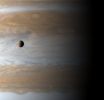
IO 2.jpgIo & Jupiter (from Cassini)63 visiteL'immenso Giove ed il piccolo (ma affascinante e VIVO, geologicamente parlando) Io, in un transito immortalato dalla Sonda Cassini, in transito accanto al Signore degli Dei ed in viaggio verso il Sistema di Saturno.
|
|

Jupiter - HST.jpgTriple eclypse on Jupiter (false colors - HST)63 visiteDa "NASA - Picture of the Day" dell'11.11.2004: "This false-color image of banded gas giant Jupiter shows a triple eclipse in progress on March 28 - a relatively rare event, even for a large planet with many moons. Captured by the Hubble Space Telescope's near-infrared camera are shadows of Jupiter's moons Ganymede (left edge), Callisto (right edge) and Io, three black spots crossing the sunlit Jovian cloud tops. In fact, Io itself is visible as a white spot near picture center with a bluish Ganymede above and to the right, but Callisto is off the right hand edge of the scene. Viewed from Jupiter's perspective, these shadow crossings would be seen as solar eclipses, analogous to the Moon's shadow crossing the sunlit face of planet Earth. Historically, timing the eclipses of Jupiter's moons allowed astronomer Ole Roemer to make the first accurate measurement of the speed of light in 1676".
|
|

Ganymede-PIA02580.jpgCalderas on Ganymede?63 visiteThe shallow, scalloped depression in the center of this picture from NASA's Galileo spacecraft is a caldera-like feature 5 to 20 Km (3 to 12 miles) wide on Jupiter's largest moon, Ganymede.
Calderas are surface depressions formed by collapse above a subsurface concentration of molten material. Some shallow depressions in bright, smooth areas of Ganymede have some overall similarities to calderas on Earth and on Jupiter's moon Io. On Ganymede, caldera-like depressions may serve as sources of bright, volcanic flows of liquid water and slush - an idea supported by a Ganymede photo obtained by Galileo during its seventh orbit (PIA01614). In the more recent image here, from Galileo's 28th orbit, a tall scarp marks the western boundary of a caldera-like feature. The western scarp is aligned similarly to older tectonic grooves visible in the image, suggesting the feature has collapsed along older lines of weakness. The interior is mottled in appearance, yet smooth compared to most of Ganymede's bright terrain seen at high resolution. The eastern boundary of the caldera-like feature is cut by younger, grooved terrain. Small impact craters pepper the scene, but the lack of a raised rim argues against an impact origin for the caldera-like feature itself. Instead, water-rich icy lava may have once flowed out of it toward the east. If so, later tectonism could have erased any telltale evidence of volcanic flow fronts. Direct evidence for icy volcanism on Ganymede continues to be elusive.
North is to the top of the picture and the Sun illuminates the surface from the left. The image, centered at -24 degrees latitude and 318degrees longitude, covers an area approximately 162 by 119 kilometers(101 by 74 miles). The resolution is 43 meters (141 feet) per picture element.
|
|

Europa-HR.jpgEuropa (full disk - HR)63 visitenessun commento
|
|

ZA-The Red Spot from HST.jpgMoments of the "Red Spot" - HST62 visitenessun commento
|
|

Io-Eruptions-PIA00293.jpgContinuous eruptions on Io62 visiteThis image, taken by NASA's Galileo spacecraft, shows a new blue-colored volcanic plume extending about 100 kilometers (about 60 miles) into space from Jupiter's moon Io (see inset at lower left). The blue color of the plume is consistent with the presence of sulfur dioxide gas and 'snow' condensing from the gas as the plume expands and cools. Galileo images have also shown that the Ra Patera plume glows in the dark, perhaps due to the fluorescence of sulfur and oxygen ions created by the breaking apart of sulfur dioxide molecules by energetic particles in the Jovian magnetosphere. The images at right show a comparison of changes seen near the volcano Ra Patera since the Voyager spacecraft flybys of 1979 (windows at right show Voyager image at top and Galileo image at bottom). This eruptive plume is an example of a new type of volcanic activity discovered during Voyager's flyby in 1979, believed to be geyser-like eruptions driven by sulfur dioxide or sulfur gas erupting and freezing in Io's extremely tenuous atmosphere. Volcanic eruptions on Earth cannot throw materials to such high altitudes. Ra Patera is the site of dramatic surface changes. An area around the volcano of about 40,000 square kilometers, area about the size of New Jersey, has been covered by new volcanic deposits. The image was taken in late June 28, 1996 from a distance of 972,000 kilometers (604,000 miles).
|
|
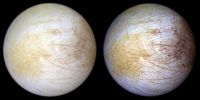
Europa-PIA01295.jpgEuropa in natural colors (Sn) and enhanced colors (Dx)62 visiteThis color composite view combines violet, green, and infrared images of Jupiter's intriguing moon, Europa, for a view of the moon in natural color (left) and in enhanced color designed to bring out subtle color differences in the surface (right). The bright white and bluish part of Europa's surface is composed mostly of water ice, with very few non-ice materials. In contrast, the brownish mottled regions on the right side of the image may be covered by hydrated salts and an unknown red component. The yellowish mottled terrain on the left side of the image is caused by some other unknown component. Long, dark lines are fractures in the crust, some of which are more than 3,000 kilometers (1,850 miles) long.
North is to the top of the picture and the sun fully illuminates the surface. Europa is about 3,160 kilometers (1,950 miles) in diameter, or about the size of Earth's moon. The finest details that can be discerned are 25 kilometers across. The images in this global view were taken in June 1997 at a range of 1.25 million kilometers by the Solid State Imaging (SSI) system on NASA's Galileo spacecraft, during its ninth orbit of Jupiter.
|
|

Jupiter-PIA02401.jpgLook at Me!62 visiteWhen 17th-century astronomers first turned their telescopes to Jupiter, they noted a conspicuous reddish spot on the Giant Planet. This Great Red Spot is still present in Jupiter's atmosphere, more than 300 years later. It is now known that it is a vast storm, spinning like a cyclone. Unlike a low-pressure hurricane in the Caribbean Sea, however, the Red Spot rotates in a counterclockwise direction in the Southern Hemisphere, showing that it is a high-pressure system. Winds inside this Jovian storm reach speeds of about 270 mph.
The Red Spot is the largest known storm in the Solar System. With a diameter of about 15.400 miles, it is almost twice the size of the entire Earth and 1/6th the diameter of Jupiter itself.
The long lifetime of the Red Spot may be due to the fact that Jupiter is mainly a gaseous planet. It possibly has liquid layers, but lacks a solid surface, which would dissipate the storm's energy, much as happens when a hurricane makes landfall on the Earth. However, the Red Spot does change its shape, size, and color, sometimes dramatically. Such changes are demonstrated in high-resolution Wide Field and Planetary Cameras 1 & 2 images of Jupiter obtained by NASA's Hubble Space Telescope between 1992 and 1999(PIA01594 thru PIA01599 and PIA02400 thru PIA02402). This image was obtained in April 1997.
|
|

IO_-_TRUE_COLOR_FROM_GALILEO.jpgIo: the World of Sulphur62 visitenessun commentoMareKromium
|
|

Amalthea-Galileo.jpgAmalthea, from Galileo62 visiteOn its way in and out, Galileo took these two snapshots of Amalthea. The purpose was to improve navigation for the upcoming flyby of this little moonlet, but such images also help in the study of the shape of irregular worlds.MareKromium
|
|
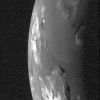
Io-PIA03530-1.jpgIo: the Loki Volcano from Galileo (RAW-HR and b/w Original NASA-Galileo Spacecraft Frame)61 visiteCaption NASA:"Light from the setting Sun falls across the Loki Volcanic Region on Jupiter's moon Io in this image taken by NASA's Galileo Spacecraft taken on October, 16, 2001.
The image was taken to examine the relative depths and heights of the major Surface Features existing in the Region. The Sun illuminates the surface from the right. Galileo's camera caught the large Volcanic Crater, or "Patera" of Loki near the Terminator (such as the boundary line between night and day). The image also shows several smaller craters plus shadows cast by the high peaks of several mountains.
Shadows cast by the low Sun should reveal any topography associated with Loki, such as a plateau in the center of the Patera or high Patera Walls. The near absence of shadows in this Region surprised Galileo scientists, as they had expected much more pronounced topography near Loki.
Another surprising aspect of this image is that features that have been black in previous Voyager and Galileo images of Loki, such as the dark Lava Flows visible inside the Patera, are here brighter than their surroundings. The best explanation is that the shiny, glassy surfaces of chilled Lava Flows look extremely dark when the Sun is directly overhead, but they reflect the Sun's light comparatively well when it shines at a low angle, in a similar manner to the reflective surfaces of bodies of water.
Other Volcanic Paterae in this image show the same unusual reflectance as seen at Loki. Some of them are being viewed at such an angle that these reflections from Lava Flows are the brightest features in the image. This image tells us that Lava Flows on Io chill quickly and form glassy surfaces, not unlike recently cooled lava flows in Hawaii.
The image has a resolution of about 1,1 Km (approx. 0,7 miles) per picture element. North is to the top of the picture".
|
|
| 325 immagini su 28 pagina(e) |
 |
|
|
|
|
12 | |
|
|
|
|





