| |

| Piú viste - Jupiter: the "King" and His Moons |

Io-Sulphur volcanism-PIA03887_modest.jpgPotential Source of Sulphur Flow on Io67 visiteA field of bright lava flows next to a shield volcano could be a source of recent sulfur volcanism on Io, as detected by instruments aboard NASA's Galileo spacecraft.
The mosaic at left combines higher-resolution images (330 meters or about 1080 feet per picture element) taken in October 2001 with lower-resolution color images (1.4 kilometers or 0.9 mile per picture element) taken in July 1999 by Galileo's solid-state imaging camera.
By comparing these images with a map of hot spots taken in February by Galileo's near-infrared mapping spectrometer (lower right), Galileo scientists noted that a new hot spot west of the active volcano Prometheus became bright in February 2000 and dimmed later. This hot spot appears to correspond with the bright flow field just west of a recently discovered shield volcano (see PIA03532), which is the only fresh volcanic material in the area.
The relatively low intensity of the February 2000 hot spot in the infrared data suggests a low-temperature eruption, consistent with sulfur lava rather than silicate lava as found elsewhere on Io and also on Earth. Sulfur lavas are thought to cool to a gray-yellow color on Io, as seen in the new flow field visible in the camera image. This bright flow field could be the best example of active sulfur lava flows deposited on Io during the Galileo mission. At upper right is a global view of Io showing the location of the more-detailed images.
The low temperature of this hot spot differs from many of Io's other active volcanoes, such as Pele, Tvashtar and Prometheus. Intense tidal flexing of Io helps keep the moon's interior molten, at some places producing silicate lavas hotter than any seen on Earth in billions of years. Io has the greatest known diversity of volcanic activity in the solar system.
North is to the top of all these images.
|
|

Callisto-PIA00080-PCF-LXTT-IPF.jpgClosing-up on Valhalla (Absokute Natural Colors; credits for the additional process. and color.: Dr Paolo C. Fienga/Lunar Explorer Italia/Italian Planetary Foundation)67 visiteCallisto was revealed by the NASA - Voyager 1 cameras to be a heavily cratered and - most likely (as it was thought at that time) - geologically inactive Celestial Body. This mosaic of Voyager 1 images, obtained at a distance of about 400,000 Km (about 248.000 miles) from Callisto, shows Surface details as small as 10 Km (such as 6,2 miles) across. The largest Impact Features on the Callistoan Surface are the so-called "Multi-Ring Impact Basins"; two of them are enormous and Valhalla - the prominent Impact Feature visible here, in today's APOD - is the largest one, with a Bright Central Region approx. 600 Km (a little more than 372 miles) in diameter, and Rings extending as far as about 1800 Km (approx. 1118 miles) from the center. The second largest Impact Multi-Ring Basin is named Asgard, and it measures about 1600 Km (a little more than 993 miles) in diameter.
Multi-Ring Impact Structures probably originated as a result of a Post-Impact Concentric Fracturing of the Lithosphere lying on a layer of soft or - maybe - even Liquid Material: possibly, an Ocean. Last, but not least, in our opinion, as IPF, the remarkable resemblances existing between the Callistoan Valhalla Crater and the Tyre Crater, located on the other Jovian moon Europa, (*) may tell us, in the end, VERY similar stories about these two mysterious Celestial Bodies. Stories that may talk about worlds that, certainly a long, long time ago, were completely (or almost completely) covered by water. Stories that should also tell us something about what could still be happening, even now, up there: in the depths of Callisto, Europa and, maybe, of a few other Celestial Objects orbiting around the four Gas-Giant Planets of the Solar System...
(*) note: if you want to take a look at Tyre Crater, please refer to the APOD of January, 29, 2013
The Catenae, on the other hand (for example the Gomul Catena), are long Chains of Impact Craters lined up in straight lines across the Surface of Callisto. They were probably created by objects that were tidally disrupted as they passed close to Jupiter prior to the impact on Callisto, or by very oblique Impacts.
This frame (which is an Original NASA - Voyager 1 Spacecraft false color image mosaic published on the NASA - Planetary Photojournal with the ID n. PIA 00080) has been additionally processed and then re-colorized, according to an educated guess, by Dr Paolo C. Fienga (LXTT-IPF), in Absolute Natural Colors (such as the colors that a human eye would actually perceive if someone were onboard the NASA - Voyager 1 Spacecraft and then looked outside, towards the Jovian moon Callisto), by using an original technique created - and, in time, dramatically improved - by the Lunar Explorer Italia Team. Different colors, as well as different shades of the same color, mean, among others, the existence of different Elements present on the Surface of Callisto, each having a different Albedo (---> Reflectivity) and Chemical Composition.MareKromium
|
|

Jupiter-water cloud-GAL-PIA01639_modest.jpgWater clouds on Jupiter66 visiteThis false-color picture of a convective thunderstorm 10.000 Km(6.218 miles) northwest of Jupiter's Great Red Spot was obtained by NASA's Galileo spacecraft on June 26, 1996. The white cloud in the center is a tall, thick cloud about 1.000 Km (620 miles) across, standing 25 Km (15 miles) higher than most of the surrounding clouds. Its base extends off to the left and appears red in this representation. This red color indicates that the cloud base is very deep in the atmosphere, about 50 Km (30 miles) below the surrounding clouds. Most of the wisps and features in Jupiter's clouds are thick and thin ammonia clouds, forming at a pressure just less than Earth's sea level pressure. On Jupiter, water is the only substance to form a cloud at a depth where the pressure is about 5 times the Earth's sea level pressure. The red base of this thunderstorm is so deep that it can only be a water cloud. In 1979 NASA's Voyager spacecraft saw convective clouds of this type near the Great Red Spot. They erupted like this roughly once every 10 days and lasted a few days each. But Voyager's cameras could not allow the determination of the storms' altitude. It is thought that this storm is analogous to an Earth thunderstorm, with the cloud's high, bright, white portion comparable to the familiar anvil cloud on Earth. Whether any rain or snow is falling below this cloud is unknown, but there are indications that similar storms on Jupiter have lightning in them.
|
|
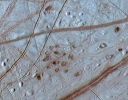
Europa-PIA03878_modest.jpgLenticulae on Europa66 visiteCaption NASA originale:"Reddish spots and shallow pits pepper the enigmatic ridged surface of Europa in this view combining information from images taken by the Galileo spacecraft during 2 orbits. The spots and pits visible in this region of Europa's northern hemisphere are each about 10 Km across. The dark spots are called "lenticulae," the Latin term for freckles. Their similar sizes and spacing suggest that Europa's icy shell may be churning away like a lava lamp, with warmer ice moving upward from the bottom of the ice shell while colder ice near the surface sinks downward. Other evidence has shown that Europa likely has a deep melted ocean under its icy shell. Ruddy ice erupting onto the surface to form the lenticulae may hold clues to the composition of the ocean and to whether it could support life".
Nota Lunexit: Si, la NASA parla di un "profondo oceano liquido" al di sotto della crosta ghiacciata di Europa.
Un oceano "vivo", forse?
Ci chiediamo: ma perchè abbiamo abbandonato questa strada (sempre complessa, ma più vicina e più solida) per andare a cercare "qualcosa" di completamente indefinibile - e per giunta muovendoci alla cieca - su Titano?
Insomma, l'idea del Landing su Titano (attuata) è stata un Grande Passo, ma fermarsi su Europa e guardare meglio era proprio un'idea sbagliata?!?... Misteri della NASA.
|
|

Amalthea-PIA01072.jpgFirst look at Amalthea66 visiteOriginal caption:"Galileo's first view of Amalthea, a small inner moon of Jupiter, showing the end of the elongated satellite that faces permanently toward the Giant Planet. North is to the top of the picture and the Sun illuminates the surface from the left. The circular feature that dominates the upper-right portion of the disk is Pan, the largest crater on Amalthea. This crater is about 90 Km wide. The bright spot at the South Pole is associated with another, slightly smaller crater named Gaea. (...) ".
|
|

Jupitercrescent_cassini_big.jpgJupiter from Cassini65 visiteLa "falce" di un Giove crescente, ripresa dalla Sonda Cassini mentre si avvicinava e si apprestava ad effettuare il "fly-by" del Gigante Gassoso.
Una splendida immagine che ci ricorda alcune sequenze del capolavoro di Stanley Kubrick, "2001 - A Space Odyssey" in cui Giove appariva agli occhi di Dave Bowman proprio come lo vediamo in questo frame.
|
|

Io-Eruption-PIA02545.jpgEruption on Tvashtar Catena65 visiteAn active volcanic eruption on Jupiter's moon Io was captured in this image taken on February 22, 2000 by NASA's Galileo spacecraft. Tvashtar Catena, a chain of giant volcanic calderas centered at 60 degrees north, 120 degrees west, was the location of an energetic eruption caught in action in November 1999. A dark, "L"-shaped lava flow to the left of the center in this more recent image marks the location of the November eruption. White and orange areas on the left side of the picture show newly erupted hot lava, seen in this false color image because of infrared emission. The two small bright spots are sites where molten rock is exposed to the surface at the toes of lava flows. The larger orange and yellow ribbon is a cooling lava flow that is more than more than 60 kilometers (37 miles) long. Dark, diffuse deposits surrounding the active lava flows were not there during the November 1999 flyby of Io.
This color mosaic was created by combining images taken in the near-infrared, clear, and violet filters from Galileo's camera. The range of wavelengths is slightly more than that of the human eye. The mosaic has been processed to enhance subtle color variations. The bright orange, yellow, and white areas at the left of the mosaic use images in two more infrared filters to show temperature variations, orange being the coolest and white the hottest material. This picture is about 250 kilometers (about 155 miles) across. North is toward the top and illumination from the Sun is from the west (left).
|
|

Io-Southern Limb and light-PIA02250.jpgThe Southern Limb of Io and a possible "Transient Phoenomenon"65 visiteUn'immagine interessantissima del bordo dell'emisfero sud di Io. Elevatissimo dettaglio e grande suggestione del paesaggio. Io è un mondo violento ed in costante tumulto: il numero di vulcani attivi su questo Pianeta è elevatissimo (gli ultimi dati in nostro possesso parlavano di 6 vulcani attivi contemporaneamente), dunque non ci meravigliamo se vediamo delle flares, come quella alla Dx di questo frame, splendere nel buio. Potrebbe trattarsi di un outgassing: un classico fenomeno transitorio.
Original caption:"NASA's Galileo spacecraft captured this dramatic image of mountains on Io in February 2000. The image was taken when the Sun was low in the sky, illuminating the scene from the left, so it reveals topographic details of Io's surface. A low scarp, roughly 250 meters (820 feet) high, runs from the upper left toward the center of the image. Mongibello Mons, the jagged ridge at the left of the image, rises 7 kilometers (23,000 feet) above the plains of Io, higher than any mountain in North America. Few of Io's mountains (see also PIA02526) resemble volcanoes. Instead, Galileo scientists believe that the mountains are formed when blocks of Io's crust are uplifted along thrust faults. Angular mountains are thought to be younger, while older mountains have more subdued topography, such as the rise near the top center of this image.
The image has a resolution of 335 meters (1,100 feet) per picture element. North is to the top of the image.
|
|

Europa-fullcolor-PIA02590_modest.jpgEuropa in full colors64 visitenessun commento
|
|
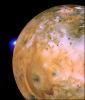
Io-Plumes from Loki-V1-PIA00010_modest.jpgLoki's eruption on Io (the "Plume")64 visiteUn'informazione importante per chi volesse provare a calcolare le dimensioni effettive della "piuma vulcanica" (conoscendo, ovviamente, le dimensioni di Io): l'immagine è stata scattata da (circa) 490.000 Km.
Original caption:"Voyager 1 image of Io showing active plume of Loki on limb. Heart-shaped feature southeast of Loki consists of fallout deposits from active plume Pele. The images that make up this mosaic were taken from an average distance of approximately 490.000 Km (about 340.000 miles)".
|
|

Jupiter_s New Spot.jpgThe "New Red Spot" of Jupiter64 visiteJupiter's "Great Red Spot" is a swirling storm seen for over 300 years, since the begining of telescopic observations of the Solar System's ruling gas giant. But over the last month, the Great Red Spot has been joined by a new one (informally named "Red Spot Jr."). Thought to be similar to the Great Red Spot itself, this smaller Red Spot was actually seen to form as smaller whitish oval-shaped storms merged and then developed the remarkable reddish hue. This webcam image showing the two red tinted Jovian storms was recorded on the morning of March 12, 2006, from the Central Coast of New South Wales, Australia - part of a series showing Jupiter's rotation. Similar in diameter to planet Earth, Red Spot Jr. is expected to last for a while and trails the Great Red Spot by about an hour as the Planet rotates. Astronomers still don't exactly understand why Jupiter's red spots...are red.
|
|

Io-hot spots-PIA02589_modest.jpgHot-spots on Io (at night) - edited63 visiteCaption NASA originale:"The left-hand frame shows the best view that Galileo has yet provided of Io's nighttime temperatures. For reference, the right hand frame, based on Galileo camera images, shows the same hemisphere of Io in visible light. The thin bright crescent indicates the only observable portion illuminated by sunlight during the temperature measurements. Several volcanoes are identified on both images: "L-K" is Lei-Kung Fluctus, "L" is Loki, "Pi" is Pillan, "M" is Marduk and "Pe" is Pele".
|
|
| 325 immagini su 28 pagina(e) |
|
|
|
|
|
11 | |
|
|
|
|
|
|





