| Piú viste - Venus |

Venusian_Clouds_and_winds_in_the_infrared_H.jpgVenusian cloud structures - Night view (2)60 visiteOriginal ESA caption:""We are also collecting the first information on the minor chemical components of the atmosphere, such as CO - Carbon Monoxide" added Pierre Drossart.
"With VIRTIS we can see in the atmosphere of the southern hemisphere deeper than any other previous mission, and we started gathering data on the yet unknown chemistry of the lower atmospheric layers, to build a global picture. Studying the variation of minor chemical compounds over different latitudes and depths is also a very useful tracer for the atmospheric global motion".
|
|

Craters-Mona_Lisa_Crater-PCF-LXTT-01.jpgMona Lisa Crater (Natural Colors; credits: Lunar Explorer Italia)60 visitenessun commentoMareKromium
|
|
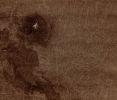
Craters-Unnamed_Craters-Lakshmi_Region-PIA00477.jpgPossible Remnants of a Meteoroid in Lakshmi Region (possible Natural Colors; credits: Dr Paolo C. Fienga - Lunexit Team)60 visiteThis full resolution mosaiced image covers an area of approx. 100 by 120 Km (such as about 62 by 74 miles) and is located in the Lakshmi Region of Venus, at 47° North Latitude and 334° East Longitude.
Due to the dense Venusian Atmosphere, Primary Impact Craters of less than a 3 Km (a little less than 2 miles) diameter are nonexistent.
The dark circular region and associated central bright feature in this image are thought to be the remnants of a Meteoroid smaller than the size necessary to create an Impact Crater, and entering the Atmosphere at low velocity (approx. 350 meters/second.)
The central bright feature appears to be a cluster of small secondary impacts, ejecta and debris from the original meteor that broke up in the Atmosphere.
Even though most of the meteorite did not hit the Surface, the Atmospheric Shock wave could be great enough to modify the surrounding region. One explanation for this radar dark circular formation, called "Dark Margins", could be that the shock wave was energetic enough to pulverize the Surface (smooth surfaces generally appear radar dark).
Another explanation is that the Surface could be blanketed by a fine material that was formed by the original meteor's breakup through the Atmosphere.
More than half of the Impact Craters on Venus have associated Dark Margins, and most of these are prominently located left of center of the rater. This is another effect which could be caused by the extremely dense Atmosphere of Venus. MareKromium
|
|

Volcanoes-Maat_Mons-PIA00487.jpgVolcanic Domes on the Flank of Maat Mons - East Ovda Region (possible Natural Colors; credits: Dr Paolo C. Fienga - Lunexit Team)60 visiteThis Magellan image is centered at about 3,2° North Latitude and 194,9° East Longitude, in the Eastern Ovda Region of Venus.
The image, which is approx. 90 Km (about 56 miles) in width and approx. 80 Km (such as about 50 miles) in length, shows some small Volcanic Domes on the Flank of the volcano Maat Mons. The bright flows to the East are most likely rough Lava Flows while the darker flows to the West are probably smoother flows. The dark flows do show some roughness, however, as can be seen by the structure in the flows to the South/West.
These dark flows also have some debris that has been deposited on top of them. The debris may be fine material from the surrounding Plains on top of the flow by wind or it may be ash from the volcano.
Small Volcanic Domes are very common features on the Surface of Venus, indicating that there has been (and maybe there still is) much volcanic activity going on almost everywhere.
Assuming that the central Volcanic Cone is symmetrical in shape and knowing the length of the cone's side and the incidence angle, radar foreshortening yields a height and slope of 688 meters and 8,2°, respectively, for the Cone.
These values are similar to heights and slopes of some Volcanic Cones on the Earth. MareKromium
|
|

Volcanoes-Sacajawea_Patera-PIA00485.jpgSacajawea Patera (possible Natural Colors; credits: Dr Paolo C. Fienga - Lunexit Team)60 visiteThis Magellan image reveals Sacajawea Patera, a large, elongate caldera located in Western Ishtar Terra on the smooth plateau of Lakshmi Planum.
The image is centered at 64,5° North Latitude and 337° East Longitude. It is approximately 420 Km (about 252 miles) wide at the base.
Sacajawea is a depression approximately 1-2 Km (0,6-1,2 miles) deep and abo 120 by 215 Km (approx. 74 by 133 miles) in diameter; it is elongate in a S/W-N/E direction.
The depression is bounded by a zone of circumferential curvilinear structures interpreted to be Graben and Fault Scarps. These structures are spaced 0,5-4 Km (0,3-2,5 miles) apart, are 0,6-4 Km (0,4-2,5 miles) in width and up to 100 Km (approx. 62 miles) in length.
Extending up to approximately 140 Km (about 87 miles) in length from the South/East of the Patera, is a system of linear structures thought to represent a flanking rift zone along which the lateral injection and eruption of magma may have occurred.
A shield edifice of approx. 12 Km (about 7 miles) in diameter with a prominent Central Pit, lies along the trend of one of these features.
The Impact crater Zlata, approx. 6 Km (a little less than 4 miles) in diameter is located within the zone of Graben to the N/W of the Patera.
Few flow features are observed in association with Sacajawea, possibly due to age and state of degradation of the flows.
Mottled bright deposits of about 4 to 20 Km (such as 2,5 up to approx. 12 miles) in width are located near the periphery and in the center of the Patera Floor, within local topographic lows. Diffuse patches of dark material approx. 40 Km (such as about 25 miles) in width are observed S/W of the Patera, superposed on portions of the surrounding Graben.
The formation of Sacajawea is thought to be related to the drainage and collapse of a large Magma Chamber. Gravitational relaxation may have caused the resultant Caldera to sag, producing the numerous Faults and Graben that circumscribe the Patera.
Regions of complex, highly deformed tessera-like terrain are located North and East of the Patera and are seen in the upper portion of the image.MareKromium
|
|

Venusian_Clouds-Venus_Express-VOI_composit.jpgVenusian cloud structures: day-side and night-side59 visiteThe early infrared image making use of the windows, show complex cloud structures, all revealed by the thermal radiation coming up from different atmospheric depths. In this colour scheme, the brighter the colour (that is, the more radiation comes up from the lower layers), the less cloudy is the observed area.
During capture orbit, preliminary data about the chemical composition of the Venusian atmosphere were also retrieved. Venus’ atmosphere is mainly composed of Carbon Dioxide (CO2). The incoming solar radiation dissociates this molecule into Carbon Monoxide (CO) and Oxygen (O2) in the upper atmospheric layers. In fact, Venus Express has already spotted the presence of an Oxygen airglow high in the atmosphere. However, Venus Express has revealed the presence of Carbon Monoxide as low as the cloud-layer top.
Scientists will continue the data analysis and retrieval to understand the phenomenon, which is very important to clarify the complex chemical processes and cycles at work in the atmosphere of Venus under the influence of solar radiation.
|
|

9-Venus.gifApproaching Venus (GIF anim.)59 visiteOn 20 April 2006, after its first 9-day, elongated orbit around Venus, ESA’s Venus Express started to get closer to the Planet, until it reached its final 24-hour long orbit on 7 May. During this time, and up to today, the spacecraft has been working relentlessly: the new data coming in are already providing first glimpses on planetary features never seen before.
If taking the first ever clear images of the double-eye vortex at Venus’ south pole - imaged by Venus Express during its very first orbit - was already a first in the history of planetary exploration and a very pleasant surprise for the scientists, nobody could expect that the vortex had a structure even more complicated than possibly foreseen.
Infrared images taken by the Ultraviolet/Visible/Near-Infrared spectrometer (VIRTIS) on board the spacecraft not only provided the first clear view of the vortex, but also gave a much closer insight into it when Venus Express flew over the South Pole at the end of May this year (2006). MareKromium
|
|
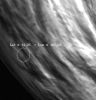
Venusian_Atmosphere-VI410_01_23_with_spot_H1.jpgThe Venusian Atmosphere under the Messenger59 visiteCaption ESA:"This grey-scale image, obtained by the VIRTIS instrument on board ESA’s Venus Express, shows the Atmospheric Region of Venus over which NASA’s MESSENGER Spacecraft passed on 5 June 2007. The Region of MESSENGER’s closest approach is in the night side (marked by a circle).
VIRTIS obtained this image at 2,3 micrometres from about 35.000 Km from the Planet, on the night side.
This wavelength makes it possible to probe the atmosphere down to about 30 Km from the surface. Much of the contrast in this image is due to the structure of the lower clouds.
The bright areas correspond to radiation from the lower atmospheric layers, indicating that the clouds are thinner in those areas. At the 2,3-micrometre wavelength it is possible to study not only the morphology of the cloud layers, but also its chemical composition (such as Carbon Monoxide - CO -, Water - H2O -, Sulphur Dioxide - SO2 -, etc)".MareKromium
|
|

Volcanoes-PIA00261.jpgVolcanoes in Guinevere Planitia (possible Natural Colors; credits: Dr Paolo C. Fienga - Lunexit Team)59 visiteThis image, with radar illumination from West to East, shows three unusual Volcanoes located in the Guinevere Planitia Lowland. At the center of the image is a large feature (approx. 50 Km or about31 miles in diameter) with an unusual shape; very round when viewed from above with steep slides and a flat top.
These Volcanoes are believed to be the result of relatively thick and sticky (viscous) Lava Flows that originated from a point source. Although a faint remnant of its original circular shape is preserved, the Northern Rim of this center Volcano has a steep Scarp.
The Scarp is probably the result of material that has slid away from the Volcano and subsequently has been covered by Lava Flows. This Volcano overlaps another feature to the South-West that is about 45 Km (approx. 28 miles) in diameter and disrupted by many fractures.
The South-Eastern Volcano (about 25 Km or approx. 15,5 miles in diameter) appears to be the highest of the three as its illuminated Western Edge has the brightest radar return. The scalloped Edges give this feature a bottlecap-like appearance. The highly scalloped Edges are probably the result of multiple material slides along the Volcano Margin.MareKromium
|
|

Craters-Barton_Crater-PIA00463.jpgBarton Crater (possible Natural Colors; credits: Dr Paolo C. Fienga - Lunexit Team)59 visiteDuring orbits 404 through 414 on 19-20 September 1990, the Magellan Probe imaged a Peak-Ring Crater that is about 50 Km in diameter located at Latitude 27,4° North and Longitude 337,5° East. The name "Barton" has been proposed by the Magellan Science Team for this Crater, after Clara Barton, founder of the Red Cross; however, the name is tentative pending approval by the International Astronomical Union.
Barton is just at the diameter size that Venus Impact Craters appear to begin to possess Peak-Rings instead of a single Central Peak or Central Peak complex like does about 75% of the craters with diameters between about 50 and 15 Km.
The floor of the Crater is flat and radar-dark, indicating possible infilling by volcanic deposits sometime following the impact event. Barton's Central Peak Ring is discontinuous and appears to have been disrupted or separated during or following the cratering process. The extremely blocky crater deposits (ejecta) surrounding Barton appear to be most extensive on the South-West to South-East (lower left to right) side of it.MareKromium
|
|

Hestia_Rupes-PIA00469.jpgComplex Network of Narrow Fractures near Hestia Rupes Region (possible Natural Colors; credits: Dr Paolo C. Fienga - Lunexit Team)59 visiteThis is a Magellan radar image covering an about 105- Km (approx. 63-mile) by 45-Km (approx. 27-mile) Region near Hestia Rupes on the North-Western corner of Aphrodite Terra.
The complex network of narrow (such as <1 Km) Fractures in the center of the image extends for approx. 50 Km (about 31 miles). This network exhibits tributary-like branches similar to those observed in river systems on Earth. However, the angular intersections of the tributaries suggest tectonic control.
These features appear to be due to drainage of lava along preexisting fractures and subsequent collapse of the Surface. The underlying tectonic fabric can be observed in the North-East trending Ridges which predate the Plains.MareKromium
|
|

Craters-Stephania_Crater-PIA00475.jpgStephania Crater (possible Natural Colors; credits: Dr Paolo C. Fienga - Lunexit Team)59 visiteCrater Stephania is located at 51,3° Norh Latitude and 333,3° East Longitude in Northern Sedna Planitia.
With a diameter of about 11 Km (6,8 miles), Stephania is one of the smaller Craters on Venus.
Because many small meteoroids disintegrate during their passage through the dense Venusian atmosphere, there is an absence of craters smaller than 3 Km (approx. 1,9 miles) in diameter, and even craters smaller than 25 Km (15,5 miles) are relatively scarce.
The apron of ejected material suggests that the impacting body made contact with the Surface from an oblique angle. Upon closer observation it is possible to delineate secondary craters, impact scars from blocks ejected from the primary crater.
A feature associated with this and many other Venusian Craters is a radar-dark halo.
Since dark radar return signifies a smooth surface, it has been hypothesized that an intense shock wave removed or pulverized previously rough surface material or that a blanket of fine material was deposited during or after the impact.MareKromium
|
|
| 126 immagini su 11 pagina(e) |
 |
|
|
|
|
7 | |
|
|
|





