| Piú viste - Venus |

Venusian_Surface-Venera_13-05.jpgVenus, from Venera 13 (an Image-Mosaic by Dr Marco Faccin - Lunexit Team)64 visiteQuesta immagine esce un pò dai canoni tipici e propri delle solite (ed orrende) immagini che si trovano in giro sulla Rete; sono stati usati, per la fotocomposizione, i frames originali - che sono stati ri-processati per ottenere qualcosa di decente su cui lavorare.
Parte dell'illuminazione di fondo ("glare") dell'Atmosfera di Venere è stata rimossa e/od abbattuta (ed infatti il pezzo che si vede in mezzo al frame ha una parte bianca, ed essa è bianca rispetto a tutte le altre famose foto reperibili sul WWW; la bandierina dei colori è meno confusa - si nota il rosso ed anche un altro colore, più blando, che però si stacca e non si fonde con il resto del panorama.
A qualcuno questa immagine potrà sembrare brutta, ma i colori originali sono quelli e NON SONO STATI ALTERATI!
Intendiamoci, questa elaborazione è nettamente più scura delle altre che si trovano sulla Rete, ma è proprio questo il nostro punto: creare un'alternativa RAZIONALE e CREDIBILE!
ATTENZIONE: l'Atmosfera di Venere non consente la diffusione della Luce Blu e, probabilmente, dei toni più chiari della Luce Verde.
Un altro grandissimo Lavoro del nostro eccezionale Dr Faccin (alias Titanio44).MareKromium
|
|

Venus-South_Pole-05.jpgVenus' South Pole (UV)63 visiteFalse-colour view imaged in ultraviolet of Venus' South pole captured by VMC - onboard Venus Express - on April, 12, 2006.
|
|

Venus-South Pole-PioneerVenus_South%20PoleVortex_H.jpgThe South Pole of Venus (again)63 visiteThese two images of Venus’s South Pole were taken by NASA’s Mariner 10 (during a Venus fly-by on its way to Mercury) and Pioneer Venus Missions during the early 1970s and 1980s, respectively.
The images provided the first glimpses about a stormy atmospheric behaviour at the south pole of the planet.
|
|
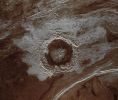
Craters-Dickinson_Crater-PIA00479.jpgDickinson Crater (possible Natural Colors; credits: Dr Paolo C. Fienga - Lunexit Team)63 visiteThis Magellan image is centered at 74,6° North Latitude and 177,3° East Longitude, in the North/Eastern Atalanta Region of Venus.
The image is approximately 185 Km (about 115 miles) wide at the base, and shows Dickinson, an Impact Crater of about 69 Km (approx. 43 miles) in diameter. The Crater is complex, characterized by a partial Central Ring and a Floor flooded by radar-dark and radar-bright materials.
Hummocky, rough-textured ejecta extend all around the Crater, except to the West. The lack of ejecta to the West may indicate that the Impactor that produced the Crater reached the Surface on an oblique angle, and from the West.
Extensive radar-bright flows that emanate from the Crater's Eastern Walls may represent large volumes of impact melt, or they may be the result of volcanic material released from the Subsurface during the cratering event.MareKromium
|
|
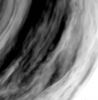
Venusian_Atmosphere-ORB157_01_17_WB_H.jpgVenusian Turbulence: the Alpha Regio Area61 visiteThis image of the Venusian South Polar Region was acquired on 24 September 2006 by the Ultraviolet, Visible and Near-Infrared Mapping Spectrometer (VIRTIS) on board ESA’s Venus Express, from a distance of about 65.000 Km from the Planet’s surface.
The image, showing a complex cloud system, was taken on the night-side of Venus (04:00 Local Time - V.L.T.), at a wavelength of 1,7 micron that allows viewing the deep atmospheric layers. The field of view covers an area located at approximately 20° West Longitude (diagonal top left to bottom right), spanning from the Equator (at the horizon on the right) to 60° Southern Latitude (top left corner of the image).
The grey-scale of the image is such that black means more transparency, therefore less clouds, while white means more opacity, therefore more cloud concentration.
The Alpha Regio area is at the bottom left of the image. This area is characterised by a series of troughs, ridges, and faults that are oriented in many directions, with surface features that can be up to 4 kilometres high. It is not yet clear if atmospheric turbulences may be induced by the rough topography below the clouds.MareKromium
|
|

Volcanoes-Ammavaru-PCF-LXTT.jpgAmmavaru (Natural Colors; credits: Lunar Explorer Italia)61 visitenessun commentoMareKromium
|
|

South_Polar_Regions-2.jpgHot vortex over Venus' South Pole60 visiteESA's Venus Express has returned the first-ever images of the hothouse Planet’s South Pole from a distance of 206.452 Km, showing surprisingly clear structures and unexpected detail. The images were taken on April 12, 2006, during the spacecraft’s initial capture orbit after successful arrival on the 11th.
Engineers have lost no time in switching on several of the instruments and yesterday the VMC (Venus Monitoring Camera) and VIRTIS (Visible and Infrared Thermal Imaging Spectrometer) imaged, for the first time in space history, the Southern Hemisphere of Venus as the spacecraft passed below the Planet in an elliptical arc.
Scientists are especially intrigued by the dark vortex shown almost directly over the South Pole, a previously suspected but until now unconfirmed structure that corresponds to a similar cloud structure over the North Pole. “Just one day after arrival, we are already experiencing the hot, dynamic environment of Venus” said Dr Hakan Svedhem, Venus Express project scientist“.
“We will see much more detail at an unprecedented level as we get over 100 times better resolution as we get closer to Venus, and we expect to see these spiral structures evolve very quickly.”
|
|
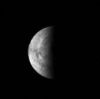
Venus-South_Pole-04.jpgVenus' South Pole (UV)60 visiteIn the 1st capture orbit, Venus Express will have 5 more opportunities for gathering data until reaching pericentre. These observations represent a great opportunity because, at apocentre, the full disc of Venus is fully visible for the spacecraft’s imagers. Such opportunities will not occur again during the nominal mission, starting on June, 4, 2006, when the range of distances from the Planet will be much smaller. In addition to VMC and VIRTIS, the spacecraft’s MAG (Venus Express Magnetometer) has been switched on for initial verification and is operating nominally. Together with the ASPERA (Analyser of Space Plasma and Energetic Atoms), the 2 instruments are expected to gather information about the unperturbed solar wind and the atmospheric escape processes on Venus, a Planet with no magnetic protection.
A series of further engine and thruster burns are planned to gradually reduce the apocentre during the following 16 orbital loops around the planet and the spacecraft is due to attain its final 24-hour polar orbit on 7 May, ranging from 66 000 to 250 kilometres above Venus.
|
|

Venus-South Pole-Infrared-COB_combi_38b.jpgVortex over the South Pole of Venus (infrared vision)60 visiteDuring this first orbit – called the 'capture orbit' – some of the Venus Express instruments were used to perform the first observations at different distances from Venus, for a few hours per time on six different slots between 12 and 19 April 2006.
Amazing infrared, visible and ultraviolet images of the Venusian globe already reveal several atmospheric features of great interest.
The most striking of these is a huge, double-eye atmospheric vortex over the South Pole, not dissimilar from the equivalent structure present at the North Pole – the only one previously studied in some detail.
Only glimpses of the stormy atmospheric behaviour at the south pole were obtained by previous missions (Pioneer Venus and Mariner 10), but such a double-eye structure was never clearly seen before now.
This composite image shows six infrared views of Venus as seen by the Ultraviolet/Visible/Near-Infrared spectrometer (VIRTIS) on board ESA’s Venus Express spacecraft between 12 and 19 April 2006, during the first orbit, or ‘capture orbit’, around the planet.
The images (taken at 5 microns) were obtained at six different time slots and at different distances from Venus (top left: 12 April, from 210 000 kilometres; centre left: 13 April, from 280 000 kilometres; bottom left: 14 April, from 315 000 kilometres; top right: 16 April, from 315 000 kilometres; centre right: 17 April, from 270 000 kilometres; bottom right: 19 April, from 190 000 kilometres), while the spacecraft moved along a long ellipse around the planet.
The infrared radiation coming from Venus was converted in this reddish colour scheme. Thermal radiation comes from the lower atmosphere, (just above the cloud top, located at about 60 kilometres altitude). Solar radiation reflected by the upper atmospheric layers (roughly between 60 and 80 kilometres altitude) and thermal radiation from the layers below contribute to the brightest part of the image.
The south polar vortex structure is visible from different view points close to the centre of the images, mostly in the dark side.
|
|

7-Venus_orbit31V3_fc_H.jpgThe Bright&Blue Northern Hemisphere of Venus60 visitenessun commento
|
|

South_Polar_Vortex-01.jpgVenusian South Polar Vortex (2)59 visiteOriginal ESA caption:"Infrared images taken by the Ultraviolet-Visible-Near-Infrared spectrometer (VIRTIS) on board the spacecraft, not only provided the first clear view of the vortex, but also gave a much closer insight into it when Venus Express flew over the South Pole at the end of May 2006.
VIRTIS is an instrument that can operate at different wavelengths. Each infrared wavelength provides a view of the Venusian atmosphere at a different altitude, like a 'cross-section'.
"When we looked at this gigantic vortex at different depths, we realised how much its shape is varying over altitude", said Pierre Drossart, VIRTIS co-Principal Investigator, from the Observatoire de Paris, France.
"It is like if we were looking at different structures, rather than a single one.
And the new data we have just started gathering and analysing reveal even stronger differences".
|
|

Venusian_Clouds_and_winds_in_the_infrared_H.jpgVenusian cloud structures - Night view (2)57 visiteOriginal ESA caption:""We are also collecting the first information on the minor chemical components of the atmosphere, such as CO - Carbon Monoxide" added Pierre Drossart.
"With VIRTIS we can see in the atmosphere of the southern hemisphere deeper than any other previous mission, and we started gathering data on the yet unknown chemistry of the lower atmospheric layers, to build a global picture. Studying the variation of minor chemical compounds over different latitudes and depths is also a very useful tracer for the atmospheric global motion".
|
|
| 126 immagini su 11 pagina(e) |
 |
|
|
|
6 | |
|
|
|
|





