| Piú viste - Venus |
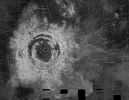
Craters-Mona_Lisa_Crater-PCF-LXTT-00.jpgMagellan Probe: radio image of Mona Lisa Crater115 visiteL'età media della superficie di Venere è di circa 500 milioni di anni ed una delle domande più interessanti attiene la causa dell'attuale aspetto della superficie del Pianeta (una "lastra di lava").
Forse una serie ravvicinata di eventi cataclismici occorsi, appunto, circa 500 milioni di anni fa i quali hanno causato l'esplosione simultanea di migliaia di vulcani (con conseguenze catastrofiche evidenti) oppure l'effetto di lenti, ma costanti e lunghissimi, processi di accumulo e deposito di materiali eiettati dagli innumerevoli vulcani che tutt'ora costellano - ed illuminano - la superficie del Pianeta?
|
|

Z-Venus~1.jpgIs there Life on Venus?113 visitePotential signs of life on Venus are fading as astronomers downgrade their original claims.
"The announcement in September 2020 took the World by storm: Researchers using two radio telescopes found signs that the clouds of Venus were harboring phosphine, a toxic compound that on Earth is only made in significant quantities by microbes and chemists. The unexpectedly high levels detected on Venus could point to a floating microbial biosphere, the researchers suggested in a paper published in Nature Astronomy. But almost immediately, other astronomers began to criticize the results, with four independent studies pointing out questionable methods or failing to reproduce the results.
Now, after reanalyzing their data, the original proponents are downgrading their claims. Even the most favorable interpretation of their data now suggests phosphine levels are at least seven times lower than first reported, making it a much more tentative finding, the authors reported in a preprint posted on 17 November to arXiv. But the team still believes the gas is there, with the possibility that local pockets rise to higher levels, said Jane Greaves, an astronomer at Cardiff University who led the work, in a talk today to NASA’s Venus Exploration Analysis Group (VEXAG). “We have again a phosphine line.”
Lets hope more research and study provide the necessary data to prove one way or another!".MareKromium
|
|

A-Venus.gifThe Phases of Venus (2) - GIF111 visiteCaption originale:"Venus goes through phases. Just like our Moon, Venus can appear as full as a disk or as a thin as a crescent. Venus, frequently the brightest object in the post-Sunset or pre-Sunrise Sky, appears so small, however, that it usually requires binoculars or a small telescope to clearly see its current phase. The above time-lapse sequence, however, was taken over the course of many months and shows not only how Venus changes phase but how it's apparent angular size also changes. In the middle negative image, Venus is in a new phase, the same phase that occurred during its rare partial eclipse of the Sun in 2004".
|
|

2-Rising_Venus.jpgThe Phases of Venus (1)108 visiteThe images above, by the talented amateur astronomer Damian Peach, show the appearance of Venus through a high-quality telescope, at various points in its orbit. When Venus is close, its diameter is almost visible to the naked eye (one minute of arc), but it is then lit from behind.
|
|

Venus-Mariner_10.jpgVenus, from Mariner 10 (Natural Colors; credits: NASA/JPL)107 visitenessun commentoMareKromium
|
|

Venusian_Clouds-IR-PIA00124.jpgLow altitude Venusian clouds (false colors)97 visiteThis false-color image is a near-infrared map of lower-level clouds on the night side of Venus, obtained by the Near Infrared Mapping Spectrometer aboard the Galileo spacecraft as it approached the planet's night side on February 10, 1990. Bright slivers of sunlit high clouds are visible above and below the dark, glowing hemisphere. The spacecraft is about 100.000 Km above the planet. An infrared wavelength of 2,3 microns (about 3 times the longest wavelength visible to the human eye) was used. The map shows the turbulent, cloudy middle atmosphere some 50-55 Km above the surface, 10-16 Km below the visible cloudtops. The red color represents the radiant heat from the lower atmosphere (about 400° Fahrenheit) shining through the sulfuric acid clouds, which appear as much as 10 times darker than the bright gaps between clouds. This cloud layer is at about -30° Fahrenheit, at a pressure about 1/2 Earth's surface atmospheric pressure. Near the equator, the clouds appear fluffy and blocky; farther north, they are stretched out into East-West filaments by winds estimated at more than 150 mph, while the poles are capped by thick clouds at this altitude.
|
|

Craters-Wanda_Crater-PIA00250.jpgMagellan Probe: radio image of "Wanda" Impact Crater in Akna Montes96 visiteCaption NASA originale:"This Magellan full-resolution image show the northern part of the Akna Montes. The Akna range is a North-South trending ridge belt that forms the western border of the elevated smooth plateau of Lakshmi Planum. The Lakshmi plateau plains are formed by extensive volcanic eruptions and are bounded by mountain chains on all sides. The plains appear to be deformed near the mountains. This suggests that some of the mountain building activity occurred after the plains formed. An impact crater (Official International Astronomical Union name 'Wanda,' mapped first by the Soviet Venera 15/16 mission in 1984 at LR) with a diameter of 22 Km was formed by the impact of an asteroid in the Akna mountains. The crater has a rugged central peak and a smooth radar-dark floor, probably volcanic material. The crater does not appear to be much deformed by later crustal movement that uplifted the mountains and crumpled the plains".
|
|

Craters-Unnamed_Craters_in_Lavinia_Planitia-PIA00103.jpg3D view of impact craters in Lavinia Planitia (simulated colors)90 visiteCaption NASA originale:"Three impact craters are displayed in this 3D perspective view of the surface of Venus. The center of the image is located at approx. 27° South latitude, 339° East longitude in the NWestern portion of Lavinia Planitia. The viewpoint is located SW of Howe Crater, which appears centered in the lower portion of the image. Howe is a crater with a diameter of 37,3 Km. Danilova, a crater with a diameter of 47,6 Km, appears above and to the left of Howe in the image. Aglaonice, a crater with a diameter of 62,7 Km, is shown to the right of Danilova.Magellan synthetic aperture radar data is combined with radar altimetry to develop a three-dimensional map of the surface. Rays cast in a computer intersect the surface to create a three-dimensional perspective view. Simulated color and a digital elevation map developed by the U.S. Geological Survey are used to enhance small-scale structure. The simulated hues are based on color images recorded by the Soviet Venera 13 and 14 spacecraft".
|
|

Craters-Unnamed_Complex_Crater-PIA00462-PCF-LXTT-IPF.jpgUnnamed Complex Crater (Possible Absolute Natural Colors; credits for the additional process. and color.: Dr Paolo C. Fienga/Lunar Explorer Italia/Italian Planetary Foundation)86 visiteThe NASA - Magellan Spacecraft imaged this multiple-Floored, highly Irregular Impact Crater at Latitude 16,4° North and Longitude 352,1° East, during its 481st and 482nd orbits around the Planet Venus (on Earth, it was September, 27, 1990). This Impact Crater, about 9,2 Km (such as approx. 5,7 miles) in maximum diameter, was formed on what appears to be a slightly fractured, radar-dark (---> smooth) Venusian Plain. The abundant, low viscosity Flows associated with this Impact Event have, however, filled local Fault-controlled Troughs (---> Graben). These shallow Grabens are well portrayed on this Magellan image but they would have been unrecognizable if they had not (coincidentally) been infillled by the radar-bright Crater Flows.
This fortuitous enhancement by the Crater Flows - of Fault Structures - that were below the resolution capacity of the Magellan Synthetic Aperture Radar provided the Magellan Science Team with valuable Geologic information. For instance, the Flow Deposits from this Impact Crater are now thought to consist - primarily - of "Shock Melted Rock" (---> such as a remarkable quantity of almost liquid rocky material that got pushed away and outwards by the powerful shock-wave/s that followed the original Impact Event/s) and Fragmented Debris resulting from the nearly simultaneous impacts of 2 (two) projectile fragments into the hot (---> approx. 426° Celsius - or about 800 degrees Farheneit) Surface Rocks of Venus. On the other hand, the presence of various Floors in this highly Irregular Impact Crater is interpreted to be the result of Crushing, Fragmentation, and eventual Aerodynamic Dispersion of a single entry projectile (---> meteor) during its passage through the dense Venusian Atmosphere.
This frame (which is an Original NASA - Magellan Spacecraft Radio-Image published on the NASA - Planetary Photojournal with the n. PIA 00462), since it is just a Radio-Image of the Venusian Surface and NOT a real view of it, has been colorized, according to an educated guess carried out by Dr Paolo C. Fienga (LXTT-IPF), in what they could reasonably be its possible Absolute Natural Colors (such as the colors that a human eye would perceive if someone were onboard the NASA - Magellan Spacecraft and, once the thick layer of Venusian Clouds and Fogs is completely overcome, looked down, towards the Surface of Venus itself), by using an original technique created - and, in time, dramatically improved - by the Lunar Explorer Italia Team.MareKromium
|
|

Craters-Adivar_Crater-1.jpgAdivar Crater (Natural Colors; credits: Lunar Explorer Italia)84 visitenessun commentoMareKromium
|
|

Landslides-Navka_Region-PIA00262.jpgMagellan Probe: radio image of Landslides in Navka Region83 visiteCaption NASA originale:"The Magellan spacecraft has observed remnant landslide deposits apparently resulting from the collapse of volcanic structures. This Magellan radar image is centered about 25,4° south latitude and 308° east longitude in the southwestern Navka Region of Venus. The image shows a 17,4 Km (approx. 10,8 mile) diameter volcanic dome on the plains. The dome is approximately 1,86 Km (approx. 1,2 mile) in height and it has a slope of about 23°. The northwest and northeast flanks of the dome have collapsed to form landslides that have deposited debris on the plains. The image shows an area 110 Km (approx. 68 miles) across and 100 Km (approx. 62 miles) in length".
|
|

Lakhshmi_Planum-PIA00249.jpgMagellan Probe: radio image of Lakhsmi Planum and Danu Montes82 visiteCaption NASA originale:"Southwest Lakshmi Planum is bounded on the south by the Danu Montes. Lakshmi Planum is an elevated plateau that is bounded on all sides by mountain chains. Here, the Danu mountains have an angular fractured appearance. Chasms slice diagonally across the mountains in the lower left (southwest) corner of the image. Because of the steep slopes and the local relief of the mountains of several kilometers, these fault-bounded troughs appear to zig-zag through the mountains when, in fact, they are probably straight if viewed from above. The radar view provides a perspective that would place the viewer's eye to the right, 27° above the horizon. Thus, slopes facing to the right can be seen completely, though dark, and slopes facing away to the left appear shortened, often seen only as thin bright lines. In the center of the image is a low volcanic dome 20 Km in diameter. This type of volcanic feature frequently occurs on the low plains. This dome on the edge of Lakshmi is deformed and faulted where it has been affected by the forces that created the Danu mountains".
|
|
| 126 immagini su 11 pagina(e) |
 |
|
4 | |
|
|
|
|
|
|





